Governments are pushing for stronger intellectual property measures that excessively favor entertainment and pharmaceutical industries through international fora such as World Intellectual Property Organization (WIPO) - by trying to create new rights for Broadcasters, and more pressingly, through international agreements such as the Anti-Counterfeiting Trade Agreement (ACTA) and the Trans-Pacific Partnership Agreement (TPP). Many of us in civil society are fighting back and are calling attention to the crucial need to enable and facilitate content to enter the public domain. UNESCO has been a big supporter of this initiative, standing up against the privatization of knowledge and the great risk it poses to improving quality of life around the world.
Information, media, and educational professionals, as well as government executives and members of the public met at the International Conference Media and Information Literacy for Knowledge Societies in Moscow, Russia last June. UNESCO, the International Federation of Library Associations and Institutions (IFLA), and other state and non-state agencies held this conference in order to raise awareness of the significance, scale, and topicality of media and information literacy advocacy.
This document was produced through a collaborative process involving participants from 40 countries:
" The changing media landscape and the rapid growth in information are affecting individuals and societies now more than ever. In order to succeed in this environment, and to resolve problems effectively in every facet of life, individuals, communities and nations should obtain a critical set of competencies to be able to seek, critically evaluate and create new information and knowledge in different forms using existing tools, and share these through various channels. This literacy creates new opportunities to improve quality of life. However, individuals, organizations, and societies have to address existing and emerging barriers and challenges to the free and effective use of information, including, but not exhausted by, the following:
This literacy creates new opportunities to improve quality of life. However, individuals, organizations, and societies have to address existing and emerging barriers and challenges to the free and effective use of information, including,
but not exhausted by, the following:
* Limited capacities, resources and infrastructure;
* Censorship, limited information in the public domain, commercialization, privatization, and monopolization of information;
* Lack of respect for cultural and linguistic diversity;
* Excessive and inappropriate legal barriers to accessing, distributing and owning information;
* Lack of awareness of long-term preservation of information, particularly personal digital information; and
* Lack of cross-sectorial and interdisciplinary collaboration among stakeholders (between librarians and media educators, between mass media outfits and academic organizations, etc.)" Moscow Declaration, June, 2012 [PDF]
Media and Information Literacy is a basic human right in an increasingly digital, interdependent, and global world, and promotes greater social inclusion. It can bridge the gap between the information rich and the information poor. Media and Information Literacy empowers and endows individuals with knowledge of the functions of the media and information systems and the conditions under which these functions are performed.
The final declaration is now available. The set of presentations and texts that provided the background leading to the declarati
While trying to board a flight out of Buffalo, New York recently, a PhD student at Arizona State found out the hard way that being on a no-fly list isn’t the only way to attract the attention of the TSA — wearing a funny shirt will do the trick, too.
In a post published to his personal blog on Tuesday, a 31-year old doctoral candidate named Arijit recounts the horrors he experienced while attempting to fly from Buffalo-Niagara International Airport to Phoenix over the weekend after attending a funeral. In around 3,000 words he goes into great detail about being booted from a domestic flight, getting stuck renting a car and scrounging for overnight accommodations — something he argues most likely wouldn’t have happened if authorities didn’t make such a big fuss over his t-shirt.
The article of clothing that caused such a concern was a red t-shirt that featured a mock-up of the US Department of Homeland Security’s seal, surrounded with phrases such as “Bombs ZOMG,” “ZOMG Terrorists” and “Alert level bloodred — run, run take off your shoes.”
Arijit says he made it through the Transportation Security Administration’s standard screening routine without incident and that he was only questioned after arriving at his departure gate. There, he says, a supervisor from Delta Airlines started inquiring about the clothing, and soon after Arijit was quickly interrogated by others. He writes that he was then surrounded by agents with both the TSA and a crew from the Niagara Frontier Transportation Authority, the law enforcement agency that patrols Western New York’s mass transit system.
“I politely explained that it was ‘mocking the security theater charade and over-reactions to terrorism by the general public,’” Arijit writes. A supervisor for Delta Airlines, however, argued that it had made numerous passengers and employees “very uncomfortable.”
After being vigorously screened and questioned multiple times, Arijit says he was finally given permission, once more, to board his plane. The pilot of the aircraft, however, had had enough of the whole ordeal and asked the Delta supervisor to relay the message that, due to the discomfort the shirt had caused, neither Arijit nor his wife would be allowed to board the aircraft.
“Passengers on the plane supposedly felt uncomfortable with my very presence on the flight,” Arijit writes, “And the Delta manager went out of his way to point out that he wholeheartedly agreed with the pilot’s decision.”
“You’re f------ kidding me,” Arijit says he responded. “Why can’t I board? What’s the concern?”
“Just use your imagination,” the Delta supervisor informed him.
On his blog, Arijit says his reaction is still the same a few days later: “Wow.”
“Whatever I do, I am suspicious. Why?” he asks. “[It’s not] because the shirt I’m wearing presents some sort of legitimate threat. Not because I have weapons or potential bomb-making tools in my luggage. And not because I’ve shown any other indication of any sort that I’m a potential terrorist.Rather, the pilot and some Delta rep can project upon me their worst fears of what I am possibly capable of.”
“If that’s the case,” he continues, “why even bother with the bloated security apparatus — since Delta pilots have discretion to kick off passengers who've passed multiple checks, after all?”
By the time his entire ordeal was over, Arijit and his wife were forced to rent a car and find a place to stay for the evening on their own — they were rebooked for a flight the following morning.
Not before being interrogated further, though, and this time by local law enforcement officers with the NFTA. Even after being booted, Arijit says that transit cops questioned him relentlessly, asking him about where he got his shirt and for details about his family.
According to Arijits account, an NFTA officer named Mark radioed in on his walkie-talkie for permission to further interrogate the dangerous potential terrorist.
“He gave a stupid answer,” Arijit recalls hearing the officer say to a supervisor. “And he looks foreign.”
“Certainly he wasn’t implying that dark-skinned people are not real Americans and that white people are the only true Americans,” Arijit writes in part of his snark-filled synopsis. “Fortunately, Mark’s request was denied. Apparently, someone at NFTA recognized this bigoted meathead for the bigoted meathead he was and that nationality is simply a concept that exists solely on paper and cannot be discerned from just looking at someone.”
In the end, though, the alleged racism on the part of the NFTA was just a sliver of a seriously troubling ordeal that Arijit could assume is likely to occur again and again. On his personal Twitter account, he writes that that, although he might not agree with it, he certainly learned a lesson: “mock the security charade or offend racists by being brown and @Delta won't let you fly.”
Anton Vickerman, 38-year old owner of the once popular link site surfthechannel.com (STC), was sentenced to four years in prison on Tuesday by a British judge. But the prosecutors sitting across the courtroom from him didn't work for the Crown—they were lawyers for the movie studio trade group Federation Against Copyright Theft (FACT).
FACT, not public officials in the UK, was the driving force behind Vickerman's prosecution. Indeed, FACT effectively took on the role of a private law enforcement agency. Private investigators hired by FACT first identified Vickerman as the administrator of STC and built the case against him. His assets were frozen at FACT's request by a government agency—which was itself funded by FACT. And when the UK's public prosecutors decided not to press charges against Vickerman at all, FACT initiated a criminal prosecution on its own dime.
This is a new development for anti-piracy efforts. Organizations like the MPAA, RIAA, IFPA, and FACT have long lobbied law enforcement officials to prosecute "rogue sites" and have provided them with information and logistical support to do so. But public prosecutors generally have the final say on who will be indicted. In the Vickerman case, the public prosecutors concluded that there wasn't enough evidence to merit prosecution. FACT disagreed and invoked what one lawyer told us is an "archaic right" for a private organization to bring criminal prosecutions against other private parties.
Vickerman posted a lengthy testimonial to his site after he was convicted. In it, he describes FACT as a lawless conspiracy to shut down his site for the benefit of competing video sites, and he portrays Judge Evans as an "imbecile" who didn't understand the legal issues in the case. While many of the accusations seem overwrought, Vickerman did include a cache of documents that came out during his trial. From them we can paint a clear picture of just how far one private party was allowed to go in its bid for justice.
FACT confirmed the authenticity of the court documents for us but declined to get into the specifics of Vickerman's account—arguing that his conviction by a jury of his peers speaks for itself.
Surfthechannel.com grew rapidly—so rapidly that it soon came to the attention of Hollywood. The site hosted no videos, but its meticulously organized collection of links made it popular with those seeking infringing content. And plenty of people were interested. At the site's peak in mid-2009, STC attracted hundreds of thousands of users per day, earning Vickerman up to £50,000 ($78,500) per month in advertising revenue.
FACT wanted to shutter the site, but first it had to find out who was running the thing. Vickerman had kept a low profile, registering the domain through an anonymizing service and purchasing server space offshore. Undeterred, FACT hired an investigator named Pascal Hetzscholdt to pose as a potential investor who lured Vickerman to a London hotel on July 10, 2008. While the two ate lunch, a surveillance team recorded the encounter from a nearby table. Investigators working for FACT then tracked Vickerman back to his home 250 miles north of London in Gateshead.
The contents of that lunch discussion are disputed. Vickerman insists that he "did not discuss anything whatsoever about movies, illegality, or other such matters." Hetzscholdt has a different recollection. In a report filed after the meeting, he stated that Vickerman discussed plans to "experiment with using the BitTorrent network as the infrastructure to offer popular current films through STC." The whole thing was recorded, so the truth should have been a simple matter to verify—but FACT says that no audio of the meeting exists, making it impossible to check Hetzscholdt's story. Vickerman suspects foul play.
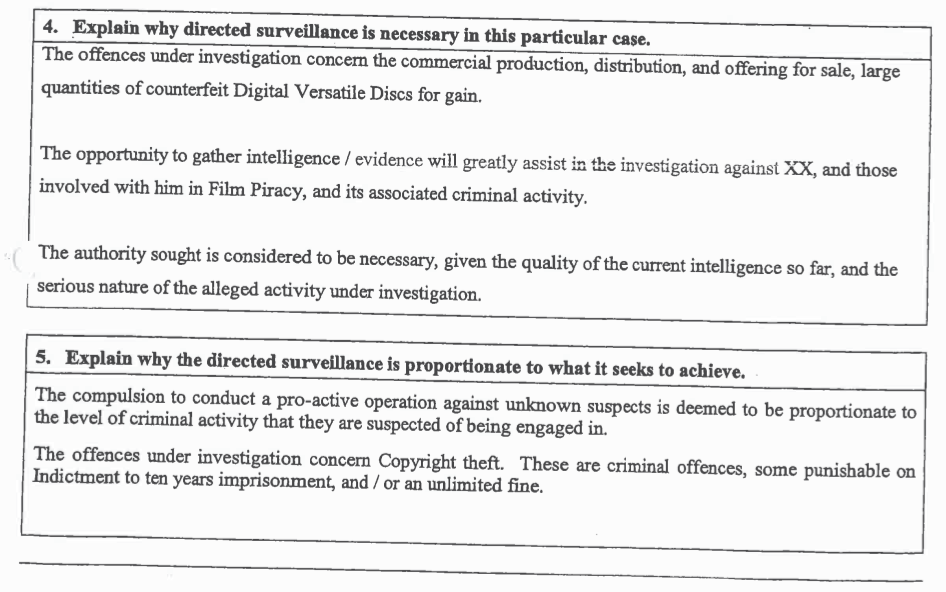
"I am firmly of the belief that such an audio recording did exist but that it was 'disappeared' by FACT Ltd due to it containing nothing controversial," he wrote. Enlarge / Form seeking authorization under the Regulation of Investigatory Powers Act to conduct "directed surveillance" of Vickerman during the London hotel meeting. Contrary to FACT's claims, Vickerman was not in the business of selling counterfeit DVDs.
FACT soon discovered that the home Vickerman shared with his wife was for sale. So, two days after the London meeting, another FACT agent posed as a potential buyer in order to access the residence. The agent covertly recorded the home walk-through and filed a detailed report on the operation.
Meanwhile, FACT was busy collecting other information about Vickerman. The group asked the satellite provider BSkyB for information about the couple's satellite TV subscription, for instance. An investigator tailed Vickerman's wife Kelly on a day's errands. The Guardian reports that "other private eyes had already obtained detailed information about his bank accounts, cars, and telephone records." FACT was nothing if not thorough.
On August 18, 2008, Northumbria police raided the Vickermans' home. Vickerman says that FACT agents participated in the raid and that they were "clearly directing the police." A FACT spokesman declined to comment to us on this allegation, but court documents do indicate that FACT was heavily involved in planning the raid. FACT, for instance, hired the forensic investigator used in the case.
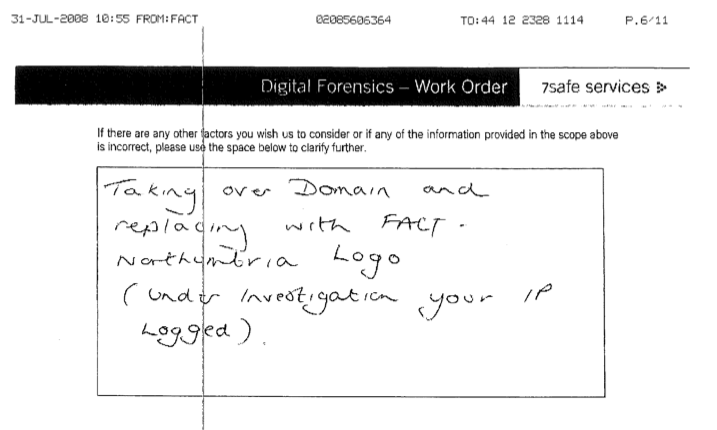
In an e-mail sent a week prior to the raid, FACT's Colin Tansley outlined a plan for FACT's investigators to take down STC and replace it with a seizure notice. Vickerman says this plan failed because FACT believed, inaccurately, that the STC servers were located inside Vickerman's house. (The servers were actually located in Sweden, beyond the reach of FACT and the Northumbria police.) When we asked, FACT again refused to comment on Vickerman's allegations.
During the search, Vickerman and his wife were both arrested. Vickerman told both police and FACT investigators that the STC site was, in his view, legal; it acted "as a search engine" and was exempt from liability, he said.
The Vickermans were soon released on bail, but the other shoe was about to drop. Their cash was about to be seized. Enlarge / Work order requesting forensic investigator to take down STC site and replace it with a FACT logo.
Asset freeze
Two weeks later, on September 1, investigator Alan Connolly from the Bedfordshire Trading Standards Financial Investigations Unit showed up at the Vickermans' home. He knocked on the front door and presented them with an "asset restraint order," which the unit had taken out at FACT's request. Vickerman claims that he and his wife were then barred from accessing any of their funds, aside from £125 per week, per person, to cover living expenses. As a result of the order, Vickerman says that he "started to default on my bills and rapidly started spiraling into severe financial problems."
The Bedfordshire Trading Standards Financial Investigations Unit (BTSFIU) has a grandiose name but a strange history—and it's hardly the impartial agent of government justice its name might suggest. A statement on the agency's website explains that, in 2007, the "Bedfordshire Trading Standards Service was approached" by FACT and "offered a unique sponsorship opportunity" to create the Financial Investigation Unit. With FACT's generous support, the BTSFIU was soon able to focus on conducting piracy-related property confiscations.
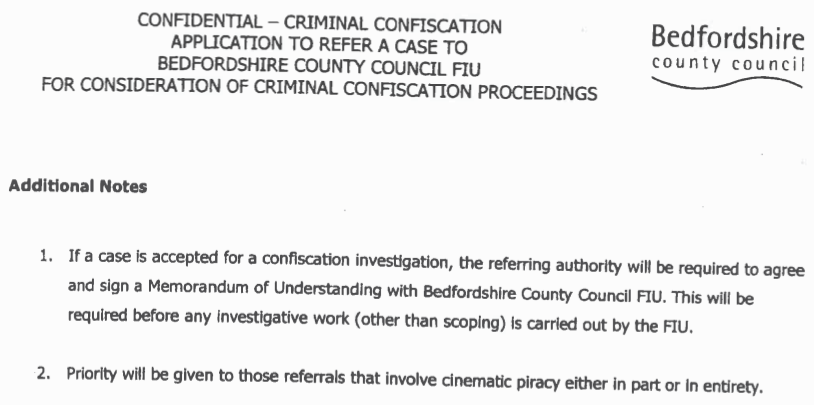
Indeed, so deep is the partnership that, on the form used to request an asset confiscation, the agency states that "priority will be given to those referrals that involve cinematic piracy." Vickerman says he filed a Freedom of Information Act request that revealed that "BTSFIU had made 23 similar restraint order applications in 2008, all on behalf of FACT."
In a Tuesday interview, FACT spokesman Eddy Leviten brushed off any suggestion that the financial ties between FACT and the BTSFIU created a conflict of interest, however.
"The banking industry in the UK funds the check and credit bureau in the Metropolitan Police," he told us. "It's something that happens in the UK where private industry can fund specific units within law enforcement to take on a specific role. Those units still have to withstand the same scrutiny" as any other law enforcement agency. We e-mailed two BTSFIU agents seeking comment on the relationship but never got a response.
Unable to spend his own funds on legal representation, Vickerman borrowed money from his father to hire an attorney who challenged the asset freeze. According to Vickerman, "It turns out it is unlawful for BTS to act outside of Bedforshire County," so the asset freeze was cancelled about a month after it had been put into place.
And the news got even better for Vickerman. It soon emerged that the government had no interest in charging him with a crime. Indeed, the government wasn't even convinced he had committed one. Enlarge / The instructions of the BTSFIU asset confiscation form notes that priority is given to piracy cases.
"I cannot advise any prosecution"
Vickerman was referred to Crown Prosecution Service (CPS), the arm of the UK government responsible for criminal prosecutions. CPS chose not to prosecute him, explaining its decision in a letter dated December 12, 2008.
"I understand that the investigation into the suspects was prompted by FACT and in effect this is an enquiry that has been undertaken almost entirely by FACT although with the assistance of the Northumbria Police," the letter explained. The CPS prosecutor then continued:
I understand from [Northumbria Detective Constable] Watkin that there have been no other successful prosecutions that he is aware of where we could point to this type of website being classified as amounting to "making available... by electronic transmission," the legal standard needed to find Vickerman guilty of copyright infringement. At present it appears uncertain if in fact what the suspect has done does infringe this particular legislation. Certainly on the evidence thus far provided it is impossible for me to determine if this is the case and therefore I cannot advise any prosecution on the evidence presented.
CPS also pointed to additional problems with prosecuting STC. "It is obvious that this suspect does not put copyrighted material on the Internet itself," said the letter. "His 'crime' is to make it easier for others to find what is already there. This begs the rather obvious question of why he is being pursued rather than those who actually breach the copyright by displaying the material."
The agency also wondered whether there are "civil law remedies available perhaps including an injunction to close offending websites down," and if those remedies existed, why they weren't being pursued. (Such civil process has been used in the US to shut down Napster, Grokster, LimeWire, and many others, though such cases have been less successful in the UK.) CPS also noted that "such well established sites as YouTube occasionally fall foul of copyright and that they are not prosecuted in the manner suggested here."
The letter concluded that "the evidence provided is too vague to establish what actual offences are alleged and thus I cannot advise any charge at this stage."
It sounded like the end of the case, and in most cases would have been—but FACT badly wanted Vickerman in jail and was willing to do the work itself if necessary.
Going it alone
In the United States, public prosecutors generally have the power to decide when criminal prosecution is appropriate. Eleanor Lackman, a copyright attorney at the New York firm of Cowan DeBaets, Abrahams, and Sheppard, told Ars that "criminal liability generally is only prosecuted by government entities" such as the Department of Justice. A private party can request a copyright prosecution—as in the Megaupload case—but the final decision rests with the government.
Enlarge / Vickerman outside the courthouse with an unidentified companion.
United Kingdom law differs. There, private parties can initiate criminal prosecutions if they're willing to cover the costs out of their own pockets. FACT was, and so it bypassed CPS and brought criminal charges against Vickerman directly. "It is now our intention to run a private prosecution," FACT's Colin Tansley wrote in an e-mail to his colleagues on December 12, 2008.
Litigation dragged on for years. Vickerman charges that FACT withheld key documents from him, including the CPS letter recommending against prosecution, that he says would have bolstered his case. Indeed, he became so concerned with FACT's conduct that he actually petitioned government prosecutors to take over the prosecution. The request was rejected.
"In July 2010, the stress and strain of the nightmare we have endured for nearly two years finally breaks our marriage," Vickerman wrote. "Myself and my wife separate. FACT Ltd's decision to charge my wife as well, despite them knowing she has no involvement in STC, has bore them fruit." But to FACT, and even to the judge in the case, the problems and the prosecution were of Vickerman's making.
"You didn't bother to check with the copyright owners"
The trial finally commenced in May 2012. Vickerman was optimistic because he thought he had a key precedent on his side. In its 2008 letter, CPS noted that "FACT are currently involved in a prosecution of others involved in a similar website known as tvlinks." By the time the STC case reached trial in 2012, another judge had ruled that TV-Links had not infringed copyright.
But a jury found Vickerman guilty of "conspiracy to defraud" (rather than of facilitating copyright infringement) and the judge pronounced sentence. In his Tuesday remarks, Judge Evans made a curious reference to the TV-Links case, saying that Vickerman "pressed on, knowing that TV-Links had been taken down following the intervention of FACT on the basis that what it had been doing was unlawful."
Of course, the courts, not FACT, determine what is and isn't unlawful—and the courts had ultimately found that TV-Links had not violated the law. Judge Evans seems to have believed that FACT's simple accusation of unlawful conduct should have been sufficient basis for Vickerman to shut down his website.
"Your arrest and the interviews that followed did not act as any kind of warning about the criminal activity in which you were engaged or as any sort of barrier to the continued operation of STC," Judge Evans said. "With an arrogance of a kind that you displayed repeatedly during your evidence at the trial you carried on as before and indeed only shut down STC days before this trial began in May."
In March 2009, Judge Evans said, STC had two million links, of which "in excess of 5,500 links" were to infringing movies. "You insisted that you couldn't know if it was infringing copyright, that the studios might have granted right holder licences to the films of which you had no knowledge," Judge Evans said. "That was certainly true and bound to be true if you didn't bother to check with the copyright owners and check you most certainly didn't."
Vickerman places blame for his conviction squarely at the feet of Judge Evans. "We were about to enter a parallel universe in which there were two prosecutors, FACT Ltd and Judge Evans," Vickerman wrote in his Tuesday statement. It was a universe "in which the Judge had no grasp of the Internet or copyright law and in which evidence that would never have normally made it up the courtroom steps due to its dodginess was readily accepted as factual here.... I was surprised to find that I was more upset about the way FACT Ltd had won rather than the actual fact that they had won."
But Evans was having none of it. "You demonstrate a complete absence of remorse," he told Vickerman. "In the trial, you levelled criticism of virtually everyone involved in this investigation. You would not countenance, and it’s evident from your demeanor now that you still do not countenance, the idea that you were doing anything wrong. I’m bound to say that in all the years I’ve worked in this court I have never encountered arrogance of the kind that you displayed during the trial... The vast majority of the material made available through that website infringed copyright."
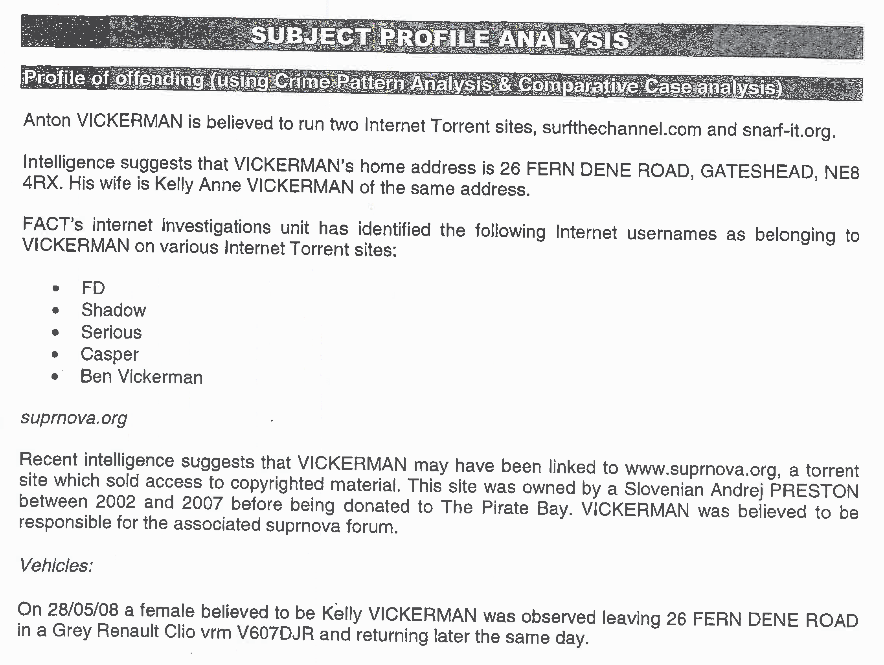
The privatization of justice Enlarge / In 2008, FACT compiled a lengthy dossier on Anton and Kelly Vickerman.
Ars sought comment from David Cook, a solicitor who successfully represented defendants connected to two other websites: OiNK and FileSoup. Those cases were formally handled by CPS rather than private groups, but even so Cook regarded the degree of industry involvement as "an abuse of the Court process as a result of the involvement of the International Federation of the Phonographic Industry (IFPI) at all stages of the investigation and subsequent prosecution."
Those cases, he said, were "brought by the CPS, with the trade bodies malevolently lurking in the shadows but with their fingerprints all over the evidence." In the STC case, by contrast, the industry dispensed with the "lurking" and drove the case itself from start to finish. Cook describes the right of private parties to initiate criminal prosecutions as "archaic."
He argues that the ability of private companies to bring criminal charges opens the door to abuses. For example, Cook questions whether it is right for the "police to be able to use the powers that are specifically bestowed to them to seize a person’s property, only to then decide not to do anything themselves and simply pass the material to an 'interested third party'" like FACT. (Cook concedes that this transfer of evidence was ruled legal by a UK appeals court.)
FACT's Leviten disagreed. He told us there's a "rich historical precedent" for private parties bringing criminal prosecutions. He compared FACT to the Royal Society for the Prevention of Cruelty to Animals, which brings criminal animal welfare cases. Private criminal prosecutions, he said, are "part of the democratic system in the UK."
But Cook worries that the "enormous financial resources and clout" of organizations like FACT, and the lack of public oversight of their activities, could deprive defendants of a fair trial.
"There is no doubt that copyright holders deserve the full protection of the law," he told me. "But I still think that the manner in which they conduct these prosecutions is offensive."
LendInk, an innovative site dedicated to helping readers share their legally purchased ebooks with one another, has chosen to shut down in the face of legal intimidation. Despite the fact that the site was apparently operating within the terms of service of the Amazon Kindle and the Barnes & Noble Nook, its hosting company was targeted with "hundreds of threats," including cease-and-desist letters.
LendInk didn't even host any ebooks itself: it simply connected users seeking a particular title with other users who had a legally-purchased ebook to lend. The site planned to eventually make money by providing links to purchase books through the Amazon affiliate program, but for the past year it had been operating without income.
This shutdown sets a dangerous precedent for the future of innovation in the ebook world. It creates confusion for consumers about what behaviors are actually legal and will likely have a chilling effect on entrepreneurs that could otherwise create new businesses — and new profit centers for the publishers. In an interview with Digital Media Machine, LendInk's owner Dale Porter expressed his disappointment in having to shutter his business:
I am simply a hard working guy that was trying to provide a legit service. ... Sadly, it appears that my American Dream has been left as road kill at the hands of misguided individuals.
That those misguided individuals were able to target his site so effectively is a potent reminder that free speech is only as strong as the weakest link. In this case, the threats took the form of cease-and-desist letters to his hosting service — and as a result, he hasn't even had the opportunity to review the notices himself. As he told Digital Media Machine, it's not even clear yet whether the notices are from authors, publishers, or both.
But it's clear that the individuals are misguided, because LendInk only enabled activities that had already been approved by the rightsholders. In fact, all of the lending enabled by the site took place through the built-in Kindle and Nook lending features, which are extremely limited in comparison to a traditional book. Not only is it limited to ebooks that have been explicitly "lending-enabled," but each copy of the ebook may also only be lent exactly once for a total of 14 days. Loans can only be initiated by a user in the United States, but may be unsuccessful if the recipient is in a country with additional geographic restrictions.
Of course, these barriers come from contracts, not from limitations in the technology. It's clear that while ebooks could in theory be more flexible and versatile than paper books, prohibitive licenses have prevented that from happening.
As author and EFF Fellow Cory Doctorow has put it, "Everyone knows that it's a bug and not a feature that if one person is reading a book, someone else can't." Instead of trying to patch the bugs that afflict traditional books, publishers use DRM software and restrictive licenses to suppress the potential new features.
Some of these efforts even attempt to unravel the first sale doctrine, which has long been a cornerstone of U.S. copyright law. That principle means that "if you buy it you own it," and it's the way used bookstores can exist. Indeed, it is essential to real-world book-sharing communities like BookCrossing and BookMooch.1
The legal threats against service like LendInk are not about sales. Rather, they are just the latest efforts in a wrongheaded campaign to crush any segment of the content distribution chain that lies outside of the rightsholders' traditional direct control. The same mindset drove Warner Brothers to sue Redbox, the kiosk-based DVD rental operation, even though it was perfectly legal under the first sale doctrine. It's led Capitol Records to sue an emerging marketplace for "second-hand" digital music, even though used music sales have existed for decades. It's even behind the Association of American Publishers' stubborn opposition to a treaty that could end the "famine" of accessible books that devastates the visually impaired community.
Needless to say, this mindset can only result in less innovation. And that's bad for readers, it's bad for platform developers, and in the end it's bad for publishers, too.
As public scrutiny continues to mount against the use of license plate readers (LPRs) across the country, the Electronic Privacy Information Center (EPIC) has now released government documents showing that such data, which includes precise GPS location, date, and timestamps, in addition to the plate in question, are shared with an auto insurance umbrella organization.
The documents, published on Tuesday as the result of a Freedom of Information Act (FOIA) request, include a six-page memorandum of understanding (MOU) from 2005 between the National Insurance Crime Bureau (NICB) and the United States Customs and Border Protection (CBP) agency.
The NICB is a nonprofit organization funded by hundreds of American auto insurance corporations around the country, which "partners with insurers and law enforcement agencies to facilitate the identification, detection, and prosecution of insurance criminals."
Ars, as part of its recent investigation into the use of LPRs, also has a pending FOIA request with CBP, but has yet to receive a response beyond a perfunctory acknowledgement of the request.
The revelation has certainly raised some eyebrows, but the NICB now says that while insurance companies are members of the organization, they do not automatically gain access to the LPR data.
Roger Morris, the NICB's chief communications officer, clarified by e-mail that only authorized "Special Investigations Units" personnel from NICB member companies have access to such data "for theft prevention activities."
Every 24 hours, the NICB receives an electronic data transfer from all border stations, providing LPR details on all cars that have crossed in and out of the country. Mainly, the NICB says it's looking for cars that have been (possibly fraudulently) reported stolen, but were spotted at a border.
Morris added that the CPB's LPR data—"roughly 15 million reads a month"—is kept for 12 months. That means the CBP makes approximately 500,000 LPR reads at the borders every single day, and passes that data along to the NICB.
"Thousands of vehicles are stolen in the U.S. each year and taken to Mexico," he added. "LPR data helps insurers and law enforcement verify that a vehicle that has been reported stolen has been taken into Mexico and helps NICB and law enforcement in attempts to recover the vehicle and repatriate it back to the U.S. These stolen vehicles represent millions of dollars in insurance losses and recovering as many as possible helps reduce the impact of theft on insurance rates."
Future privacy challenges likely
Ginger McCall, an attorney with EPIC, said that she found it surprising that a government agency was providing LPR data to a private organization.
"People have the right to know what data is being collected, how it’s being shared," she told Ars. "You could imagine a situation where a plate was mis-scanned or what mis-entered into the database. Or perhaps insurance rates may go up? Who knows how industry is going to use this."
McCall also argued that under this year’s Jones v. United States case, where the Supreme Court unanimously found that law enforcement does not have the right to warrantlessly track someone’s car via a GPS device placed on the car, that there may be room for future legal challenges.
"[Justice] Scalia didn’t rule out the possibility that there would be a wider implication here," she said. "If you look at concurrence by [Justice] Sotomayor, there are great implications over privacy data and this sort of signals from the court that it was going to look at these issues more closely."
NICB: It's CPB's data, not ours!
Other legal scholars who have watched the evolution of LPRs have also raised questions about the collection, transmission, and disclosure of LPR data by and from private companies and organizations.
The MOU also allows the NICB to sub-contract management of this data to a "data processing service," and requires that any misuse of the LPR data be reported to the NICB, and then reported on to the CBP.
"In short, US Customs is granting a private company access to what it admits is 'highly sensitive commercial, financial, and proprietary information,' and then further allowing the private company to outsource the management of that 'highly sensitive' data to yet another private company," wrote Kade Crockford, the director of the Technology for Liberty Program at the ACLU Massachusetts, in a Wednesday blog post.
"The only auditing and accountability mechanisms required are self-policing and self-reporting. These documents reveal a growing problem that extends far beyond the management of license plate data. The government is increasingly collecting vast quantities of information about ordinary people accused of no crime, and increasingly it is relying on private contractors to manage, sort, and analyze this data looking for crime or even 'pre-crime' trends. The sharing of our license plate data with private companies should be viewed as but one troubling example of this much larger problem."
But the ACLU isn't the only group raising questions.
"These documents are illustrative of why individuals often feel so helpless with information that is shared with others or in public—it is very difficult for us to police the use of our information ‘downstream,’" wrote Woodrow Hartzog, a law professor at Samford University, in an e-mail sent to Ars.
"Not only does the lack of transparency in such information sharing make the discovery of information misuse difficult, our current legal regime is not well-suited to address the problems arising from our slow but steady creep towards ubiquitous public surveillance."
Frank G. Scafidi, an NICB spokesperson, also told Ars he was not sure if motorists could query the NICB to examine, verify, or edit records that it held.
"That information is coming from CBP," he said. "That’s where it’s coming from. That’s not our data. They share it with us for a specific purpose. I’m not saying it can’t be done, but unless there’s a method for doing that, it’s not for us to decide at this point in time."
The FBI, Secret Service and the Chesterfield Police 'swarmed' Brandon Raub, a former U.S. Marine and decorated veteran, before Raub was allegedly arrested and taken to a psychiatric hospital. Raub believes 9/11 was an inside job and wrote about the coming 'Revolution.' An FBI agent reportedly claimed, 'The threats that he was making were terrorist in nature.'
There are conspiracy theorists who believe 9/11 was an inside job. I don't really follow that news, but can people be arrested after saying so online, exercising their First Amendment right to Freedom of Speech? On August 16, the FBI, Secret Service and the Chesterfield Police arrested a decorated former U.S. Marine for "airing his critical views of the U.S. government on Facebook." Is there such a thing as Facebook terrorism?
(See Raub's posts on Facebook or click here to see larger.) According to Salem-News, an FBI agent claimed, "The threats that he was making were terrorist in nature."
The Jeenyus Corner noted, "Brandon Raub is a former U.S. Marine, decorated combat veteran, and he founded the Richmond Liberty Movement, based in Virginia. Brandon was arrested by government officials last night over some 'terroristic' posts he made on Facebook. To be clear, he was arrested for speaking his mind about his opinions, which is supposed to be a constitutional right in our country. He is currently being 'held' at John Randolph Psychiatric hospital in Hopewell VA." The site republished Raub's 'The Truth' article from November 2011 which began with "America has lost itself. We have lost who we truly are. This is the land of the free and the home of the brave."
On Facebook, Raub talked about the Illuminati, a shadow organization in which "some of the leaders were involved with the bombing of the twin towers" and the "great amount of evil perpetrated by the American Government." He said people may think he was going crazy, but a "civil war," the "Revolution" is coming. "I'm starting the Revolution. I'm done waiting." On July 24, he said he was at a "great crossroads. As if a storm of destiny is about to pick me up and take me to fight a great battle." On August 9 he talked about severing heads and told the generals he was coming for them. On August 13, he wrote, "Sharpen up my axe; I'm here to sever heads." On August 14, Raub wrote, "The Revolution will come for me. Men will be at my door soon to pick me up to lead it." On August 15, Raub wrote, "And they will say he said it to the NSA first." To know all that was said, please read it for yourself here or on Facebook.
In this video, Raub's mother says the authorities showed up "in a swarm" to arrest him before taking him to John Randolph Psychiatric Hospital. She said her son does not suffer from PTSD. Raub allegedly was arrested by Chesterfield Police after he "assaulted an officer and resisted arrest," but "Chesterfield PD said Raub has not been charged with resisting arrest and assaulting an officer." Here are links to many more videos regarding Raub. There are five articles written by Raub that were published on Don't Tread on Me. Here, DeathRattleSports asked whether Raub was the NDAA's first victim.
Many times in the past, we've looked at ridiculousFBI or DHS you-might-be-a-domestic-terrorist-iflists which seem to indicate that otherwise innocent acts may flag you as potentially suspicious. Sadly, our nation's veterans are potentially suspicious, according to some of these lists. To me, a terrorist is someone or a group who inflicts terror and is actually out to hurt us, the USA's citizens or our critical infrastructure; terrorists who plot evil with intentions of killing people, blowing up or otherwisedestroying things. However, I recently read about the Global Terrorism Database, which is "an open-source database with information on more than 98,000 terrorist attacks and terrorist events around the world from 1970 through 2010." START is "tasked by the Department of Homeland Security's Science and Technology Directorate" and defines terrorism as "the threatened or actual use of illegal force and violence by a non-state actor to attain a political, economic, religious, or social goal through fear, coercion, or intimidation."
To better understand this, it's important to look at "Profiles of Perpetrators of Terrorism in the United States (PPT-US) Codebook" as well as "Hot Spots of Terrorism and Other Crimes in the United States, 1970 to 2008" [PDF] by START (Study of Terrorism and Responses to Terrorism). The report lists the categories of ideological motivation in terrorism as:
Extreme Right-Wing: groups that believe that one's personal and/or national "way of life" is under attack and is either already lost or that the threat is imminent (for some the threat is from a specific ethnic, racial, or religious group), and believe in the need to be prepared for an attack either by participating in paramilitary preparations and training or survivalism. Groups may also be fiercely nationalistic (as opposed to universal and international in orientation), anti-global, suspicious of centralized federal authority, reverent of individual liberty, and believe in conspiracy theories that involve grave threat to national sovereignty and/or personal liberty.
Extreme Left-Wing: groups that want to bring about change through violent revolution rather than through established political processes. This category also includes secular left-wing groups that rely heavily on terrorism to overthrow the capitalist system and either establish "a dictatorship of the proletariat" (Marxist-Leninists) or, much more rarely, a decentralized, non-hierarchical political system (anarchists).
Religious: groups that seek to smite the purported enemies of God and other evildoers, impose strict religious tenets or laws on society (fundamentalists), forcibly insert religion into the political sphere (e.g., those who seek to politicize religion, such as Christian Reconstructionists and Islamists), and/or bring about Armageddon (apocalyptic millenarian cults; 2010: 17). For example, Jewish Direct Action, Mormon extremist, Jamaat-al-Fuqra, and Covenant, Sword and the Arm of the Lord (CSA) are included in this category.
Ethno-Nationalist/Separatist: regionally concentrated groups with a history of organized political autonomy with their own state, traditional ruler, or regional government, who are committed to gaining or regaining political independence through any means and who have supported political movements for autonomy at some time since 1945.
Single Issue: groups or individuals that obsessively focus on very specific or narrowly-defined causes (e.g., anti-abortion, anti-Catholic, anti-nuclear, anti-Castro). This category includes groups from all sides of the political spectrum.
However, please note that the latest START report [PDF] from July states, "To be clear, the National Consortium for the Study of Terrorism and Responses to Terrorism (START) does not classify individuals as terrorists or extremists based on ideological perspectives." And "at no point has any START study defined persons 'suspicious of centralized federal authority' and 'reverent of individual liberty' as terrorists. Instead, we assigned ideological classifications only to groups that have already carried out completed or attempted terrorist attacks."
If there were ever such a "revolution," such as Raub supported, that caused riots like were seen in London, Public Intelligence previously posted the U.S. military's plans for the "use of deadly force, detention and interrogation of U.S. Civilians" and alleged military plans to squash civil unrest in the USA. It might also be a good time to recall Social Media Monitoring on Gov't Steroids: Anything might come back to bite you or the list of hot keywords monitored by DHS. Things are still unfolding in regards to Raub, but it is alarming if his constitutional right to free speech, his right to talk conspiracy theory smack, is considered potential terrorism.
The idea behind copyright is simple — it is supposed to be a balance in the service of the public interest. There's a trade-off: for accepting a restriction on certain speech, the public benefits from the production of more new creative works each year. That delicate equation is complicated by many factors, and the right policy should find the balance of copyright scope and duration, limitations and exceptions like fair use, and the appropriate remedies in case of infringement.
But in fact, copyright policies almost universally lack the serious cost-benefit analysis that must precede any evidence-based proposal. And indeed, while the unintended costs are clear to anybody who has observed abuse of, say, the DMCA takedown system, the evidence that these policies create incentives — or even prevent harm — is less forthcoming.
Last week Julian Sanchez of the Cato Institute posted a thought-provoking piece that questions the similar calculation at the core of national security rhetoric. In the area of security, he asks, are we actually getting a "trade-off" for all the costs we incur to the country’s budget and our personal liberty? Sanchez convincingly argues that we haven’t been working towards a balance between those two ideas at all. Liberty is consistently discarded in the name of “security,” and the resulting policies don't actually make us safer. A dialogue that focuses only on striking a balance between these two ideas fails to address more fundamental questions about our policy.
So, too, with copyright. The right copyright policy should serve the constitutional purpose of promoting "the progress of science and the useful arts" while respecting the ideals of the First Amendment. The need for such a balance is well recognized from all corners of the copyright discussion. In a post about the misguided Supreme Court opinion in Golan v. Holder this January, for example, EFF referred to the "traditional copyright balance between public and private interests"; and while EFF doesn't always see eye-to-eye on copyright issues with content lobby groups like the Recording Industry Association of America (RIAA), its chief executive Cary Sherman has also described "the careful balance struck within" copyright law.
It makes sense, then, that one typical response to bad copyright policy developments — and there are many — is to say that those developments skew this balance the wrong way, favoring the incentives and rewards for rightsholders more than is necessary to maximize creative production. But that approach overlooks the fact that many of the worst copyright proposals, like those that come out of content lobbying groups like the RIAA and the Motion Picture Association of America (MPAA) do worse than a skewed balance. Rather, they fail to strike any kind of balance at all, curtailing speech and fundamental online rights without a corresponding increase in the incentive to create new works.
If it were simply a matter of striking the wrong balance, SOPA's cost in terms of threatening human rights, curtailing freedom of speech, and damaging the economy would have to be offset by gains to the content lobby backing the bill. It wouldn't be the right trade-off, but it would make sense in the context of a balance. In reality, though, the benefits for the content lobby simply weren't there. In January, Sanchez himself calculated that the size of the foreign "pirate" movie market targeted at Americans — the kind of activity SOPA was written to address — was orders of magnitude below the MPAA claims. And for their part, the RIAA recently revealed in a leaked report from April that despite its public rhetoric, it felt SOPA was "not likely to have been [an] effective tool for music" even if it had passed.
Similarly, when the 1998 Copyright Term Extension Act — sometimes called the "Mickey Mouse Protection Act" because it kept the world's most famous rodent out of the public domain — was challenged in the Supreme Court, some of the world's leading economists lined up in a brief [pdf] to question the premise that the public benefited from retroactive term extension at all. Once again, the costs to the public are clear: we all suffer from a poorer public domain with no clear gains in return. Worse, these examples are the rule and not the exception. Many elements of policy today — from DMCA's problematic section 1201 to the unconstitutional ICE seizures of websites — and dozens more failed proposals — like the "Hollywood Hacking bill" or the broadcast flag — fit this pattern.
Compared to the trade-off of security and liberty, the question at the heart of copyright policy is an easy one: How do we optimize the incentive to create new works while minimizing the cost to our freedom of speech and ability to innovate? Unfortunately, sane policy developments that work toward this end are all too rare.
The Advisory Board documents show that FBI's database of facial images will provide search results automatically (the system won't need to rely on a human to check the results before forwarding them to the state or local agency) and that the FBI is developing "Universal Face Workstation software" to allow states that don't have their own "Face/Photo search capabilities" to search through the FBI's images.
After we read through the Advisory Board documents, we quickly sent Open Records requests to several of the states involved in the pilot program. The documents we received from Maryland and Hawaii further flesh out the story. For example, the Memorandum of Understanding (MOU) between Hawaii and the FBI shows that the government is building NGI to “permit photo submissions independent of arrests.” This is a problem because, the FBI has stated it wants to use its facial recognition system to "identify[] subjects in public datasets” and "conduct[] automated surveillance at lookout locations" (p.5). This suggests the FBI wants to be able to search and identify people in photos of crowds and in pictures posted on social media sites—even if the people in those photos haven’t been arrested for or even suspected of a crime. The FBI may also want to incorporate those crowd or social media photos into its face recognition database.
And an MOU between Maryland and the FBI will allow Maryland to submit photos in bulk to the database—something that Maryland described in an email as a “photo data dump.” This kind of an agreement could be used in the future to incorporate the same kind of facial identifying information already collected by 32 of 50 state DMVs solely to prevent fraud and identity theft.
The Advisory Board documents contain other concerning information. For example, one document discusses the FBI’s plans to combine civil and criminal biometrics records by giving them a single searchable “master name” or unique identifying number. As we’ve noted, criminal and civil records have always been kept separate in the past. While this may be a function of the differences in how each type of print is collected and stored, it has effectively meant that civil prints—collected for employment verification, for background checks, for federal jobs, and even to become a lawyer in California—have not been automatically searched every time criminal prints are checked against the database. That will all change once FBI implements its unique identity system. Although FBI states that “the criminal and civil files will remain logically separated...[to] ensure that retained civil submissions remain untainted by criminal submissions” it’s hard to see how this is functionally true, given that civil files will be searched at the same time as criminal files.
Another document discusses the federal government's extensive biometrics sharing relationships with other countries. It notes that the FBI's Global Initiatives Unit has already collected over 990,000 records from foreign partners, with over 600,000 of those coming from Afghanistan. The FBI already has information sharing relationships with 77 countries, (p.2), but CJIS is now trying to partner with "Visa Waiver Program countries" like Ireland, Spain and Australia to allow automatic access to each other's biometric databases on a "hit/no hit basis." This kind of access has already been set up to connect the German and US biometric databases.2
And finally, as NDLON has discussed in greater detail, the documents show just how far the FBI and DHS partnership has progressed to maximize datasharing as part of the Secure Communities program. For example, NDLON notes that FBI has mobile devices that permit searches of the entire IDENT database in the field. These mobile devices may subject individuals to immigration background checks without ever being arrested or booked.
The FBI has not updated the Privacy Impact Assessment (PIA) for its photo database since 2008—well before signing MOUs with the states to share face recognition data and before the development and deployment of NGI’s facial recognition capabilities. As EFF recently testified during a Senate Subcommittee hearing on facial recognition, Americans should be very concerned about the government’s plans to build up its facial recognition capabilities:
Facial recognition takes the risks inherent in other biometrics to a new level...[it] allows for covert, remote, and mass capture and identification of images, and the photos that may end up in a database include not just a person’s face but also what she is wearing, what she might be carrying, and who she is associated with.
Without an updated PIA, it is impossible to tell exactly how the FBI plans to acquire and use facial recognition data now and in the future. However, given the information in these new documents and the FBI's broad goals for face recognition data, the time is right for laws that limit face recognition data collection.
To see all the documents, go to our landing page for NGI and click on "Documents" in the middle toolbar.
1. The FBI’s CJIS Division manages the FBI’s biometrics databases, including its legacy fingerprint database (IAFIS) and NGI. CJIS’s Advisory Policy Board is charged with reviewing the “policy, technical, and operational issues related to CJIS Division programs” and makes recommendations to the FBI’s director. The Advisory Board is made up of 34 representatives from state, local, and tribal criminal justice agencies, and includes representatives from national security, and prosecutorial, judicial, and correctional sectors of the criminal justice system. It meets twice a year—generally in open meetings announced in the Federal Register—though it appears the materials from those meetings are generally only distributed to attendees and through an online system “only available to persons duly employed by a law enforcement, criminal justice, or public safety agency/department, and whose position requires secure communication with other agencies.”
2. The documents state the connection won't be operational until Germany addresses some "remaining internal details."
These terms are detrimental to creativity and innovation and only serve to benefit the major record and movie production companies who lobbied for them in the U.S. Now starting with the Pacific region, these exorbitant counterproductive terms could be imposed on countries with more progressive copyright laws through the force of the TPP. Making these terms part of trade agreements is part of a general move towards “forum shifting” and “policy laundering” of the IP policy discussion away from places where there is at least some requirement for public input and transparency, such as Congress.
There are many problematic issues around enacting such long copyright terms into an international agreement. Primarily, it would force everyone living in a TPP signatory country to pay a heavy price in continued royalties for content. For example, one scholar estimated that the copyright extension has resulted in Australians sending an extra $88 million per year in royalties overseas.1 This is particularly troubling because international law has been exploited to escalate the scope of copyright. The incorporation of international copyright obligations into national law does not focus on whether the protection is “economically, culturally, or socially desirable.” Rather, it presents new lobbying opportunities for the entertainment industry that can result in broader copyright regimes than required by the international obligations, which in turn could be used back home to demand matching legislation.
Under this proposal, if the copyright holder is a natural person (an individual), the copyright term would extend to the lifetime of the creator plus 70 years after her death as a minimum. On average, this means that a work could only enter the publicdomain after almost 140 years.2 This provision in particular surpasses restrictions as laid out in the US Copyright Act that sets the 70 years as a ceiling,3 whereas TPP sets the 70 years term as the minimum requirement. In the case of published works whose copyrights are owned by corporations, the term of protection would extend to 95 years from the first publication. Finally, corporate works that were not published within 25 years of its creation, are protected the term of protection is 120 years from the date of the creation.
This provision expands the terms of the controversial US SonnyBonoCopyrightTermExtensionAct (or the “MickeyMouseAct” as it was called due to Disney’s heavy lobbying) to countries of the Pacific region. New Zealand, a party to the TPP negotiations, currently has a copyright term of the author’s life and an additional 50 yearsforliteraryworks. Another TPP member, Malaysia, has a copyright term of life plus 50 years for “literary, musicalorartisticwork.” Canada, which is just entering negotiations, has an even shorter term of just 50 yearsforfixedsoundrecordings. PursuanttothecurrentTPPterms [pdf], all of these countries would be required to extend their terms and grant companies lengthy exclusive rights to works for no empirical reason.
The common justification for granting restrictive monopoly rights in copyright law is to provide an “incentive” for people to generate material that can be enjoyed by the public. But economists and law scholars who have studied this rationale have found that “the optimal length of copyright is at most seven years.”4 Long copyright terms are a poor recipe for compensating creators, who generally receive lowroyalties from their works.5 And yet, the strong copyright lobby preventsanyrecommendation to reduce the presently excessive terms, attacking any attempt to speak for the public domain or for users rights and dazzles politicians with nonsensical “copyright math”.
Copyright law gives rightsholders exclusive rights to use and profit from creative works, and, in theory, secure economic rights to the creator for their efforts. In most cases however, this right has been abused in a way that deprives the public of valuable culture and knowledge. Lengthy copyright terms are simply not needed to incentivize creativity. Not only is this most plainly obvious where terms extend past the life of an author, the public domain is a necessary source from which authors can learn and create. It is the fueling source of our shared culture, and it recognizes that we are always “building on the past”. Significantly, “[t]he more we tie up past works in ownership rights that do not convey a public benefit through greater incentive for the creation of new works, the more we restrict the ability of current creators to build on and expand the cultural contributions of their forebears.”6
As proposed by Boyle [pdf - pg 51], “our intellectual property system should be audited like any other government subsidy to make sure that we are getting what we pay for, and not paying too much for what we get.”
~
Over 20,000 people have now taken our action alert aimed at congressional members. And these latest moves from state representations show that they are finally hearing our voices. Help us keep the pressure on Congress and get them to demand that this process become democratic and transparent.
A February order by a German Federal Constitutional Court determined that it is legal in Germany for telecommunications companies to demand formal identification from customers setting up prepaid SIM cards, but a regional Pirate Party politician appealed that ruling earlier this week.
Patrick Breyer, member of northern Germany's Schleswig-Holstein regional parliament, and his brother Jonas Breyer, a lawyer, appealed to the European Court of Human Rights in Strasbourg. The appeal says that anonymous communication is protected under the European Convention on Human Rights' right to private life.
Denmark and France have outlawed anonymously purchased prepaid cards, but the Breyer brothers asserted that Germany's similar law is pointless because identification can be falsified, or people can bring prepaid phones in from other countries.
While German authorities claim the law prevents illegal activities, members of Germany's digital privacy-conscious Pirate Party disagree. "Germany's Breyer said in a statement that anonymous phone calls were important for a range of legitimate activities, from protecting journalistic sources to confidential business dealings," Reuters reported.
Freedom of private communication has been a hot-button issue lately, with an appeals court sayingearlier this week that police could track a drug dealer's phone without a warrant by pinging the phone's GPS chip. And an app called "Burner" was released the week before, allowing people to create temporary numbers so the recipient of the call can't track the caller back.
A post in a thread on rightsnet.co.uk claims that ATOS (a French private company that administers disability benefits assessments for the UK Department of Work and Pensions) has declared a man in a coma to be fit for work and cut off his benefits. This is part of a the stepped up campaign to stop "benefits cheats" by requiring complex paperwork from claimants. A companion piece on Libcom has comments from others who've been cut off, including a man who's suffered brain injuries that caused him to file his paperwork late.
Client’s husband is in hospital in a coma. He was sent ESA501.
Client contacted DWP to explain situation and was asked to obtain letter from hospital confirming he is in a coma. Did so. Was told to send it to ATOS rather than local BDC. Did so. Husband has now received decision letter – yep, as he has failed to return the ESA50 without good cause and is therefore capable of work [he is] no longer entitled to ESA…
The year was December 2008, and University of Vermont graduate student Finbar McGarry faced a dilemma. An inmate in a Vermont county jail, McGarry was required by correctional authorities to work in the jail laundromat for 25 cents per hour. If he refused to work, McGarry would have been thrown in solitary confinement—otherwise known as “the hole.” Not a pleasant alternative.
There’s plenty of legal and historical precedent for putting convicts to hard work in America. Angola prison in Louisiana is perhaps America’s most notorious work farm—where not only do the inmates farm their own food, they make the prison boatloads of money by putting on an annual rodeo.
The iconographic chain gang lingers in our consciousness, thanks to films like Cool Hand Luke.
Here’s the catch: Paul Newman’s Luke, anti-heroic as he may have been, was a convicted thief. He had a definitive sentence, as do most real-life convicts condemned to hard labor in America.
McGarry had no such sentence. He was certainly facing grievous charges—he had allegedly discharged a gun in his home while threatening to kill his family, then turned his anger on a school official.
But McGarry was still awaiting trial. He had yet to be convicted.
Upward of 1,000 inmates trapped in jail pre-trial posed little to no danger to the public—more than five percent of the county jail population. They were simply being held because they were too poor to pay for bail.
Eventually, McGarry relented and chose to work in the laundry rather than face a prolonged and brutal spell in “the hole.” During the course of his work, McGarry says he contracted a serious MRSA lesion on his neck—a potentially deadly bacterial infection.
McGarry’s charges were ultimately dropped, and he was released. In 2009, he pressed a suit against his former captors in Brattleboro, Vermont, federal court for $11 million—claiming he was made a slave in violation of his 13th Amendment rights. The Brattleboro judge ruled that McGarry’s constitutional rights had not been violated, but that finding was overturned on appeal last week.
McGarry’s suit brings new life to the issue of pre-trial detention—the incarceration of people who are awaiting trial, yet to be convicted of a crime—which was already mired with debate and controversy.
A recent report by corrections expert Dr. James Austin, examining the jails of Los Angeles County (which suffer from notorious violence and overcrowding), found that upward of 1,000 inmates trapped in jail pre-trial posed little to no danger to the public—more than five percent of the county jail population. They were simply being held because they were too poor to pay for bail.
Extrapolate those numbers to the rest of the country, and many, many thousands of people, potentially, are facing a predicament like McGarry’s.
So could McGarry’s suit help win new rights for pre-trial detainees?
Back in 2009, that prospect seemed distant. Vermont federal magistrate Judge John Conroy threw out McGarry’s case because doing the laundry in jail “was nothing like the slavery that gave rise to the enactment of that [the 13th] amendment.”
However, just last week, upon appeal, Conroy’s original ruling was overturned.
“Contrary to the district court’s conclusion, it is well-settled that the term ‘involuntary servitude’ is not limited to chattel slavery-like conditions,” stated the appeals court’s opinion. “The amendment was intended to prohibit all forms of involuntary labor, not solely to abolish chattel slavery.”
Of course that decision could still be reversed by a higher court. But, for now at least, there’s still a chance that McGarry’s suit can help remind the criminal justice system that the tenet “innocent until proven guilty” should apply to our jails too.
PRAGUE, Okla.– There’s a bit of diploma drama going on between a local high school and that school’s valedictorian.
David Nootbaar is furious his daughter’s school is keeping her diploma.
He said, “She has worked so hard to stay at the top of her class and this is not right.”
Kaitlin Nootbaar graduated from Prague High School in May and was named valedictorian.
When tasked with writing the graduation speech, her dad said she got her inspiration from the movie “Eclipse: The Twilight Saga.”
Nootbaar said, “Her quote was, ‘When she first started school she wanted to be a nurse, then a veterinarian and now that she was getting closer to graduation, people would ask her, what do you want to do and she said ‘How the h*** do I know? I’ve changed my mind so many times.’”
He said in the written script she gave to the school she wrote “heck,” but in the moment she said h*** instead.
Nootbaar said the audience laughed, she finished her speech to warm applause and didn’t know there was a problem.
That was until she went to pick up the real certificate this week.
“We went to the office and asked for the diploma and the principal said ‘Your diploma is right here but you’re not getting it. Close the door we have a problem,” Nootbaar said.
He said the principal told Kaitlin she would have to write an apology letter before he would release the diploma.
A move her dad believes is illegal.
“She earned that diploma. She completed all the state curriculum. In four years she has never made a B. She got straight A’s and had a 4.0 the whole way through.”
Kaitlin starts college in a few days on a full scholarship, making the administrators’ decision even more appalling to her family.
We tried to get the school’s side of the story.
Superintendent Dr. Riick Martin gave us this statement, “This matter is confidential and we cannot publicly say anything about it.”
Kaitlin doesn’t plan on writing an apology letter because she doesn’t feel she did anything wrong.





 Posts
Posts


