20140420

Cry for help: U.S. National Parks Service hates dogs, breaks law

Jason Weisberger

Since its inception in 1979, the Golden Gate National Recreation Area has been a massive, amazing, wonderful resource for San Francisco Bay Area residents. The GGNRA's charter states that it is to be treated as an urban recreational area for use by humans and their canine companions. It is the only US National park that allows dogs to be walked off-leash, and includes miles of on-leash trails for person and beast to roam. For as long as I can remember, the National Parks Service has been trying to limit or ban dogs from having this access.

I've lived in a small community, inside the parks boundaries, since 2008. There has been constant pressure from the NPS to ban dogs. Almost every year a large group of folks from all over the Bay Area oppose these restrictions and work inside the government-mandated process to prevent these changes. The story is always the same, the NPS does a half-assed job of unscientifically deciding that dogs are bad, presents no real studies or information on the impacts and decrees that dogs must go. This time, they've gone a step further. The Park service has illegally posted signs restricting access. Rangers have also begun harassing dog walkers under the pretense that these restrictions are already law. The NPS is doing this of their own accord, outside the process our Nation is relying on to represent us.

Sadly, I am out of the country and may not be able to reach my representatives. If you are so inclined, please give them a call (their numbers are in the quote below.) Nemo and Pretzel, my best friends, walk on those trails daily. Xeni and Miles have been watching them for me, while I'm out of town on business for the site, and can attest that life would be impossible if we're locked in the house and not allowed to walk in the park.

Honestly, the NPS runs national parks, not urban recreation areas. They don't understand the difference and want to turn a community resource into a tourist attraction. They are potentially wrecking businesses that have been in place for decades, creating massive traffic problems and treating the local residents like second class citizens. I think many of us lucky enough to live close to or inside the park are willing to work with the system, but the NPS just disregards the rules and presents false studies as science.

My neighbor Laura Pandapas shares this via NextDoor:

ALL HANDS ON DECK!!! AGAIN.......I know........

CALL-IN CAMPAIGN TO REPS. JARED HUFFMAN & NANCY PELOSI scheduled for THIS THURSDAY MARCH 20th.

GGNRA initiates actions to restrict dogs NOW! Call your elected officials this Thursday March 20th.

BACKGROUND:

The GGNRA dropped a bombshell late last week. While we've all been participating in good faith in the planning process by providing public input about the Dog Management Plan, the GGNRA has been getting ready to circumvent its own process and started implementing rules against dogs NOW.

• The GGNRA and the Presidio Trust plan to implement an "interim" rule to go in to effect in May that will restrict professional dog walking on GGNRA lands. No matter that professional dog walking rules are included in the GGNRA's dog management proposal that is undergoing an official federal review process; apparently the GGNRA has decided that it can just select a part of it's proposed plan and push it through outside of the process.

• Meanwhile, this past weekend in Marin, the GGNRA installed new signs restricting dog access, and rangers have been hassling the public to try and enforce new dog rules that don't exist yet.

The GGNRA hasn't even had time to read the thousands of public comments we submitted in opposition to their plan just one month ago! And they are over a year and a half away from the scheduled release of the final Environmental Impact Statement and ruling.

TAKE ACTION:

CALL YOUR U.S. REPRESENTATIVE
THURSDAY MARCH 20TH


...and respectfully request Congressional oversight. That is the ONLY was to stop this disaster.

Jared Huffman sits on the Subcommittee for Public Lands and Environmental Regulation. He has the power to ask the Chairman to call for hearings on this issue. Tell him that's what you want! Call both offices for each Representative.

Jared Huffman (415)258-9657 AND in DC at (202) 225-5161

Nancy Pelosi (415) 556-4862 AND in DC at (202) 225-4965

WHAT TO SAY:

• Over the last week, the GGNRA has taken some extremely troubling and bad-faith steps. They've erected NEW incorrect signage restricting dogs, and rangers are telling people to leash their dogs in areas that don't require leashes, when we are over a year and a half away from completion of a federally mandated public process! And with the "interim permit requirements" for professional dog walking, they are attempting to change the rules outside of the process altogether.
• Congress MUST get involved because the GGNRA is clearly not playing by the rules and don't intend to. The GGNRA's disregard for the public process cannot be allowed to continue. Congress should care when a Federal agency shows such utter contempt for the public and the the public process.
• I am respectfully asking Rep. Huffman/Leader Pelosi to push for Congressional oversight of this process. Thank you!

***********

Endorsed by Crissy Field DOG, Ft. Funston Dog Walkers, Keep Muir Beach Dog Friendly, Marin County DOG, Save Off Leash Dog Walking, SF Professional Dog Walkers, and SFDOG.
Please call Representatives Huffman and Pelosi and let them know how you feel.

City In Illinois Prevents Church From Helping Homeless People

by Melissa McGlensey

Many more people will be forced to sleep outside in below freezing temperatures now that the city of Rockford has told a church to stop providing shelter for the homeless.

In the freezing temperatures of an Illinois winter, finding shelter could be the difference between life and death for those without homes. That's why the Apostolic Pentecostal Church in Rockford, Ill., served as a refuge and warming center to help the homeless survive the frigid winter nights, but now city officials have shut them down citing zoning violations and fire safety hazards, WIFR reported.

Church leaders were told last week that continuing to act as a shelter would be illegal, and many are disheartened. The small building housed as many as 50 people on the coldest nights, according to WTVO-TV.

"To me, people are first. I do believe there would have been a lot of people that wouldn't have been here today if they had not been here [at the church] for four months, because it was very cold outside and I think we saved lives," Theresa Frederick of Apostolic Pentecostal Church told WIFR.

Although homelessness declined by nearly 4 percent between 2012 and 2013, the number of people without shelter in the United States remains high. According to the U.S. Department of Housing and Urban Development, on any given night in January of last year, 610,042 people were homeless. The majority were housed in shelters and transitional housing, but 35 percent were unsheltered and forced to find refuge on the streets, in cars and abandoned buildings or other public places not intended for human habitation.

Rockford is home to a number of housing and shelter options for the homeless, including the Rockford Rescue Mission, which offers shelter as well as food and medical care. Shelter Care Ministries, another local option, focuses on helping and housing people with chronic mental illness.

"The people that came to the center have feelings just like everyone else, and they need their necessities. Food, water, shelter, and love," Thomas Stirling, an employee at Apostolic Pentecostal Church, told WTVO-TV. "They were able to get it all here, and now they cant."

Cancer patient jailed for late payment on $5 dog license renewal

Every law, big or small, is backed by men with guns willing to lock people in cages.


HOLYOKE, MA — A sick woman found herself shackled and locked in a cage — all stemming back to a $5 late fee to the government.

In Massachusetts, freedom is so abridged that even simple things like owning a pet require paid permission from the government. Its so onerous that in some municipalities, there are multiple licenses required. Such is the case in Holyoke, where dog owners must pay for permission from both the state and the city — every year.

But asking for permission to own her 14-year-old dog, Pumpkin, for another year was not exactly a high priority for Ann Musser, 41. Musser had been “fighting death” ever since she developed cancer. She recently underwent massive abdominal surgery for ovarian cancer and been trying to survive a regimen of harsh drugs.

She admits that she forgot about the license fee, according to The Republican. In her bouts with sickness, she went for a prolonged period without opening her mail. Musser also failed to see any additional notices of her unpaid renewal application.

As a policy, the licensing bureaucrats wait 21 days, and then turn the un-permitted pet owners over to the District Court. Musser became one of them.

Afterwards, Ann and her husband got caught up on their mail, and paid the extortionists the $5 they demanded plus a $25 late fee.

But it didn’t matter. There was an outstanding warrant hanging over her head. She attempted to see a judge to clear it. She was forced to wait in a long line among many other people in a crowded courthouse, receiving no special treatment for being gravely ill. She felt that her frail health was actually being put in jeopardy due to the stress and germs. Musser has a weakened immune system caused by the toxic chemotherapeutic drugs, and has been directed by doctors to avoid crowds. She decided that 3 hours of waiting was all she could handle.

Musser decided to go home where she belonged and rest. She hoped the government would figure out that the fee had already been paid and that they would leave her alone. For a few months that worked.

On Friday, March 21st, 2014, a cop pulled over her husband as he entered their driveway. The husband had left his license — a driver’s license — inside the house. The officer requested that he go fetch both his and his wife’s licenses from inside. Once he ran Ann Musser’s license through the system, the warrant appeared and she was told that she was going to jail.

Even though she was inside recovering from a week of bronchitis and high fever, the officer claimed that he had no choice but to arrest her. His conscience could not intervene with his fulfillment of his orders. “I hadn’t left the house in days because I was so sick,” Musser explained to Mass Live, saying that she was a cancer patient and vulnerable to infection.

Nonetheless, Musser was put into handcuffs, and transported to jail in tears. There she was surrounded by filthy conditions and drug users. She was terrified that the germ exposure would make her sick.

“[Ann] got arrested for a non-crime. Basically for a $5 fee that was already paid off,” said Ozzie Ercan, Ann’s husband. “If they can’t differentiate between this and serious crime, and treat a really sick person this way, then I don’t see how they are capable of serving and protecting.”

The government apparently can’t make that distinction, seeing that people go to jail for petty reasons such as this all the time. Just earlier this month another Massachusetts dog owner was jailed for similar reasons. How else would the the courts be so overcrowded if not for petty nonsense?

Apologists for the police state insist that this arrest wasn’t exactly due to a dog license or a late fee; it was due to disrespecting the court process. But the truth is that every petty ordinance — and every well-intentioned law — is backed by men with guns who are willing to throw people in cages. Even the most menial license requirement can ultimately make an innocent person’s life miserable. And as we have seen, most police officers will follow through with making an arrest, no matter how ridiculous the offense; no matter how unjust the situation; no matter how pathetic the victim.

The most obvious lesson is that society should be extremely diligent and careful about what laws they tolerate remaining on the books. A pet license may seem like a tolerable annoyance to some, but are they comfortable with harassing and imprisoning people like Ann Musser when they fail to comply? If not, the system should be wiped from the books or made into a completely voluntary system. Why should “free people” ask permission to own a dog, anyway?

The Logical Conclusion Of Zero Tolerance: College Prof Suspended Because Daughter Wore A Game of Thrones T-shirt

When we talk about the stupidity that are school-affiliated zero-tolerance policies, those stories usually revolve around an administration's inability to marry common sense with their reactions to non-issues. This can produce somewhat varied results, from really dumb stories about children being children and ending up in serious trouble, to a far more angering practice of victim-blaming. What it all boils down to, though, is an overreaction to certain tragic situations that results in bureaucratic lunacy on a level I never would have thought possible. School shootings and violence are the impetus in these cases, but we see this elsewhere as well. 9/11 resulted in the s#!*-show we know as airport security and NSA surveillance. The Boston Marathon bombing has resulted in the kind of militarized protection and media-blitzkrieg that would likely have other world nations that deal with far more terrorism shaking their heads. And, in each of these cases, we learn a simple truth that we should have seen coming all along: reactionary policies breed stupidity, corruption, and trouble.

So let's get back to zero-tolerance policies in schools and witness the logical conclusion they offer: a college professor who had recently been at odds with his school's administration was just suspended for posting a picture of his child wearing a Game Of Thrones t-shirt.

A popular community college professor was suspended after posting a photo of his daughter wearing an oversized T-shirt bearing a tagline from this season of Game of Thrones—Daenerys Targaryen's "I will take what is mine with fire and blood." Francis Schmidt, who teaches art and animation at Bergen Community College in New Jersey, shared the photo on Google+, where it was seen by several of his work contacts. One of them, a dean, decided the shirt was a veiled threat of some kind.
In case you can't see the image, it's of Schmidt's daughter doing a handstand while wearing a Game of Thrones t-shirt that includes the tagline: "I will take what is mine with fire & blood." In case you think it's reasonable that such a picture being shared on social media could be interpreted as a threat to commit violence at a local community college, stop thinking that because that's a stupid thought. I imagine Schmidt said as much when he was called in to meet with the administration to explain why he'd sent a "threatening email", despite the fact that no email had been sent.
At the meeting, Schmidt explained the shirt in the context of Game of Thrones and showed Miller that the "fire and blood" tagline has 4 million results on Google. The professor asked why his photo had caused such a reaction, and was told that "fire" could be a metaphor for "AK-47s." Schmidt was placed on administrative leave without pay later that week, and told he would have to pass a psychiatric evaluation before he could return.
Now, like me, you should be even more confused. There's no way you could somehow interpret "fire" to mean "AK-47" any more than you could interpret "fire" to mean "Easter ham." They aren't related. And if you're thinking that there's so little sense being made here that there must be something more to this story, there sure as hell is. The head of the school's administration had just been delivered a vote of no confidence by the staff, including Schmidt, who had also filed a grievance recently for being denied a request for a sabbatical. You don't need to read between the lines much to understand that this is probably a trumped-up charge serving to punish a member of the teacher's union.

Which brings us nicely back to my original point: it isn't just the stupid you have to worry about when it comes to zero-tolerance policies, it's also the corrupt. When we overreact to admittedly tragic occurrences, we almost invariably open up the possibility for abuse through that overreaction.

After seven years, exactly one person gets off the gov’t no-fly list

New report on terrorism "blacklists" suggests it won't be easier the next time.

by Joe Silver

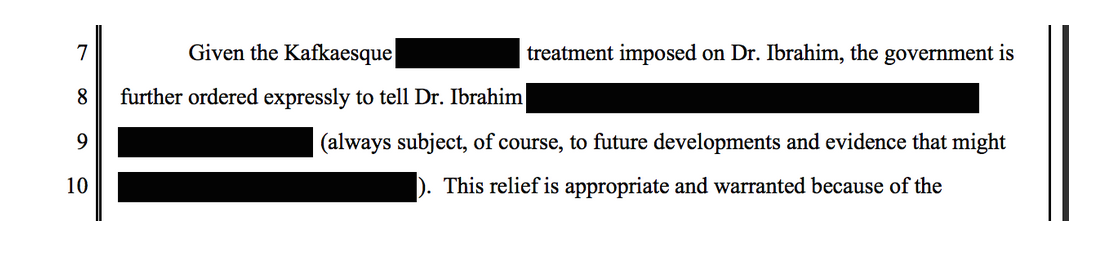
A hearing in federal court Tuesday has apparently marked the conclusion of a drawn-out, costly, and, to use the judge’s own term, “Kafkaesque” legal battle over the government no-fly list. Malaysian college professor Rahinah Ibrahim sued the government back in 2006, after Dr. Ibrahim’s name mistakenly ended up on a federal government no-fly list.

Last month, US District Judge William Alsup ruled that Ibrahim must be removed from the government's various watchlists. At Tuesday's hearing, a Department of Justice lawyer said that the government did not intend to appeal the ruling. The ruling in Ibrahim v. DHS calls into question the government's administration of its controversial no-fly list as well as other terrorist watch lists, but it leaves no clear roadmap for other people wrongly placed on such lists.

Ibrahim's pro bono attorney, Elizabeth Pipkin, has asked for the government to pay more than $3.5 million to cover her legal fees and costs. Alsup didn't rule on that motion, but said that the issue was "not easy," while indicating that Pipkin is unlikely to be entitled to such a large payout.

No recourse

The Ibrahim case marks the first and only successful challenge to the terrorist watch-listing program, which arose following the 9/11 attacks. But Ibrahim's case, as just one of hundreds of thousands of individuals who have been placed on such lists, shows the system's opacity. First, the only surefire way to even determine if one is on such a list in the US is to attempt to board a flight and be denied. Even after that happens, when a denied person inquires about his or her status, the likely response will be that the government “can neither confirm nor deny” the placement on such lists.

The government's surrender in Ibrahim comes on the heels of a new report by the American Civil Liberties Union that shows just how insanely difficult it is to contest one's status on the government blacklists. The ACLU explains:
The 'redress' procedures the US government provides for those who have been wrongly or mistakenly included on a watchlist are wholly inadequate. Even after people know the government has placed them on a watchlist... the government's official policy is to refuse to confirm or deny watchlist status. Nor is there any meaningful way to contest one's designation as a potential terrorist and ensure that the US government... removes or corrects inadequate records. The result is that innocent people can languish on the watchlists indefinitely, without real recourse.
The report also includes several examples of people challenging no-fly determinations, and it's a very murky procedure. Litigation is typically subject to sealed filings and a closed proceeding.

One of the secrets of the government's watchlists is how big they are. No one outside of the intelligence community seems to know for sure. The ACLU report cites a National Counterterrorism Center Fact Sheet, which notes that the "consolidated terrorist watchlist" contained about 875,000 names in December 2011. It also described how the Terrorist Screening Center's watchlist has grown significantly over time, from approximately 158,000 records in June 2004 to over 1.1 million records in May 2009. It cites an AP report from February 2012 documenting that there were approximately 21,000 people on the no-fly list (including about 500 US citizens and permanent residents) and saying that the list had more than doubled in the previous year.

Even after the drawn-out Ibrahim case, there's still no good way to question the government's determination besides going to court. The next person who wants to challenge a no-fly decision is probably going to have to retread the same path as Ibrahim. Taking a look back at her ordeal is instructive, if not inspiring.

The Ibrahim saga

Rahinah Ibrahim was admitted to the US on a student visa to study at Stanford’s graduate school in 2000. Five years later, when attempting to fly from San Francisco to Hawaii, she was denied entry onto the plane, was handcuffed—despite being wheelchair-bound at the time—and was placed in a holding cell, detained for two hours, and then questioned. During questioning, a police officer attempted to remove her hijab. Eventually, she was released and told that her name had been stricken from the no-fly list.

After flying back to Hawaii and then to Malaysia a few days later, her student visa was revoked, and she was denied reentry into the US. That was the beginning of a nine-year fight over whether she could travel back to the US, which Ibrahim said she considered her "second home."

As explained in Alsup’s opinion, the whole dispute stemmed from an errant check placed on a form filled out by FBI agent Kevin Kelly. At trial, Agent Kelly admitted his mistake, and government lawyers actually conceded that Ibrahim doesn't pose a threat to national security and never has. The mistake was not a small thing, Alsup wrote.
At long last, the government has conceded that plaintiff poses no threat to air safety or national security and should never have been placed on the no-fly list. She got there by human error within the FBI… the FBI agent filled out the nomination form in a way exactly opposite from the instructions on the form, a bureaucratic analogy to a surgeon amputating the wrong digit—human error, yes, but of considerable consequence.
Much of the litigation took place even while Ibrahim was unable to get much information about the government's case against her. In December, Alsup denied Ibrahim’s request to see the classified evidence submitted by the government in its defense against her lawsuit.

Kafka today

Ben Wizner, Edward Snowden’s attorney at the ACLU, remarked at SXSW that problems with the no-fly list aren't going away; the world we're facing will look more like Kafka than Orwell. It will be a place where we simply can't get answers. Wizner said:
We already have watch lists that say that some people can fly and some people can’t, or that they can go in this lane or they can go in that lane. But that’s only going to proliferate as there’s more and more data and faster and faster computers and more confidence that they can make these predictions about us. I worry about due process. I worry about basic fairness. And I worry about a world—not a world that looks like Orwell. The law professor Daniel Solove has said that maybe the better analogy for this, or metaphor, is not Orwell, but Kafka, where a big data state makes judgments that can be permanent and irreversible, and don’t seem fair, and we don’t have a chance to speak back.
In Kafka’s famous novel, “The Trial,” the protagonist, Josef K. awakens one morning to be arrested for an offense that is never explained and for which he is subsequently to be tried without ever learning of the nature of the charges.

The sense that it's impossible to know what one is up against runs through the Ibrahim opinion. In one section, shown below, Judge Alsup orders the government “expressly to tell Dr. Ibrahim”—and then the remainder of the sentence is redacted.

Setting the Stage for Tyranny: Public Schools Deliberately Create a Culture of Fear

Daisy Luther

What is the best way to ensure that gun control takes place within a generation?

Forget trying to change the minds of those who already have guns. The best way to do this is to encourage a culture of fear among young people.

And the public school system, with all of its zero tolerance lunacy, is doing just that. They are setting the stage for tyranny.

Case in point:

Yesterday in Baltimore, some students saw a person carrying a tripod through the school. Frightened, they reported this to administrators, which resulted in an immediate lockdown:
This morning, KIPP Ujima Village Academy and KIPP Harmony were placed in heightened security status, based on a report of a possible intruder. Police responded and secured the building, while police and school staff together ensured the safety of all children and staff. After a thorough investigation, police determined that there was no intruder in the building or on school grounds. 
As a precaution while the large school building was searched, students were taken by bus to the shared campus of Baltimore Polytechnic Institute and Western High School. Parents were contacted by phone and through local and social media channels, and were directed to pick up children from that location. (source)
As it turned out, the person carrying the tripod was a journalism student and the tripod was for his camera. However, a SWAT team descended on the school and children and parents alike were terrified after a 4 hour lockdown scenario.

Critical thought is not encouraged. Panic is praised.

Security ‘expert’ Rob Weinhold sums it up:
It’s just not a time to use any judgment. Take the guesswork out. Lock down the school system. Make sure everyone is safe. (source)
Another incident recently occurred in Maryland when two people hunting ducks with a pellet gun caused terror on the campus of Stevenson University.
The Owings Mills campus was locked down for more than two hours Monday after someone reported a man with a gun. 
Investigators say two students hunting ducks with a pellet gun caused that incident. 
“The bottom line is that lockdowns save lives,” said security expert Rob Weinhold. 
He says in the wake of the Sandy Hook school shooting, school officials cannot be cautious enough when there’s a suspicion of a gunman on campus. (source)
The issue here is pretty clear. The younger generation is being taught that the very sight of a gun or anything that could be related to a gun is a reason for fear. That fear is cemented in the minds of children and parents when they are traumatized by the handling of the incidents.

Kids are getting in trouble for drawing pictures of guns. For having tools which are sharp. For wearing t-shirts with the word “gun” printed on them. For cutting their poor, defenseless food in the lunchroom. For biting a pastry into a shape that could either be a gun or the state of Florida. Maybe we should outlaw maps of Florida because the shape of that state is “intimidating.”

They are being taught to have an irrational fear of inanimate objects. And because everyone else shares that fear, that mass delusion, it becomes “normal”. It becomes so commonplace that it isn’t fear anymore, but an accepted fact: “Guns are scary.”

The fear is quite literally being implanted. When police refuse to tell people what is going on, when kids are rapidly evacuated, when cops in military-style SWAT gear swoop in – all of these dramatic scenes are not soon forgotten. When the dreaded “gun sighting” occurs in the future, the natural human response is to flash back to the last time that it happened. Instantly, the emotional response is overwhelming fear.

When you read the following statements from those involved in the lockdown, keep in mind this incident was not triggered by a masked man with a machine gun firing in the hallways. This series of emotional responses began when someone saw a kid with a camera tripod.
“They were really freaking out because the police were pushing you away so you didn’t know what was going on,” said Michelle Ward, parent. 
The school told parents to meet at Poly-Western. 
They quickly swarmed the parking lot and turned to each other for support. 
“My child is in there. I know he a nervous wreck,” one mother said. 
Tiffany Taylor has four children at KIPP Academy. 
“It’s really frightening to hear on the radio that something is going on at the school,” Taylor said. 
A large group of several hundred parents were on hand when police told the crowd all children were safe and would soon be bused to Poly to reunite with their families. 
“In my heart, I felt a little relieved but I still need to see my children and be reunited with them. It just won’t be over until I get them home,” Taylor said. 
Though it took some time and a lot of patience from parents, the buses started arriving and reunions got underway. 
Student Damaya Smith told us about her ordeal. 
“Everybody started crying. We had to hide because we felt uncomfortable,” she said. “It was a little scary when it started, but I listened to my teacher.” 
For her parents, it was the perfect end to a long day. 
“I’m just glad everything is OK. I’m just happy that nobody got hurt,” said Derrick Smith, parent. (source)
Make no mistake, this is deliberate. Those in charge are setting the stage for tyranny beyond our wildest dreams and they will never have to fire a shot. These kids will be begging the government to take away all of the guns and keep them “safe”. People that are this afraid of a tripod aren’t going to be leading the next revolution.

A Kindergartner’s Nightmare


Is this education? Is this what we want for our children and grandchildren?

Teachers have called the testing regime child abuse and here you get to read about it firsthand.

A teacher’s recount of the first day of Common Core Testing as posted on the Badass Teachers (BATS) Facebook page:

“I’m aiming for the short version here.

My kindergartners had their standardized computerized test today.

There were over 100 questions. Answers were selected by drop and drag with a trackpad, no mouse is available. One class took five hours to finish. Kids crying in 4 of 5 classes. Multiple computer crashes (“okay, you just sit right there while we fix it! Don’t talk to anyone!”). Kids sitting for half hour with volume off on headsets but not saying anything. Kids accidentally swapping tangled headsets and not even noticing what they heard had nothing to do with what they saw on the screen. Kids having to solve 8+6 when the answer choices are 0-9 and having to DRAG AND DROP first a 1 then a 4 to form a 14. Some questions where it was only necessary to click an answer but the objects were movable (for no reason). No verbal explanation that you must click the little speaker square to hear the instructions. To go to the next question, one clicks “next” in lower right-hand corner…..which is also where the pop-up menu comes up to take you to other programs or shut down, so about many shut-downs or kids winding up in a completely different program.

If this is not what you want for your kids and grand-kids, you’d better start making some noise. Ten years ago we would’ve thought this would be literally impossible.”

This is kindergarten people! This is what it has become between the Common Core Standards and high stakes testing.

This is a good way to create students who don’t want to go to school and think learning is hell.

Immigration Enforcement Doesn't Belong in the Courthouse

By Reverend Elmer Zavala Gonzalez, Minister Member of Mid-Kentucky Presbytery

In a matter of minutes, I went from seeking justice, to bearing witness, to being racially profiled.

My youngest son who is 3 years old often accompanies me as I do my duties as a minister member of our Mid-Kentucky Presbytery in Louisville. We visit new members of the congregation to welcome them. We attend community events and celebrations. Sometimes, he comes with me as I lend a hand to a congregant in need of assistance.

On a sunny day last October, I offered to take one congregant, we'll call her Lilia, to the courthouse in Louisville to deal with a traffic offense. My son came along with me. Little did I know the challenge I would face that morning to do the right thing – both as a minister and as a parent.

We arrived at the courthouse and walked up the long set of stairs and under four tall Roman columns into the main lobby of this imposing building and into the courtroom assigned to Lilia's hearing. We were there for only a few minutes when someone opened the door to the courtroom and asked for Lilia, who is an undocumented immigrant, by name. She left and a few minutes later I decided to follow her because she hadn't returned.

Soon I saw Lilia walking toward me accompanied by a man. Her face was red, and clearly she was upset. The man was with U.S. Immigration and Customs Enforcement (ICE), although I didn't know it at the time because he had no identification badge. As they approached, she tried talking to me, hoping I would help her understand what was happening.

When I asked this individual why immigration would be involved with a case in local traffic court, the man who still had not identified himself to me as an ICE agent turned and began to question me. I have an accent, and my skin is dark. The agent asked, "Where are you from?" (Honduras, I replied). "Do you have legal documents?" (Yes, I replied).

He then asked me to show my documents. When I asked him why he was asking me to show documents, he threatened me, saying "You know, if you don't have documents, I can detain you and send your child to Child Protective Services." To avoid traumatizing my son, I showed the agent my residency card. Lilia was taken away and eventually detained for deportation.

I am disturbed on many levels by what transpired. This was a case of brazen racial profiling, and this federal agent acted in an intimidating way towards all of us. Lilia came to court that day just to answer a traffic offense. I came to help her, and my son was innocent to all of it, in the arms of his father. The official did not need to act this way.

I am convinced that my dark skin and my accented English prompted the agent to begin asking me where I was from and if I had documents. When I asked for a simple explanation for his decision to detain Lilia and to question me, he could have answered me in a simple, direct manner and showed me his identification. Instead, he chose to intimidate us, focusing on the presence of my young son.

It was not necessary to threaten me with detention and taking my son away. But this intimidation put me in a difficult position. Although I would never do something intentionally that would traumatize or hurt my son, I knew that what the agent was doing was wrong. I did what I thought was best as a parent: I became quiet and showed the official my documents.

Now I feel a moral imperative to raise this publicly because I know that hundreds of people in Kentucky face situations like this daily. Mine did not result in a separation from my son and wife, but many of these interactions do. That this occurred at a courthouse, where individuals come to seek justice and to settle their obligations is an outrage.

What does ICE enforcement at courthouses say to immigrants, and in fact to people whose skin is dark or who may have an accent? That they may be subject to ill treatment and discrimination for coming to a place that is supposed to be dedicated to justice? This makes no sense. Courthouses should not be locations for ICE enforcement.

Now, although I will still accompany a congregant to the Louisville courthouse to pay a traffic citation, sadly, I do not take my son. I do, however, ask another pastor or congregant, one whose skin is white, to accompany us both.

DOJ Investigation Confirms: Albuquerque Police ‘Executing’ Citizens

Lauren McCauley

Protesting against systemic abuse by the Albuquerque Police Department on Sunday April 6, demonstrators encountered officers in riot gear. (Photo: Cole L. Howard)Residents of Albuquerque, New Mexico are marching on the police department Saturday to demand retribution against the city’s mayor and police chief for their role in the police force’s documented “execution” of citizens.

The march comes after the Department of Justice slammed the Albuquerque Police Department for their frequent use of excessive and lethal force in a damning report released on Thursday.

Though, according to advocates, abuse by local law enforcement has been systemic for years, calls for increased scrutiny of the APD were amplified following the police shooting death of James Boyd, a homeless man suffering from mental illness, on March 16.

Advocates welcomed the DOJ’s findings, saying the report was “spot on” in terms of identifying the root causes of this behavior, such as the “aggressive culture of the department” and the way in which “force is prioritized in training.”

However, according to David Correia, an organizer with the Task Force for Public Safety who has been working with families of victims of APD violence, the DOJ’s inclusion of Mayor Richard J. Berry and police chief Gorden Eden in the negotiations for the consent decree, which will dictate how those recommendations will be implemented, is a “non-starter” for the community groups.

The systemic deficiencies identified by the DOJ are “all produced and reinforced through leadership,” Correia told Common Dreams. “To say those people should be involved to us is ‘no go.’ We don’t want them to be a part of it.”

Further, Correia noted that the report did not go so far as to address some of the larger issues including laws around homelessness, access for people suffering from mental illness and access for veterans, which he says are also major contributors to the police violence in the city.

The Saturday evening protest will begin at 5 PM MST at Civic Plaza from where demonstrators will march to the APD. During another recent protest against the department, police assaulted demonstrators with tear gas.

Activists are calling for the removal of those officials, including Berry and Eden, who oversaw the frequent “execution” of citizens and for a federal monitor to be appointed. Correia said that they need to “interrupt the idea that this is somehow resolved,” now that the DOJ has released their report.

“Our fear is that people will now think that the sheriff has come down in his white hat and we can all sit back and relax,” Correia continued.

The Justice Department investigation, launched in November 2012, found:

APD officers too frequently use deadly force against people who pose a minimal threat and in situations where the conduct of the officers heightens the danger and contributes to the need to use force;

APD officers use less lethal force, including electronic controlled weapons, on people who are passively resisting, non-threatening, observably unable to comply with orders or pose only a minimal threat to the officers; and

Encounters between APD officers and persons with mental illness and in crisis too frequently result in a use of force or a higher level of force than necessary.
The DOJ also cited “systemic deficiencies” which contribute to these patterns which include deficient policies, failed accountability, inadequate training and supervision, ineffective systems of investigation and adjudication, the absence of a culture of community policing and a lack of sufficient civilian oversight.

Government to introduce law requiring porn sites to obtain proof that users are over 18

The UK Government plans to make anyone aiming to view porn online prove that they are over 18 years of age through new requirements for website owners.

The new laws will see adult website owners forced to block anyone unable to provide proof that they are over the age of 18, in a bid to crack down on children viewing pornographic websites, The Sunday Times has reported.

The system is expected to be similar to one used abroad, with credit card details or official records being provided those visiting pornographic websites in order to gain access. Sites that fail to comply with the measures will be blocked.

A statement from the Department for Culture, Media and Sport, said: “We are legislating to put R18 material that can only be sold in licensed sex shops behind access controls on video-on demand services.

“The same protections should apply online as offline and we are clarifying the law to make sure that is the case — we want the legislation to be in place by the end of the year. No decision has been made about offshore sites.”

20140419

Woman experiences DEA raid at 5:00AM after shopping for indoor gardening supplies

"They had a gun pointed at me when they said, 'Are there any illegal substances in your house?'"

SHOREWOOD, IL — A woman became the subject of an investigation when she was observed shopping for indoor gardening supplies at a hydroponics store. Police and federal agents began staking out the woman’s home, sifting through her garbage, and monitoring her electricity usage. The investigation prompted gun-wielding agents to show up in her bedroom in the middle of the night.

The subject of this investigation was Angela Kirking, a 46-year-old artist who does face-painting for children at local fairs. She enjoys indoor gardening and grows a hibiscus plant for her consumption. She shops for fertilizer and supplies at a local shop called Midwest Hydroganics.
“They had a gun pointed at me when they said, ‘Are there any illegal substances in your house?’”

It so happened that police and the Drug Enforcement Administration (DEA) had been staking out Midwest Hydroganics to attempt to bust citizens who grow unauthorized plants without government permission. Angela Kirking was witnessed exiting the store “carrying a green plastic bag containing unknown items” on September 17, 2013, the Shorewood Patch reported. The bag contained organic fertilizer for her hibiscus flowers.

Based only on the woman’s shopping habits, an investigation was launched that lasted nearly a month.

Police began spying on Kirking’s utility bills. They discovered that her electricity usage was “consistently higher” than her neighbors. Officers were then sent to sneak around the outside of her property at 4:15 a.m. to dig through her trash. According to The Shorewood Patch, the garbage-pickers reportedly found “multiple green plant stems” that smelled strongly of “green cannabis.”

This evidence was enough to make the police and prosecutors believe that her home may contain the forbidden cannabis plant. A few days later, a paramilitary team of plant enforcers was assembled to arrest Mrs. Kirking.

Police tacticians decided that the most effective way to arrest the artist would be to wake her up at 5:00 a.m. with gun-toting strangers in her bedroom. That’s what Mrs. Kirking awoke to on October 11th, 2013.


Angela Kirking and her attorney. (Source: Joseph Hosey)

“They had a gun pointed at me when they said, ‘Are there any illegal substances in your house?’” Kirking recalled.

DEA agents and Shorewood police officers were standing over her bed. Apparently they had waited for her husband to leave for work at 4:50 a.m. and then made him let them in the home.

The Shorewood Patch reported that the agents confiscated her computer, some books, and a few grams of a plant that they claimed was marijuana. These crimes amounted to misdemeanor charges, and Mrs. Kirking was taken away in handcuffs.

Of course, the investigation was based on rubbish. Kirking’s attorney, Jeff Tomczak, is trying to get the search warrant voided because of its shaky pretexts.

Indoor gardeners are frequently the targets of police raids. John Kohler, an indoor gardening advocate who runs GrowingYourGreens.com, had his home invaded by police because he grew vegetables in his bathroom. A Kansas family who grew a garden in their basement suffered a no-knock raid under nearly the same pretexts as Mrs. Kirkling.

State of Surveillance: Police, Privacy and Technology


20140418

Los Angeles Cops Argue All Cars in L.A. Are Under Investigation

Jennifer Lynch

Do you drive a car in the greater Los Angeles Metropolitan area? According to the L.A. Police Department and L.A. Sheriff's Department, your car is part of a vast criminal investigation.

The agencies took a novel approach in the briefs they filed in EFF and the ACLU of Southern California's California Public Records Act lawsuit seeking a week's worth of Automatic License Plate Reader (ALPR) data. They have argued that "All [license plate] data is investigatory." The fact that it may never be associated with a specific crime doesn't matter.

This argument is completely counter to our criminal justice system, in which we assume law enforcement will not conduct an investigation unless there are some indicia of criminal activity. In fact, the Fourth Amendment was added to the U.S. Constitution exactly to prevent law enforcement from conducting mass, suspicionless investigations under "general warrants" that targeted no specific person or place and never expired.

ALPR systems operate in just this way. The cameras are not triggered by any suspicion of criminal wrongdoing; instead, they automatically and indiscriminately photograph all license plates (and cars) that come into view. This happens without an officer targeting a specific vehicle and without any level of criminal suspicion. The ALPR system immediately extracts the key data from the image—the plate number and time, date and location where it was captured—and runs that data against various hotlists. At the instant the plate is photographed not even the computer system itself—let alone the officer in the squad car—knows whether the plate is linked to criminal activity.

Taken to an extreme, the agencies' arguments would allow law enforcement to conduct around-the-clock surveillance on every aspect of our lives and store those records indefinitely on the off-chance they may aid in solving a crime at some previously undetermined date in the future. If the court accepts their arguments, the agencies would then be able to hide all this data from the public.

However, as we argued in the Reply brief we filed in the case last Friday, the accumulation of information merely because it might be useful in some unspecified case in the future certainly is not an "investigation" within any reasonable meaning of the word.

LAPD and LASD Recognize Privacy Interest in License Plate Data

In another interesting turn in the case, both agencies fully acknowledged the privacy issues implicated by the collection of license plate data.

LAPD stated in its brief:
"[T]he privacy implications of disclosure [of license plate data] are substantial. Members of the public would be justifiably concerned about LAPD releasing information regarding the specific locations of their vehicles on specific dates and times. . . . LAPD is not only asserting vehicle owners' privacy interests. It is recognizing that those interests are grounded in federal and state law, particularly the California Constitution. Maintaining the confidentiality of ALPR data is critical . . . in relation to protecting individual citizens' privacy interests"
The sheriff's department recognized that ALPR data tracked "individuals' movement over time" and that, with only a license plate number, someone could learn "personal identifying information" about the vehicle owner (such as the owner's home address) by looking up the license plate number in a database with "reverse lookup capabilities such as LexisNexis and Westlaw."

The agencies use the fact that ALPR data collection impacts privacy to argue that—although they should still be allowed to collect this information and store it for years—they should not have to disclose any of it to the public. However, the fact that the technology can be so privacy invasive suggests that we need more information on where and how it is being collected, not less. This sales video from Vigilant Solutions shows just how much the government can learn about where you've been and how many times you've been there when Vigilant runs their analytics tools on historical ALPR data. We can only understand how LA police are really using their ALPR systems through access to the narrow slice of the data we've requested in this case.

20140414

Judge says flashing headlights is free speech

By JEFF BARNARD

GRANTS PASS, Ore. (AP) — Hauling a truckload of logs to a Southern Oregon mill last fall, Chris Hill noticed a sheriff's deputy behind him and flashed his lights to warn a UPS driver coming the other way.

The deputy pulled over Hill on U.S. Highway 140 in White City and handed him a $260 ticket for improperly using his headlights, saying another deputy had seen the flashing lights from behind the UPS truck and alerted him to stop the log truck because of the signaling.

Outraged, Hill decided to fight the ticket, and on Wednesday, a Jackson County Justice Court judge dismissed the citation, finding that motorists flashing their headlights amounts to speech protected by the Oregon Constitution.

Judge Joseph Carter determined the law covering the use of high beams was valid, but was unconstitutional as it was applied by the deputy.

"The citation was clearly given to punish the Defendant for that expression," the judge wrote. "The government certainly can and should enforce the traffic laws for the safety of all drivers on the road. However, the government cannot enforce the traffic laws, or any other laws, to punish drivers for their expressive conduct."

The Jackson County Sheriff's Office did not return a telephone call for comment.

Hill, 38, of Klamath Falls, has been driving truck for 10 years, and was not interested in seeing his insurance rates go up for getting a ticket. He initially told the deputy that the UPS driver was his neighbor, and he was just saying hello.

"My point to the cop was his partner didn't know why I was flashing my lights," Hill said. "He couldn't tell for sure what I was doing."

By the time his case went to court last month, Hill had researched the law and found nothing that expressly prohibited the use of headlights to signal other drivers. He also recalled a TV news story about a federal judge in the Midwest barring police from handing out tickets to drivers who flashed their lights to warn others of a speed trap ahead.

"I thought, 'Well, I'll throw that in there, too,'" he said.

Acting as his own attorney in a hearing conducted by telephone, Hill said he acknowledged the UPS driver wasn't his neighbor, and he raised the free speech argument.

"What I did wasn't illegal, whether it's freedom of speech or not," he told The Associated Press.

Dave Fidanque, director of the American Civil Liberties Union of Oregon, noted the Oregon Court of Appeals overturned a traffic law prohibiting horn honking for non-traffic purposes on similar grounds in the 1990s after a number of people got tickets for honking in support of U.S. troops during the first Gulf War.

"If the motive of the sheriff's deputies was in fact not to make the roads safer, but to raise more revenue from traffic enforcement, that would be even more reason why it should be unconstitutional," Fidanque said. "If this is part of a pattern, then it probably would be worth us looking into it in more detail."

Special Ed. Student Records Audio Proof of Bullying, Threatened With Charges of Felony Wiretapping

By: Priscilla Jones

A South Fayette High School sophomore claims to have been bullied all year at his new school located in McDonald, Pennsylvania. In February, the student made an audio recording of one bullying incident during his special education math class. Instead of questioning the students whose voices were recorded, school administrators threatened to charge him with felony wiretapping before eventually agreeing to reduce the charge to disorderly conduct. On Wednesday, March 19, the student, whose name we have agreed to not include in this story, was found guilty of disorderly conduct by District Judge Maureen McGraw-Desmet.

Before the defendant was able to give a statement, McGraw said, “Normally, if there is — I certainly have a big problem with any kind of bullying at school. But normally, you know, I would expect a parent would let the school know about it, because it’s not tolerated. I know that, and that you guys [school administrators] would handle that, you know. To go to this extreme, you know, it was the only alternative or something like that, but you weren’t made aware of that and that was kind of what I was curious about. Because it’s not tolerated, but you need to go through — let the school handle it. And I know from experience with South Fayette School that, you know, it always is. And if there is a problem and it continues, then it is usually brought in front of me.” (emphasis added)

The student and his mother, Shea Love, testified before the magistrate that the boy has been repeatedly shoved and tripped at school, and that a fellow student had even attempted to burn him with a cigarette lighter. The defendant is, according to school records, a well-behaved student with no history of disciplinary action. He was, however, previously diagnosed with a comprehension delay disorder, which is a slower processing speed for information than is normal, ADHD, and an anxiety disorder. He says the bullying treatment is especially harsh and academically disruptive during his special education math class, in which students with behavioral problems are also placed. On February 11, after doing research on several anti-bullying websites, he used his school approved personal iPad to make a seven-minute audio recording of his classroom experience. He played the recording at home for his mother. Outraged, Love, a former Air Force Morse code operator, transcribed the audio before calling school administrators.

According to Love, as the teacher is heard attempting to help her son with a math problem, a student says, “You should pull his pants down!” Another student replies, “No, man. Imagine how bad that cunt smells! No one wants to smell that twat.” As the recording continues, the teacher instructs the classroom that they may only talk if it pertains to math. Shortly thereafter, a loud noise is heard on the recording, which her son explained was a book being slammed down next to him after a student pretended to hit him in the head with it. When the teacher yells, the student exclaims, “What? I was just trying to scare him!” A group of boys are heard laughing.

The school board’s bullying policy pledges no retribution for reporting suspected bullying. Its policy for abuse of electronic devices is disciplinary action and/or confiscation of the device pending a conference with the parent. South Fayette High School’s policy guidebook on the discipline of disabled students states, “Students with disabilities who engage in inappropriate behavior shall be disciplined in accordance with their Individualized Education Program (IEP), positive behavior support plan in place, each building’s Code of Conduct, and Board policy.”

The School’s Response: “Could Be Charged With Felony Wiretapping”

Love says that upon fielding her complaint, Principal Scott Milburn called South Fayette Township police Lieutenant Robert Kurta to the school to interrogate her son in the presence of Associate Principal Aaron Skrbin and Dean of Students Joseph Silhanek. The defendant testified before Judge McGraw-Desmet that he was forced to play the audio for the group and then delete it. Love says by the time she arrived at the school, her son was surrounded by school officials and the police officer and was visibly distraught. She says

Principal Milburn advised her that her son was “facing felony wiretapping charges” because he made a recording in a place with an expectation of privacy, and that Officer Kurta agreed.
Milburn defended the teacher’s response to the classroom disturbance.

Kurta testified before the magistrate that Milburn requested his presence at the school on February 12 at 8:20 a.m. The officer said, “He believed he had a wiretapping incident.” Upon his arrival, Kurta said Milburn advised him that Silhanek fielded a call that morning from Love notifying him “that she planted a recording device in her son’s backpack to record the activities in one of his classes.” According to Kurta’s testimony, after Milburn consulted with the school district’s attorney, he advised reporting the incident to the police and treating it as a crime. The officer then admitted he did not hear the audio file in question or do an investigation into the recording, presumably because the student was ordered to erase it prior to his arrival at the school. Silhanek testified, “Mr. Milburn asked (the defendant) to delete it (the recording) after we heard it and (the defendant) complied.” The defendant clarified that the recording was still on his iPad when Lt. Kurta arrived at the school. He said of the recording, “Mr. Milburn told me to delete it, and I just felt, like, really pressured to do it. I didn’t want to. I just think that it wasn’t really right. Like, I’m getting prosecuted for trying to seek help…If I had known it was illegal, I wouldn’t have done it.”

Love testified, “ I didn’t believe it (the bullying) was as bad as what it was. And when I heard the recording, I flipped out. He did not want me to say anything to anybody, but I wanted to be able to say something because what I heard was not right. It was not okay.”

In his defense, the student testified as to why he made the recording. “I wanted her (Love) to understand what I went through. Like, it wasn’t like I was overexaggerating it. I wasn’t lying. It was really happening. I was really having things like books slammed upside my head. I wanted it to stop. I just felt like nothing was being done.” Love testified that she was aware of the bullying but, “I did not tell him to record. I did hear the recording. …I’ve emailed her (the special education teacher) several times on this incident with other kids.”

Kurta said, “After I left the school, I wasn’t sure what charge to file so I contacted the district attorney’s office. This would fall under a wiretapping violation, which is a felony.” He later answered as to why he thought the disorderly conduct charge applied to this case by saying, “Because his (the student’s) actions — he engaged in actions which served no legitimate purpose.” He then read the statute as, “Creates a hazardous or physically offensive condition by acts which serve no legitimate purpose.”

Love’s attorney stated during the March 19 proceeding, “I’m not so sure that there wasn’t a crime committed by that evidence being destroyed. There’s no recording here that anybody’s introduced into evidence.” He continued in his closing arguments, “We’ve shown that there’s a legitimate purpose for the recording. And there’s no physically offensive or hazardous condition that was created by this recording. I don’t see how a recording of students that are bullying my client could be physically offensive or dangerous to anyone, other than potentially the people that are bullying my client.”

Disorderly conduct is defined in Pennsylvania as “the intent to cause public inconvenience, annoyance or alarm, or recklessly creating a risk thereof” such as by engaging in “fighting or threatening, or in violent or tumultuous behavior, unreasonable noise, obscene language, obscene gestures,” or creating “a hazardous or physically offensive condition by any act which serves no legitimate purpose of the actor.”

Convicted of Disorderly Conduct

While Love’s son was never officially charged with felony wiretapping, the magistrate pronounced him guilty of disorderly conduct. This occurred after the administrators gave the student a Saturday detention to serve and he completed it as asked.

The 15-year-old defendant, whose favorite class is Civics, plans to appeal the conviction. His next court appearance is April 29 in Pittsburgh. When asked if she was afraid of retaliation by school officials or harassment by the police, Love said, “I refuse to be threatened. I just want my son to have a chance to bloom and not fall so far behind in a totally disruptive environment.”

The school immediately removed Love’s son from the special education math class. The students whose voices were caught on tape remain enrolled.

Transcripts of the court proceedings were made by a court stenographer hired by the defense team. The school will not comment on the matter.

20140407

Border Patrol Terrorizes a Mom and Her Two Kids


Report Outlines Medical Workers’ Role in Torture

By SCOTT SHANE

WASHINGTON — Medical personnel were deeply involved in the abusive interrogation of terrorist suspects held overseas by the Central Intelligence Agency, including torture, and their participation was a “gross breach of medical ethics,” a long-secret report by the International Committee of the Red Cross concluded.

Based on statements by 14 prisoners who belonged to Al Qaeda and were moved to Guantánamo Bay, Cuba, in late 2006, Red Cross investigators concluded that medical professionals working for the C.I.A. monitored prisoners undergoing waterboarding, apparently to make sure they did not drown. Medical workers were also present when guards confined prisoners in small boxes, shackled their arms to the ceiling, kept them in frigid cells and slammed them repeatedly into walls, the report said.

Facilitating such practices, which the Red Cross described as torture, was a violation of medical ethics even if the medical workers’ intentions had been to prevent death or permanent injury, the report said. But it found that the medical professionals’ role was primarily to support the interrogators, not to protect the prisoners, and that the professionals had “condoned and participated in ill treatment.”

At times, according to the detainees’ accounts, medical workers “gave instructions to interrogators to continue, to adjust or to stop particular methods.”

The Red Cross report was completed in 2007. It was obtained by Mark Danner, a journalist who has written extensively about torture, and posted Monday night with an article by Mr. Danner on the Web site of The New York Review of Books. Much of its contents were revealed in a March article by Mr. Danner and in a 2008 book, “The Dark Side,” by Jane Mayer of The New Yorker, but the reporting of the Red Cross investigators’ conclusions on medical ethics and other issues are new.

Khalid Shaikh Mohammed, the chief planner of the Sept. 11 attacks, told investigators that when he was waterboarded, his pulse and oxygen level were monitored, and that a medical attendant stopped the procedure on several occasions.

Another prisoner, Walid bin Attash, who had previously had a leg amputated, said that when he was forced for days to stand with his arms shackled above his head, a health worker periodically measured the swelling in his intact leg and eventually ordered that he be allowed to sit.

The report does not indicate whether the medical workers at the C.I.A. sites were physicians, other professionals or both. Other sources have said that psychologists helped design and run the C.I.A. interrogation program, that physicians’ assistants and former military paramedics worked regularly in it, and that physicians were involved at times.

By policy, the Red Cross, the chief independent monitor of detention conditions around the world, keeps its reports to governments confidential to encourage officials to grant access to prisoners. Bernard Barrett, a spokesman for the organization in Washington, declined on Monday to comment on the report, adding, “We deplore that confidential material attributed to the I.C.R.C. was made public.”

Mark Mansfield, a C.I.A. spokesman, said that because of the Red Cross’s confidentiality policy, he would not comment on the report. He said that President Obama had prohibited all government interrogators from using techniques apart from the noncoercive methods in the Army Field Manual, and that the new C.I.A. director, Leon E. Panetta, “has taken decisive steps to ensure that the C.I.A. abides by the president’s executive orders.”

Mr. Mansfield added, however, that Mr. Panetta “has stated repeatedly that no one who took actions based on legal guidance from the Department of Justice at the time should be investigated, let alone punished.” The C.I.A.’s interrogation methods were declared legal by the Justice Department under President George W. Bush.

In its 40-page report, the Red Cross roundly condemned the C.I.A. detention program not only for using torture and other cruel treatment, but also for holding prisoners without notice to governments or families.

“The totality of the circumstances in which the 14 were held effectively amounted to an arbitrary deprivation of liberty and enforced disappearance, in contravention of international law,” said the report, which was provided to the C.I.A. acting general counsel, John Rizzo, in February 2007.

Shortly after taking office in January, Mr. Obama ordered the C.I.A. secret detention program closed and directed that the Red Cross be promptly informed of every person detained by the C.I.A. or any other agency.

The report also provided new details of the Bush administration’s failure to cooperate for several years with the Red Cross’s inquiries and investigations of American detention programs. Repeated inquiries and reports from the organization beginning in 2002 received no response from American officials, the report said, though the United States sent a diplomatic message addressing some inquiries in 2005.

M. Gregg Bloche, a Georgetown University law professor, who also trained as a psychiatrist and is now a visiting professor at the University of Chicago law school, called the report’s findings “a disturbing confirmation of our worst fears about medical professionals’ involvement in directing and modulating cruel treatment and torture.”

Another critic of medical involvement in harsh interrogation, Dr. Steven H. Miles, a physician at the Center for Bioethics of the University of Minnesota, said he had counted about 70 cases worldwide after World War II in which physicians were punished for participating in torture or related crimes. Most were in Brazil, Argentina, Uruguay and Chile, he said. None have been in the United States.Dr. Miles said that in recent decades, torture had almost always involved medical professionals, and that to deter future misconduct, the medical role in the C.I.A. program should be fully disclosed.

Snake Man vs LAPD "Officers" - Who will win???


20140405

There Are Lots of Legit Reasons to Look at Pornography: New Restrictions on NIH Grants Are Unscientific And Possibly Illegal


There was a moralistic, unnecessary, and wholly unscientific new restriction enacted on funding for the National Institute of Health as part of the appropriations bill passed in January. The new legislative mandate forces researchers who rely on government funding to place anti-pornography filters on their computer networks. There are serious potential consequences, such as filters overblocking sites that are anatomical rather than pornographic in nature as well as lost funding for scientific research that may legitimately need to access pornographic sites. The end result? Members of Congress, rather than the scientific community, imposing restrictions on what researchers should be investigating.

The Consolidated Appropriations Act was signed into law on January 17, 2014 and determines the funding for a range of government agencies and projects. Included in this act is a budget for the National Institute of Health, which itself is an enormous source of support for scientific research of all stripes. The new mandate has a provision stating that, “None of the funds made available in this Act may be used to maintain or establish a computer network unless such network blocks the viewing, downloading, and exchanging of pornography” and then provides a carve-out for criminal investigations.

This restriction is likely a reaction to a long-running controversy around NIH-funded research projects that involved pornographic websites. In particular, the University of Minnesota Men’s INTernet Study’s (MINTS) SexPulse research program, which was investigating ways of promoting safe sex practices among men who have sex with men (MSM), has been heavily criticized by conservative groups for integrating safe-sex surveys and education onto pornographic websites. But this debate isn’t new; back in 2004 the director of NIH was responding to criticism of NIH-backed research into pornography and prostitution, saying he “fully support[s] NIH’s continued investment in research on human sexuality.”

There are both legal and policy reasons why the restriction is ill-advised. First, the law.

Generally, the government cannot engage in direct censorship; the First Amendment prohibits it from doing so. However, Congress passed a law called the Children’s Internet Protection Act (CIPA) which required schools and libraries that receive so-called E-Rate funding to have Internet filtering software as a condition of funding. In 2003, in United States v. American Library Association, the Supreme Court held that CIPA was constitutional.

We are unaware of any court challenges to the new NIH mandate, but there are many important differences between it and CIPA.

First, the NIH mandate applies to “pornography,” a layperson’s term that is not defined either in the mandate or elsewhere in the law. By contrast, CIPA filtering is limited to three specific categories: obscenity, child pornography, and material that is harmful to minors. All of those are terms defined in CIPA itself or elsewhere in the law, and the scope of all three combined generally is considered to be less broad than common understandings of pornography. (For example, a typical Playboy centerfold might be pornographic to some, but is not obscene, child pornography, or harmful to minors.)

Second, unlike the NIH mandate, CIPA has two important limitations. Even when a filter is required, it can be turned off on request by an adult user. CIPA also has a specific exemption for bona fide research or other lawful purposes, but the NIH mandate has none. The only exemption from the NIH mandate is for law enforcement purposes.

Thus, notwithstanding the CIPA case, there are reasons to question the legality of the new NIH mandate.

But apart from the law, and regardless of how you feel about research that involves pornography, there are two important reasons why everyone should oppose this new federal restriction on medical research:

  1. Internet filters are inaccurate. As we noted when discussing the Children’s Internet Protection Act, filters block far more than explicit websites. Filters have been known to block LGBTQ-themed sites, websites for art museums, information on teen smoking, Second Amendment advocacy sites, and even sites about role playing games.
    By throwing these filters onto the computers of research institutions across the nation, we run the risk of inadvertently blocking all sorts of legitimate content from scientists engaged in research.
  2. Filters are secretive. One way to ensure that Internet filters aren’t blocking non-pornographic content (such as anatomy websites or sites covering issues like testicular and breast cancers) is to have transparency around what content is actually being blocked. Unfortunately, most Internet filters hide their blacklists and algorithms, claiming trade secrets. This means that U.S. scientists will, by and large, have no simple, objective way to choose the least-censoring Internet filter possible. And we, the American public, have no simple, objective way of seeing how many non-pornographic websites are being blocked by this new restriction.

Perhaps most importantly, researchers ought to be able to access pornographic material. While it may make some people uncomfortable, there are research topics that unquestionably benefit from access to pornographic websites. For example, there are research projects examining the spread of HIV associated with viewing pornography depicting unprotected anal intercourse, research examining whether frequent pornography viewing has a relationship to sexual aggression for certain groups of men, and studies on a potential relationship between men's pornography consumption and their attitudes supporting violence against women.

These and no doubt countless other areas of investigation could potentially be hindered by unwieldy restrictions on federal grants for research.

Congress shouldn’t dictate what topics are worthy of investigation. Excising Internet pornography from the realm of things researchers should examine when working to understand the human body and mind places unnecessary barriers on scientific curiosity.

Let’s support rigorous, uncensored scientific research.

Comment: Why has Grayling banned prisoners being sent books?

By Frances Crook

New rules introduced by the justice secretary ban anyone sending in books to prisoners. From now on, any man, woman or child in prison will not be able to receive a book from outside. This is part of an increasingly irrational punishment regime orchestrated by Chris Grayling that grabs headlines but restricts education or rehabilitation.

The rules governing possessions of prisoners are arcane and not consistently applied by every prison. These new restrictions relate to a downgrading of the system of rewards and punishments, ostensibly designed to encourage prisoners to comply with prison rules.  Yet the ban on receiving books is a blanket decision, so no matter how compliant and well behaved you are, no prisoner will be allowed to receive books from the outside.

Last November new rules were introduced so that families are no longer permitted to send in small items to prisoners. Children are not allowed to send a homemade birthday card. Prisoners with a particular expertise or interests cannot receive magazines, no matter how innocuous it might be to want to know about bird watching or steam trains.

The rules apply to clothing too. Prisoners are no longer permitted to have underwear sent in and so have to wear pants and socks worn by many other people. Women prisoners are particularly hard hit by this rule as they are not provided with a uniform and are dependent on family for underwear and outerwear. If underwear cannot be sent in, women are forced to wear the same pants and bras for months.

Book banning is in some ways the most despicable and nastiest element of the new rules. Prison libraries are supplied and funded by local authorities and have often been surprisingly good, but so many libraries are now closing and cutting costs that inevitably the first service to feel the pinch is in prison.

An inspection report published on March 18th on Wetherby prison, which holds 180 young boys, praised the jail for only containing the children in their cells for 16 hours a day during the week and 20 hours a day at weekends. Whilst many will not want to read a book to pass these endless hours, many boys I have met in prison do indeed read avidly.

Of course prisons should have incentives schemes to reward good behaviour. But punishing reading is as nasty as it is bizarre.

Video of white cop arresting black man in his friend’s home for not showing ID sparks furor

By Scott Kaufman

The video shows a deputy for the Jefferson Parish Sheriff’s Office taking Donrell Breaux into custody after, the deputy alleged, Breaux refused to provide the officer with proper identification. It begins shortly after the deputy announced his intention to arrest Breaux, so it is unknown whether his actions compelled the deputy to arrest him.

According to Colonel John Fortunato, spokesman for the Jefferson Parish Sheriff’s Office, a neighbor of Eric Banegas told police that he was sitting on his porch with his wife and children when he overheard someone loudly using profanity. When the neighbor confronted Banegas and Breaux, who were standing on the porch, Breaux unleashed “profanity-laced sentences” at him, his wife, and his children.

At this point, the neighbor called the police, whom he also told that he smelled marijuana “in the area where Breaux was standing.” He said that he felt threatened, and told police he wanted to press charges.

The deputy who responded approached Banegas and Breaux with the intention of issuing a misdemeanor summons for disturbing the peace, but decided to arrest them when he also smelled marijuana. He asked the men for their I.D.s, and Breaux said that he believed his was inside.

According to Col. Fortunato, the deputy saw the attempt to go inside the house as a refusal to present I.D., and “[a]fter he refuses to present I.D. and tries to go into the house, now [the deputy's] going to do a physical arrest as opposed to a misdemeanor summons.”

Breaux admitted to the Times-Picayune that he and Banegas were on the porch using profanity, but insisted that “[i]t wasn’t to the point that we were loud and disturbing people.” He claimed that the neighbor was combative and also used profanity when he confronted them, and that he did threaten to call the police.

However, Breaux said, “[h]e threatens to call the police all the time about stuff in the backyard and stuff going on inside the house. Things like there’s too many cars in the driveway.”

He also said that “I knew [the deputy] was a personal friend [of the neighbor] and I thought it was an unlawful arrest. I don’t have to submit to an unlawful arrest.”

“These are personal friends,” Breaux continued. “I wish I had friends that I could call and have them handle personal vendettas that I have with my neighbors.”

Breaux disputes the deputy’s claim that he approached them with the intention of issuing a misdemeanor summons. He told the Times-Picayune that the deputy immediately told him he was under arrest. “He’s grabbing my hoodie with handcuffs out. He said, ‘Let me see some ID,’ and grabs my wrist and says, ‘You’re under arrest,’ at the same time,” Breaux said.

All parties agree that that is when Banegas began videotaping the encounter on his phone.

On the video, the white officer can be seen forcing his way into the house. Breaux, the black man in the video, can be heard repeatedly saying, “You’re scaring me.”

The officer points at Banegas and tells him to “get out of here.”

“But this is my house, though,” Banegas responds.

“Sir, what is your name?” Breaux asks the officer.

“I’m not answering any questions,” the officer replies. “You’re under arrest.”

“For what?” Breaux replies. “That’s what I’m asking you — on what charge? That’s all I’m asking you?”

Thirty seconds later, Banegas can be heard telling Breaux, “just let him cuff you.”

Breaux continues to say, “I am scared, I am scared, son.” The officer continues to hold Breaux down on the couch, and when he reaches behind his back, Breaux begins to panic.

“What are you reaching for? Please, don’t shoot me! Sir — sir — sir — please, do not shoot me.”

According to Tulane University law professor Jancy Hoeffel, the 911 call alone was not probable cause to enter the Banegas residence. However, if the neighbor is able to convince the responding officer of a legitimate claim of criminal behavior — in this case, disturbing the peace — the officer can make an arrest on the spot, without a warrant.

“It’s hard for a citizen to know if a lawful arrest is occurring if they don’t know what they’re being arrested for,” Hoeffel said. The Louisiana code of criminal procedure does, however, grant citizens the right to be informed of the intention to make an arrest, the authority which grants the officer the right to make it, and the cause of it.

In the video, Breaux is asking the officer to explain the cause, but Hoeffel said that he should complied with the arrest. “You can’t have citizens second-guessing whether the officer has probable cause,” she said. “Cooperate now, litigate later. I admire people who stand up for their rights. At the same time, it’s for their safety. In general, things only get worse if you don’t cooperate.”

Watch an incorrectly titled video — it was a Jefferson Parish sheriff’s deputy, not a New Orleans police officer, who made the arrest — below.

You Don’t Have Free Speech!” — Cop Says to American Filming Him

MARYLAND — A chilling video has surfaced showing a cop yelling at an American citizen, saying “NO YOU DON’T!” when the American asserted “I have free speech.”

Officers can be seen waddling angrily in the streets and arresting people left and right.
RELATED: Pompous Cops on Power Trip, Shamed by Man Who Knows His Rights (VIDEO)

Apparently the people had been celebrating and a few of them had alcohol in public.

Nobody, however, initiated violence — except for the police.

“I thought I had free speech here,” said the man. The cop replied, “No you don’t!”

The man who was filming the video is approached repeatedly by enraged officers, taunting him and using “inciters” to try to arrest him.

The man responded calmly and said “I’ve done nothing wrong.”

At that point another officer charges at the man and tells him “Keep your fucking mouth shut or I’ll put you in jail.”

The man responds, “I thought I have freedom of speech.”

To which the cop sneers, “No you don’t! Not anymore.”

Of course, that was a lie, and it isn’t surprising that the cop would say that given that all cops are trained professionally to deceive the public.

Moreover, in the State of Maryland it is not illegal to record interactions with police.


This is another illustration of how many cops hate being filmed.

They know that they are unable to command respect naturally due to the fact that they’ve chosen to live off of taxpayer money to enforce the opinions of corrupt politicians — but they don’t want to be shamed publicly for it.

This is why many of them react in a fit of rage if a citizen so much as stands back and documents their behavior, much in the way that cockroaches squirm and flee when exposed to light.

Baltimore County cops doing their thing at the Towson bars. from Gootz on Vimeo.

20140402

Falkenberg: We expect more from our heroes than being sued by them

By Lisa Falkenberg

The wife's voice quivers. Her desperation is clear. The call to 911 is her last-ditch plea to save her husband, and maybe even her family.

For days, her husband, Kemal Yazar, a 43-year-old rug importer and loving, devoted father to their three young children in Seabrook, had been acting erratically. He refused to eat or sleep. He talked of apocalypse. He talked of President Barack Obama being the anti-Christ.

"My husband is disconnected from reality," Marlene Yazar is heard telling the operator from her mother's house in Katy, just before noon on Dec. 30, 2012. "He's just talking crazy things, like the world is going to end. And he's been like this for two or three days now."

The operator pounds her with questions and she answers them. No, he doesn't have a weapon, she says, but yes he could become violent if he thinks officers are coming to attack him.

Help is on the way, the operator says. A paramedic is first on the scene, but he quickly retreats after Kemal yells and throws a Bible at his back.

Harris County Deputy Brady Pullen arrives at 12:17 p.m., followed by another deputy. From here, accounts vary, but it's clear there's a struggle between Pullen and Kemal that leads the officers to draw Tasers and guns.

In less than 10 minutes, the delusional man is shot several times. He is pronounced dead an hour later at a Katy hospital.

The family is devastated. Marlene loses her soul mate and the family's sole provider. Her children, ages 10, 6 and 2, lose their daddy. Then it got worse.

Seeking damages

Carmina Figueroa, sitting next to daughter Marlene Yazar, is being sued by Harris County Sheriff's Deputy Brady Pullen in the aftermath of a shooting at her home that left her son in law - Yazar's husband - dead.

One of the deputies who was sent to protect the family decided to serve them instead - with a lawsuit.

Pullen, who according to an investigator's report, suffered "superficial wounds" during the incident, accused family members of "negligence and recklessness" for not fully warning him of the "violent threat" Kemal posed.

He also faults the caller for not telling the operator that Kemal, who had no criminal record or history of mental illness, recently had begun experimenting with a hallucinogen known as "DMT" he bought on the Internet. His wife later told investigators Kemal mixed the compound, known to be used shamanic rituals in the Amazon, with tea, and on at least one occasion, marijuana.

Pullen says he suffered a broken nose, needed surgery that required him to miss work, and had a concussion which affected his memory of the events. The deputy is seeking at least $100,000 in damages, including medical expenses, mental anguish, pain and suffering and loss of past earning capacity. The first hearing in the case is set for April 14 in Judge Patricia Kerrigan's court.

Oddly, the deputy didn't sue Kemal's wife, who placed the call, but her mother, Carmina Figueroa, whose name was on the home insurance policy. Figueroa wasn't home at the time. She was at work at the meat department of a Houston H-E-B, wrapping steaks and taking customer orders like she's done for 20 years. She says she wasn't even aware anyone called 911 until her son-in-law was already dead.

Compounds tragedy

In a recent interview, Figueroa said the lawsuit only compounds the tragedy, which has already taken so much from the family, including a home left riddled with bullet holes and bloodstains where she couldn't bear to live in anymore.

"The first thing I thought is this man is crazy," Figueroa said about the deputy. "Not only is he destroying our lives, but he's suing me."

Her Houston-based attorney, Dean Blumrosen was so appalled by the lawsuit he agreed to represent Figueroa for no fee. He has asked a court for sanctions against attorney Mark Long of New Braunfels for even filing the "groundless" claim. He recently sent Long a letter vowing to give up his law license if the deputy prevails in a case he says is offensive not only to a grieving family, but every law enforcement officer whose job entails inherent risk.

Long, a former Austin police officer, offered no apologies.

"I'm actually offended that people would think that police officers don't have civil rights to use civil law on their behalf. Everyone else does," he said. "If this case brings an awareness that people need to be completely, utterly honest with 911, and if people become aware that police officers have rights just like everybody else, I'm happy. Whatever else people think about me, I could care less."

Long said he and his client have no intentions of trying to bilk Kemal's mother-in-law. He says she should have just forwarded his letter about the deputy's claim to her insurance company rather than waiting for a lawsuit to be filed and then finding an outside lawyer to fight it.

In other words, she should have just accepted the insult to injury. I don't think so.

Warned 911 operator

This lawsuit is disturbing, not just because of its callousness, but because of the message it sends. Sheriff Adrian Garcia has refused to comment on the pending litigation. But he and others in his department ought to be concerned about the chilling effect it could have on citizens who may hesitate to call 911 for fear of getting sued.

Besides that, much of Pullen's case just doesn't add up. His lawyer's theory is that Marlene somehow "sugar-coated" the situation to the 911 operator, playing down her husband's potential for violence and omitting his drug use so that authorities would take him to a hospital instead of jail.

There's no evidence of that. Marlene told the 911 operator her husband could get violent. The operator didn't ask about drug use. And Marlene told me she didn't think to mention it because, as far as she knew, it had been weeks since Kemal used DMT.

"I didn't even know that's what it was," she told me, explaining she thought he was more than likely possessed.

As for her mother, who is the one being sued, Pullen's attorney says she had a duty to make the premises safe: "She can't just turn a blind eye to what's going on in her home and leave." But Figueroa says she had no knowledge of her son-in-law's violent state, or the 911 call.

In Texas, our law limits police and firefighters' right to sue in such cases, reasoning that they assume the inherent risk of their jobs when responding to emergency situations. The only exception is if someone is grossly negligent or intentionally tries to mislead the officer about danger.

Dangerous situation

To prove his case, Pullen needs to show that Figueroa knew about a danger that the deputy wasn't warned about. The truth is, Pullen got plenty of warning. Marlene warned in the 911 call. A call slip advised of a male who could get violent.

Then there's the paramedic, Percy Spradlin, who had the Bible thrown at his back. In his sworn statement, the paramedic, a field training officer with the Cy-Fair Volunteer Fire Department, says he requested a deputy to respond "priority 1" to the situation and instructed his partner to tell dispatch they were pulling out due "to an extremely violent patient." Most importantly, Spradlin states that he talked to Pullen before he entered the house, explaining "what had happened and that we had retreated from the scene for our safety."

It's true that Pullen faced a dangerous situation when he entered Figueroa's red brick home on that December afternoon. I don't know whether his use of force was warranted. The family says it wasn't, but Pullen, a peace officer for about 15 years, maintained in his statement that Kemal had tried to take his gun. A grand jury late last year declined to indict him or another deputy in the death.

What's not in dispute is that a citizen's call for help ended tragically. Now the family's loss has been made more tragic by a deputy's greed.

In this litigious culture, the definition of frivolity is ever expanding. We're almost numb to callous money-grabs.

But we expect more from people we hold up as heroes. We revere first responders because they risk their lives for ours, they run toward danger while we run away.

True heroes, though, possess a virtue as vital as their bravery. It is called decency.