Twitter's ongoing battle to demand that law enforcement request sensitive user information with a search warrant rather than a subpoena has taken a strange and dangerous turn. An ill-advised order from the judge presiding over the case means that either Twitter must disclose data without a warrant, or risk a potentially expensive contempt of court citation.
Malcolm Harris is charged in a New York City criminal court with the trivial crime of disorderly conduct (maximum punishment, $250 fine or 15 days in jail) in connection with an Occupy Wall Street protest on the Brooklyn Bridge in October 2011. Prosecutors sent a subpoena to Twitter seeking three months worth of information it had on Harris, including contacts, tweets, and IP address information Twitter stores when a person logs into the service, and which can be used to link a user to a specific location. Harris challenged the subpoena, but New York City Judge Matthew Sciarrino Jr. ruled that Harris had no standing to contest the subpoena because he didn't own his data, Twitter did. Thankfully, Twitter stepped up and challenged the subpoena itself, and together with the ACLU and Public Citizen, we supported Twitter with an amicus brief. Judge Sciarrino, however, denied Twitter's motion to quash, and instead ordered it to turn over the information to the government. Twitter continued standing up for user privacy and appealed the order to the New York appellate court, and we continued to support them with another amicus brief.
Unfortunately, Judge Sciarrino has now tried to stop Twitter's challenge to his order disclosing the information. First, he denied Twitter's request to delay disclosure until the case found its way through the appellate process. Then he threatened to hold Twitter in contempt of court if it didn't turn over the data to the government by Friday, September 14. And to put further pressure on Twitter, it ordered it to disclose its earnings statements for the last two quarters, in order to determine an appropriate fine. Of course, if Twitter were to disclose Harris' information to the DA, the privacy damage would be done. The government would likely argue that this moots the appeal, and use that as a basis to prevent the appeals court from ruling on the important legal issues.
Putting Twitter between a rock (turn the data over without a warrant) and a hard place (be held in contempt of court and face a potentially expensive fine) before the complicated legal issues at stake have been resolved by the appeals court is a miscarriage of justice. If Judge Sciarrino is worried that Twitter is making a mountain out of a molehill by continuing to press its challenge to the subpoena, the same has to be asked of the prosecutors who are using a misdemeanor disorderly conduct arrest that occurred more than a year ago as a pretense to obtain a wealth of information. The attempt to obtain this information from Twitter is to prove a point not even really contested: whether Harris was on the bridge during the protest.
This case was shaping up to be a constitutional showdown on a contested and unclear area of the law. Judges much higher up the judicial chain have been wrestling with the complicated issues brought about by the explosion of information turned over to third parties. In her concurring opinion in United States v. Jones, Justice Sotomayor of the U.S. Supreme Court wrote that she "would not assume that all information voluntarily disclosed to some member of the public for a limited purpose is, for that reason alone, disentitled to Fourth Amendment protection." If a Supreme Court justice is thinking about the issues here, why would a state trial court force Twitter into a position where it has to abandon its court case seeking clarity or risk a massive fine in deciding to pursue its appeal? Some have already questioned whether Judge Sciarrino is the right judge to pass on this landmark case.
No matter what Twitter does, it will lose. At a time when companies need to feel empowered to stand up for user privacy, Judge Sciarrino's actions have made it difficult for Twitter to do that. We urge companies not to falter in the face of this setback, and continue to fight for the users. One bad decision should not set back the fight for a future where the government is required to use due process before looking into the personal lives of ordinary Americans.
20120915
New York Judge Tries to Silence Twitter in Its Ongoing Battle to Protect User Privacy


20120912
20120910
Three Reasons Possession of Child Porn Must Be Re-Legalized In The Coming Decade
Child pornography is a toxic subject, but a very important one that cannot and should not be ignored. This is an attempt to bring the topic to a serious discussion, and explain why possession of child pornography need to be re-legalized in the next ten years, and why you need to fight for it to happen.
This article argues that our current laws on the topic are counterproductive, because they protect child molesters instead of bringing them to justice, they criminalize a generation of normally-behaving teenagers which diverts valuable police resources from the criminals we should be going after, and they lead to censorship and electronic book burning as well as unacceptable collateral damage to innocent families. Child abuse as such is not condoned by anybody, and this article argues that current laws are counterproductive
When possession of this type of information was criminalized, those who opposed that criminalization (which I didn’t, at the time – this was before my activism) pointed at four major objections:
- It would not be effective, and possibly counterproductive, in catching child molesters.
- It would lead to censorship without accountability.
- Reporters complained it would undermine journalistic freedom that has stood intact for centuries.
- Constitutional and political science scholars pointed out that it undermined centuries of free speech/expression traditions in a way that would be used by special interests to silence opponents of business interests unrelated to child porn.
1. The ban prevents catching/jailing child molesters.
This is bad enough as it is today, but it is going to get significantly worse with new technology that is just around the corner. Are you aware of Google Glass? It is a prototype new mobile phone in the shape of eyeglasses.
Essentially, we’re looking at how our mobile phones are turning into devices that look like ordinary glasses, and which let us share what we see in real time, in the present tense. It’s a quantum leap over Facebook’s photo sharing, seeing how photos are always in retrospect, changing into real-time vision sharing and storage. It’s a change as large as when CNN’s reporting of the First Gulf War was being reported in the present tense, for the first time ever: “The night skies over Baghdad are lit up by tracer fire…”.
This change is going to be significantly larger than when we went from semi-smartphones with buttons to iPhones and Android devices with touchscreens, as our communications devices become wearable and blend seamlessly with our senses.
So imagine a scenario ten years down the road, as you’re taking a stroll in the park. Your glasses (“mobile phone”) are on, as are mostly everybody else’s. You’re broadcasting and recording what you see in public, as is mostly everybody else, in case a friend drops in on your feed and start chatting about it, or in case you observe something where you need to back up your story later, if you’re so inclined – kind of why people use dashcams in cars and constantly record everything that happens.
So, on your lovely stroll in the park, you turn a corner, and to your shock, see a 12-year-old being brutally raped right in front of you. WHAM. You are now a criminal, guilty of recording, distributing, and possessing child pornography.
You are now guilty of a crime that carries higher penalties than the rape and molestation of a child right taking place right in front of you.
The rapist notices you and laughs, knowing that you can’t do anything. If you were to call the police and offer to be a witness to the rape taking place before you, you would lose your job, children, and house over the worse crime you have just committed. As you struggle in panic to delete any and all imagery that could be used to convict the child rapist, hoping that nobody was able to make a copy, you see another person coming into view of the rapist and reacting just like you did.
And on the ground, a 12-year old who is being raped watches helplessly as witnesses turn away and delete all evidence of the crime being committed against her.
This is not some far-fetched science fiction scenario. This is exactly what will happen as our mobile phones take the next step, which has already started, and we will be there in less than ten years. (The very first iPhone was released to sales about five years ago, for perspective – imagine what will happen in twice more the time since then.)
[UPDATE: Some people have complained that no court would ever convict in this scenario, since you also recorded your unintentional approach. But possession of child pornography is a strict liability offense, like possession of cocaine, at least in the entire United States as soon as you know you have it, as well as several other countries. Intent, mens rea, is irrelevant: if you have it, no matter why, you're guilty.]
This brings us to the crucial question why we have the ban on child pornography in the first place.
Is possession of child pornography harshly banned because we want to catch child rapists and molesters, or because we’re so uncomfortable with its existence that we want to legislate it out of our own field of view, raped children be damned as long as we’re feeling comfortable ourselves?
I would argue that the ban on possessing child pornography is already preventing the capture of child molesters, and it will get many, many times worse so in the coming decade. I also have a very strong feeling that the ban is in place because we’d like to pretend that things like this don’t happen, and legislate it out of our field of view, throwing actual victims of crime to the wolves in the process. That’s not worthy.
The question also begs asking – why is it only documentation of sex crimes against minors that are being banned in this way? The lawmen are perfectly fine with a video documenting how a teenager is being stabbed with a screwdriver in both eyes, then murdered (warning: the link is very real, but contains a transcript before you get to the actual video, which you probably don’t want to watch). It’s not the documentation of victimization that we prohibit, nor is it molestation as such – why is the ban just related to anything sexual, and not to the bodily harm itself, which is what it sounds like from the proponents of the ban?
Moving on to a solution, this scenario and problem doesn’t necessarily mean that every part of our child porn laws must or should be torn up. The necessary legislative change would primarily mean that you would always, as in always, be allowed to record and distribute what you see with your own eyes. A journalistic protection law that supersedes all other laws, if you like. The slightest risk of a gray area here, and people will delete all evidence of witnessed crimes against children rather than risking their own jobs and families – there must be no doubt or uncertainty whatsoever, not a shadow of it. As a side-effect consequence, deliberate recording and distribution of child porn from a first-person perspective would also be legalized with this change – but that brings us back to the question why the ban is there in the first place: is it to catch child molesters, or is it there for our own sake, to make us feel good regardless of whether it helps molested children?
2. The laws brand a whole generation as sex offenders.
Our current laws treat the video of a seven-year-old being brutally raped, on one hand, and two seventeen-year-olds who have eyes for nothing in the world but each other making consensual passionate love, on the other hand, as the exact same thing. This is mind-bogglingly odd.
The former is one of the most horrifying things you can think of – trying to picture it makes you cringe in your chair. The latter is one of the most beautiful things you can possibly picture – trying to see it makes your eyes well up with tears from joy. Why are one of the most horrible things and one of the most beautiful things in the world considered one and the same by the law? They’re obviously nowhere similar and have nothing whatsoever to do with each other. I’ll return to the answer to that.
But first, let me say that I started watching porn at age ten, as did most of my friends, and I enjoyed it. I actively sought it out and kept seeking it out (as I still do). Since I didn’t have access to the net at my age ten, I imagine people would start seeking it out earlier today, basically as soon as they get past the “boys/girls are icky” phase.
This is natural.
Let’s see what else is natural for the generation growing up today:
- Exploring and understanding their bodies as they go through puberty and afterwards, just like every single generation of Homo Sapiens has done before them.
- Communicating like crazy. Communicating everything. All the time. In text, voice, images, and video.
- Documenting everything. Including themselves naked. Including sex. It’s a memory like any other, and they’re not limited to 24 photos per roll like I was in my teens.
We observe here that today’s laws have as a horrible and completely unacceptable side effect of branding the entire growing-up generation as sex offenders, ruining their lives if caught with it, under the pretext of protecting small pre-pubescent children. This side effect includes the completely normal communication that teenagers have with each other, which would brand them as child pornographers (of themselves).
This type of dissonance between the pretext and the actual effect of the law can be seen in many lobbying efforts. I call it murder-and-jaywalking argumentation. Here’s an example:
“98% of all children have witnessed a murder or jaywalking firsthand by age seven. Witnessing a murder or jaywalking firsthand can be devastating to a child’s psyche, according to experts. Therefore, we need tougher laws against murder and jaywalking.”
Note how the “or” transforms into “and” at the end, implying that the two should be covered by the same piece of legislation. This conflation is deliberate, and is an attempt to piggyback a petty crime or harmless activity onto something vehemently detested.
In order to understand murder-and-jaywalking legislation, we turn to an ancient Latin phrase: Cui bono? (“Who benefits?”) More often than not, this gives the answer for the underlying reason for legislation.
Let’s take an example. If somebody starts talking about “rape and shoplifting”, and you discover that a chain of grocery stores is behind the wording, two things become obvious: a) they are trying to raise the penalties for shoplifting, possibly to include being branded as a sex offender for shoplifting, and b) they don’t care in the slightest that using rape as a pretext for this special interest dilutes the concept of rape and disrespects rape victims immensely.
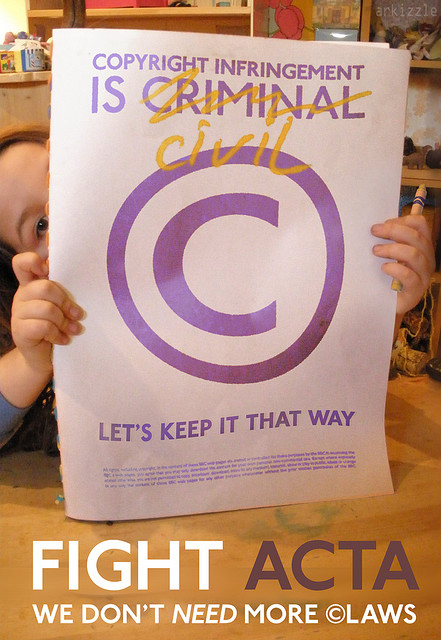
The copyright industry has long done a similar stunt, talking about “counterfeiting and piracy”, trying to assert that teenagers who share music between them should be covered by the same legislation as people who manufacture fake and fatal medicine for profit. Pretty much all enforcement treaties of the copyright monopoly are created under the pretext of preventing counterfeiting. Take ACTA, for example (“Anti-Counterfeiting Trade Agreement”). That’s another tangible example.
This is where we start tracing where the idea of banning child porn comes from. Cui bono?
It turns out that the pressure for banning possession of child pornography comes from a whole fruit salad of Christian fundamentalists, under the pretext of protecting children. In the United States, this is pretty much every nutjob in the entire Midwest. In Sweden, this role is primarily dominated by the front organization ECPAT, which pretends to care about abused children, but which has its roots in the fundamentalist Christian organization ECTWT (where the E stands for Ecumenical), and where these Christians keep being in majority at every general ECPAT assembly. Every time these fundamentalists have mentioned child abuse as a pretext to demand new laws, we end up with new criminalization of teenagers instead.
This is where we connect the dots of cui bono with the murder-and-jaywalking deception method, and hairs rise on our arms and chills go down our spine as we connect the dots mentally:
Making insecure teenagers feel guilt, fear, and shame over their own bodies and natural desires, causing them to suppress their instincts in fear, even criminalizing natural behavior and destroying their lives, was never a side effect. It was the whole idea.
In Sweden, ECPAT has pushed through laws that make you a jailable criminal for possessing images of yourself from before your 18th birthday. Can we have a show of hands to see how many think this makes any kind of sense? That this would catch any child molesters?
So does the fact that this law exists – criminalizing people who have photos of themselves, pushed through by Christian fundamentalist organization ECPAT – rhyme better with a concern to catch molesters, or better with the hair-rising conclusion above: an effort to scare teenagers into submission with fear of their own bodies?
Using child molestation as a pretext for shoving your fundamentalist religious morals down the throats of insecure teenagers is about as low as you can sink in my eyes. These people stand lower than earthworms in terms of human value to me.
The fix for this particular problem is to tell the fundamentalist Christians in ECPAT and similar organizations to fuck right off with their perverted high-horse dogmatic morals, throwing them out of the legislative process headfirst, and limit the child pornography laws to cover pre-pubescent children only. Murder and jaywalking should not be covered by the same legislation, because they are not the same thing. Rape of a seven-year old and two seventeen-year-olds making love should not be covered by the same legislation, because they are not the same thing. In case a hard age limit is needed, I would suggest separating children from teenagers at that exact age – children are children until they become teenagers. Many enough have their sexual debut at 13 today. (This suggestion doesn’t mean porn of 13-year-olds could, or indeed should, be sold. Commercial exploitation can always be separately regulated. What it does mean is that teenagers cannot and should not be branded as sex offenders for something they do voluntarily, happily, and consensually.)
If these despicable Christian fundamentalists – including ECPAT – really cared about children, they would welcome such a change, for all the reasons described above. But if you proposed it to them, you would see them fighting it tooth and nail. Cui bono?
(I predict some people will have problems with a 13-year age limit. The countries that already have this limit, e.g. Spain, display no problems at all. In contrast, those with an 18-year age limit have piles and piles of stories of destroyed teenage lives – victims of law, not victims of crime. I like evidence-based policymaking and much prefer it to moral-based policymaking, and a 13-year limit is evidenced to work well.)
3. The free speech war is won/lost at the battle of child porn.
When possession of this type of information was banned, only the net generation saw this as bringing back the book burning times. To the rest of the population, it was about “things on a computer”; the net generation doesn’t see a difference whether a book is on a computer or sitting in a bookshelf.
If regular people had had these laws re-worded into police being able to come into their homes, ransack their bookshelves, and if they found a banned book, they would burn it and arrest the owner – if regular people had understood that this is what the law says, they would be horrified. But those who don’t live online don’t make the connection.
As long as the ban on child porn remains, special interests will use this open wound in our enlightenment traditions of information freedom to infest it with their own ideas of what other information, speech, and communication should be banned and prohibited. We’ve seen everything from gambling companies to the copyright industry use child porn as a pretext for censoring business competition, consequences to society at large be damned, just like in the “rape-and-shoplifting” example above.
(There is a reason the copyright industry loves child pornography. This reason. It opens the door to censorship.)
European Commissioner Cecilia “Censilia” Malmström successfully pushed for an EU-wide censorship regime on the pretext of child pornography. Others have not been late in its wake to attempt exploiting and expanding the censorship regime to suit their own purposes.
Politicians have even gone as far as saying that child pornography is “not a legitimate expression”, and therefore not covered by constitutional freedom-of-expression, even if there isn’t an explicit exception in law. This is a legislative hair’s breadth from saying that your political opinion “isn’t a legitimate opinion”, and therefore not constitutionally protected speech.
Child pornography is horrible and awful from every angle and in every aspect. But it is not dangerous to the fabric of society. Censorship and electronic book burning, however, is.
The overall freedom of speech is won or lost with restoring freedom of information and, as a result, re-legalizing possession of child pornography. Yes, it’s awful – but so is the video of a teenager being stabbed in the eyes with a screwdriver; that’s no reason to create a censorship regime. Today, we have an open wound in our constitutionally protected right to speak freely that is being infested again and again.
We must heal that wound, exactly like the constitutional scholars warned when the child porn ban was first enacted. And that requires you, and every other information freedom activist, to let go of the stigma associated with this toxic subject and stand up for the enlightenment traditions.
Just daring to talk back will take many people completely by surprise. They won’t understand what’s going on and won’t have a script to follow. You won’t have to defend against “defending pedophiles” – you can refer to many others that take the same stance, like the Swedish Association of Journalists, who demand the ban on child porn to be repealed (the linked article is a statement from their chairperson). The entire journalistic profession doesn’t demand this from a desire to harm children – there is obviously something else that causes the entire reporters’ association to be sternly against, and demand a repeal of, the ban on possession on child pornography. That “something else” is a care for the open and transparent society.
This is where the battle stands, and this is where the war is lost or won.
“The Swedish Association of Journalists has taken a clear stand against the child pornography legislation, which prohibits possession of works classified as child pornography.” — quote from the linked article
If we lose the battle over freedom of information, we will lose it over the ban on possession of child pornography and infestations spreading from there until the open society has been killed. If we win it, we will win it over repealing the ban of possession of child pornography [as well as any other kind of information] and healing this wound. This is where the battle stands, this is where the war for freedom of speech and the open society is won or lost. This is the wound we must heal.
UPDATE: Lars Hallberg wrote a comment on G+ to this article that makes for a very good summary, so I take the liberty of copying it in as a conclusion and a TL;DR:
It’s not illegal to film a murder.
It’s not illegal to possess a film of a murder.
But it’s still illegal to murder people.
And it’s illegal to initiate a murder for the purpose of filming it.
If you have taken part in a murder and have film of it, the film may be usable as proof against you.
I can’t see that Rick suggests anything different here – i.e., I see no suggestions that it should be OK to molest children for the purpose of filming it. That’s good.
In the end it’s as simple as this: it should never be illegal to merely possess information, any information.
20120908
Twitter jokes: free speech on trial
The Twitter Joke Trial: how it happened, what it means, and the struggle to balance civility and civil liberties
On 27 July, the Lord Chief Justice of England and Wales handed down the final judgment in what had become known as the Twitter Joke Trial. Considering that this was the culmination of a two-and-a-half-year process, the assembled crowd didn’t get much of a show. It took only a few minutes for Paul Chambers to be told that he should never have been convicted of the charges that had been brought against him in Doncaster magistrates’ court, and was now acquitted. It was his third attempt to appeal the conviction.
So why was a trainee accountant of entirely blameless character arrested in front of his colleagues, questioned by police, charged by the Crown Prosecution Service, convicted, fined £1,000, fired from his job, and left dependent on the goodwill of celebrities, the donations of internet users and the tenacity of a legal blogger to put his life back together – all over one flippant tweet?
Sadly, the Director of Public Prosecutions has so far offered no good explanation. But at least, now that this bizarre case has finally been thrown out, we can be sure that nobody else will fall into the same black hole.
Or can we? Section 127 of the Communications Act 2003, under which Paul was charged, remains on the statute books and seems increasingly to be used as a catch-all for online behaviour that isn’t caught by more specific laws. And it’s not the only legislation being used against people who do no more than write words on a screen.
In some instances these laws may provide a necessary way to punish and deter the kind of verbal abuse that can make people’s online lives a misery, whether via Twitter, Facebook or other services. In others, it looks like a worryingly broad licence for the authorities to interfere with everyday speech, which increasingly takes place in the digital realm. And while the Lord Chief Justice’s remarks in the Twitter Joke Trial judgment provide a useful steer to police and prosecutors on when a communication can and can’t be considered ‘menacing’, more than enough ambiguities remain to blur the line that separates ordinary people from the nightmare of arrest, conviction, and even a potential jail sentence.
On 6 January 2010, Paul was looking forward to a planned meeting with a woman he’d begun talking to on Twitter. Since she lived in Northern Ireland, and he in Yorkshire, he’d booked a flight from Robin Hood Airport Doncaster Sheffield, as the local transport hub is cumbersomely known, on the 15th. But he’d just learned from the internet that snow had forced the airport to close. During a series of tweets exchanging pleasantries with his date, who went (and still goes) by the handle @crazycolours, Paul tweeted:
"Crap! Robin Hood airport is closed. You’ve got a week and a bit to get your shit together otherwise I’m blowing the airport sky high!!"Besides @crazycolours, this would have been seen by some of Paul’s 600-odd followers. Knowing Paul as they did, none of them thought it a particularly unusual tweet, and – like most things on Twitter – it quickly scrolled up the timeline and was forgotten.
A week later, police arrived at Paul’s place of work and asked for him by name. "My first thought was that perhaps a member of my family had been in an accident," Paul later told the Independent. "Then they said I was being arrested under the Terrorism Act and produced a piece of paper. It was a print-out of my Twitter page. That was when it dawned on me."
The officers involved would later say that they never took the tweet particularly seriously. But this seemed far from clear as they drove Paul to the police station and questioned him for two hours. After spending another hour in a cell, he was released while South Yorkshire police and the CPS decided how to proceed. His iPhone, which had been used to send the tweet, and two computers were impounded, despite the absence of any obvious reason why they would need to be examined.
The first decision that was made was that Paul couldn’t be charged with making a bomb hoax, a specific offence contained in section 51 of the Criminal Law Act 1977. To obtain a conviction under this legislation, the CPS would have had to show beyond reasonable doubt that the defendant intended to induce in another person a false belief that a bomb or other thing liable to explode or ignite was present. Clearly, Paul’s tweet had no such intention. If he’d intended to make staff at Robin Hood Airport think something was going to explode, he could have rung them up and told them so. What he actually did was post a tweet for the amusement of his own friends and acquaintances.
It was only by a remote chance that the tweet ever came to the attention of the airport. A manager at Robin Hood was searching Twitter five days later, while off duty, because he’d heard the airport had a Twitter account and wanted to see what it was like. When Paul’s tweet came up in his search results, he wasn’t sure what to make of it. (Here, again, was someone unfamilar with Twitter.) He reported it to his superior, who rated it "non credible" as a threat – "not least," as the Lord Chief Justice pointed out drily in his eventual appeal judgment, "because it featured the appellant’s name and the appellant was due to fly from the airport in the near future". Accordingly, rather than notifying the Ministry of Defence, this person passed the tweet to the airport police.
They in turn waited two days before passing on the investigation to their colleagues at Doncaster police station, who arrested Paul and proceeded to question him. "I had to explain Twitter to them because they'd never heard of it," he later told journalists. But if things weren’t quite clear to the detectives at the start, they certainly were by the time they wrote up the case file. It states: "There is no evidence at this stage that this is anything other than a foolish comment posted on Twitter as a joke for only his close friends to see."
This accurate appraisal could very easily have led to the correct view being formed: that no offence had been committed. Yet rather than letting the matter drop, South Yorkshire police now began to show worrying signs of digging in for a fight. Responding to media enquiries about the arrest, they issued a statement referring to "alleged threats about Robin Hood airport discovered on a social networking website" and adding: "The Force take such misuse of these sites seriously and will take robust action to deal with those who choose to use them in such a way as to cause unnecessary alarm and distress to members of the public."
This was an extraordinary way to characterise Paul’s case. No-one had alleged that the tweet was a threat. There was no evidence or suggestion that any member of the public had been alarmed or distressed. And the force seemed poorly qualified to pontificate about "misuse" of a social network, demonstrating little knowledge or experience of how social networks were used at all.
Heavy-handed treatment
With Paul Chambers out on bail and "huge public and media interest" (as a further statement put it) no doubt causing jitters higher up the pecking order, South Yorkshire police turned to the CPS for a "decision on disposal". Rejecting the option of issuing Paul with a caution, the CPS opted to charge him, but at this point were strangely coy about exactly what that charge would be.
I had to explain Twitter to them because they'd never heard of it
The offence they’d come up with was not one that was well known at the time. Section 127 of the Communications Act 2003 has roots going back to the Post Office (Amendment) Act 1935. The legislation has evolved every few decades to keep up with developments in technology – but not fast enough for the 2003 Act to have anticipated Twitter, which launched in 2006. Yet s127.1 seemed to provide what was needed to prosecute Paul Chambers, which the CPS had decided it should do in the public interest:
"A person is guilty of an offence if he sends by means of a public electronic communications network a message or other matter that is grossly offensive or of an indecent, obscene or menacing character."
This remarkably broad provision, created when the telephone was the predominant communications network, risked making itself ridiculous when applied to the panoply of online services available in 2010. Offensive, indecent and obscene matter of one sort or another flows across the internet daily in quantities unfathomable to the average JP, and without the filter of aggravating factors, any attempt to halt it, message by message, would surely embarrass a Canute.
This appears not to have occurred to the CPS, perhaps, again, due to a general unfamiliarity with the realities of the internet age. Their contention was that Paul’s tweet was "menacing".
At around this time the case came to the attention of David Allen Green, head of media at the London law firm of Preiskel & Co and a well-regarded blogger under the pen name "Jack of Kent". Green, whose familiarity with social media was rather more advanced, raised the issue with the CPS of the apparently over-broad scope of section 127 as they proposed to apply it.
"Bloggers and twitterers [sic] should be aware," responded the CPS, "that there are several Acts which cover potential communications offences. It is not funny to make jokes of this nature as it can cause serious disruption to transport services and divert police attention away from genuine crimes."
But this fell short of showing that parliament had intended to criminalise such jokes, however unfunny. And there had been no disruption to transport services as a result of Paul’s tweet. Even if there had been, the CPS had already acknowledged that Paul couldn’t have foreseen that, because "there was no evidence that he intended to induce in the recipient a false belief there really was a bomb" – and that was why the CPS itself had taken the decision that he couldn’t be prosecuted under the Criminal Law Act. If nobody thought the airport was going to explode, what would cause disruption?
Pleading guilty
Unfortunately, Paul Chambers and his solicitor had been led by the CPS to believe that the offence he was charged with was one of "strict liability", meaning that the mere fact of his having sent the "message", which he didn’t dispute, would be sufficient to obtain a conviction. This appears to have been the CPS’s honest, but completely erroneous, interpretation of the law at the time.
As a result, Paul made the only choice that seemed open to him, and entered a plea of guilty to attract a reduced sentence. Offences under section 127 carry a maximum term of six months in prison.
At this point, however, Paul’s attention was drawn to an article by David Allen Green in The Lawyer raising doubts about the CPS’s approach to the case and whether the offence could properly be treated as one of strict liability. Paul instructed new solicitors and applied to vacate his plea.
With a criminal record, he stood little chance of getting another job
In May, the case was re-heard in the magistrates’ court. To the surprise of almost everyone involved, the district judge, Jonathan Bennett, found Paul guilty. While accepting that the tweet was one of a number that employed "hyperbole" and "ridiculous suggestions", he noted that "we live in a society where there are huge security concerns particularly in relation to airports and air travel", and accordingly decided he could have "no doubt that the remark posted by the defendant is menacing".
This dealt with actus reus: whether Paul had done what the prosecution alleged (sent a menacing communication). More promisingly, however, Judge Bennett agreed with the defence that, by reference to the remarks of Lord Bingham in the case of DPP vs Colllins (2006), which in turn referred to Sweet v Parsley (1970), it must be presumed that Parliament intended that mens rea, the state of mind or intention of the defendant, was also to be proved.
Astonishingly, however, Judge Bennett proceeded to find, on the basis of what seemed rather vague reasoning, that he could not take Paul’s insistence that he had no intention of menacing anyone "at face value". Since he had experience of air travel and of Twitter, Paul must have been "aware that this was of a menacing nature". He was fined £385 and ordered to pay £600 costs and a standard £15 victim surcharge.
The effect of the conviction was disastrous. Having been suspended from his job as a financial supervisor on his arrest, Paul’s employment was now terminated; criminal convictions aren’t welcomed in accountancy. With a criminal record, he stood little chance of getting another job. At 27, having done (as the Lord Chief Justice would later rule) nothing wrong, he was out of pocket, unemployed, and understandably bitter.
On the plus side, he had eventually managed to visit @crazycolours, and things had gone rather well.
As a media lawyer with some experience of the application of law such as the Communications Act, David Allen Green was not impressed by Judge Bennett’s ruling. On his Jack of Kent blog, he wrote: "Regular readers of this blog will know I rarely criticise judges. However, I believe [this] judgment is not only illiberal and incorrect. I believe it is a disgrace."
At this point Green had an opportunity to do more than just blog about the case. Having discussed it with him on many occasions, not least via Twitter, Paul Chambers now made the decision to invite Green formally to coordinate an appeal, retaining Richard Haigh, the solicitor who had mounted the original defence, and, through Green, instructing Stephen Ferguson, a prominent defence barrister.
The appeal had three prongs: that, in respect of actus reus, the tweet was not menacing, because in itself it was clearly a joke and in its effect it had menaced no-one; that, in respect of mens rea (which the CPS now conceded it needed to address to obtain a s127 conviction), Paul had had no intent to send a menacing message, and had neither done anything suggestive of that, such as directing the tweet to the airport, nor demonstrated any prior awareness that anyone might find his words menacing; and that the tweet was not in any case a "message sent over a public telecommunications network" in the accepted sense.
The appeal was denied.
Fighting fund
"We are satisfied, on the evidence," said circuit judge Jacqueline Davies, "that the message is menacing in its content and obviously so. It is difficult to imagine anything more clear." As for mens rea, "we find it impossible to accept that anyone living in this country, in the current climate of terrorist threats, particularly at airports, would not be aware of the consequences of his actions in making such a statement."
The choice for Paul now was whether to give up and cut his losses or press on to the next avenue of appeal. The problem with the latter course was that preparing a case for the high court would be a much bigger undertaking, requiring more legal work than could be scraped up pro bono and requiring substantial financial backing.
A campaign began to repeat Paul’s original tweet as many times as possible
When Paul decided he would, if possible, keep going, the Twitterati who’d been following the case sprang into action. No sooner had the initial appeal been lost than a campaign began to repeat Paul’s original tweet as many times as possible, demonstrating the foolishness of prosecuting one instance. Under the #iamspartacus hashtag coined by musician @christt, thousands of users obliged.
But more concrete assistance was going to be needed in the form of hard cash. Supporter @cripesonfriday volunteered to manage a fighting fund, and by April 2011 comedians including Stephen Fry, Al Murray, Jack Whitehall, Graham Linehan, David Schneider, Susan Calman and Katy Brand had signed up for a benefit gig. This and individual donations created a sufficient "Twitter Joke Trial Fund" to cover Paul’s costs.
With Green now the sole solicitor, and Matrix Chambers human rights silk Ben Emmerson QC leading, the appeal was finally heard by two senior judges in February 2012. Taking a broader view and engaging in some debate, Emmerson, Sir Peter Gross and Mr Justice Irwin considered the balance between actus reus and mens rea.
In essence, the defence’s position was that if Paul hadn’t intended to send a menacing message, and hadn’t anticipated such an effect, then it would be wrong to punish him for it. "Does the history of human conduct ever have it that anyone planning to blow up an airport has gone on a public networking site and said they were going to do it?" he asked.
But the judges, and Irwin in particular, seemed more inclined to give weight to whether the message was objectively menacing. Although "one does not want to have a situation where things that clearly are jokes are prosecuted as criminal offences," said Irwin, a message that "might be serious" could "cause a great deal of grief".
Emmerson also raised the issue of freedom of speech, which is guaranteed by Article 10 of the European Convention on Human Rights. English law must be applied in a way that’s compatible with this. Either the court must reject the whole case as a disproportionate interference with free speech, argued Emmerson, or it must apply a high threshold to concepts like "menace" so as not to criminalise swathes of speech acts. The issue of proportionality seemed to catch the interest of the judges.
When the panel retired to produce a written verdict, the end seemed to be in sight – one way or another. But on 28 May the two judges announced that they couldn’t agree on a verdict. With no casting vote, the appeal would have to be re-heard. Such deadlocks are extremely rare.
While this was a disappointment, it soon became clear that it could be a breakthrough when a new panel of three judges was chosen and included the Lord Chief Justice, Lord Judge. Paul’s defence team, now consisting of David Allen Green, junior barrister Sarah Przybylska and John Cooper QC, went back to the drawing board to come up with new angles on the Communications Act offence, even attacking the definition of "menace" by reference to other areas of law, including blackmail. All avenues were explored.
The final hearing began on 22 June, and on the last day Paul was accompanied to the Royal Courts of Justice by Stephen Fry, Al Murray and other supporters. Once again, judgment was reserved, and there was an anxious wait until word came down that a verdict would be delivered on 27 July. When it came, it was brief and simple, setting aside the more abstruse arguments and getting back to the fundamental issue: had Paul done anything criminal by sending a facetious tweet?
No, the judges concluded, he had not. If the defendant intended the message as a joke, "even a poor joke in bad taste", it would be "unlikely" that the mens rea required for conviction could be established. But that was by the by in this case, because the appeal would be allowed on the issue of actus reus. The Crown Court had concluded as a matter of fact (something the previous panel was reluctant to interfere with) that the tweet was objectively menacing. But given the tone and context of the tweet, the unhurried reaction of the police, and Paul’s consistent assertion that it was just a joke, this decision "was not open to" the court, wrote the Lord Chief Justice – as near as one judge gets to saying another simply got it wrong.
Avoiding a repeat
What can we learn from the Twitter Joke Trial? First of all, like it or not, Twitter and other such services, including Facebook, are indeed "public electronic communications networks" for the purposes of the Communications Act 2003, and we all need to watch out for section 127. "Not just for menace," points out David Allen Green – "section 127 also covers grossly offensive, indecent and obscene matter, and s127.2 goes to causing alarm or distress. This case clarifies that emails and messages to platforms on the internet are “messages sent over a public communications network”. There was no previous case law on that; nobody had quite tested what was covered."
On the other hand, the judgment "sends a signal to the CPS and police that they can’t just use this offence as a sort of digital equivalent of the Public Order Act," says Green. "Sections 4, 4a and 5 more or less give power to arrest at will – it’s a grossly offensive piece of legislation. The High Court actually saying menace means you’ve got to put somebody in fear means [the application of the Communications Act s127] is quite limited."
What’s also been highlighted, all too obviously, is that "there’s a division between people who get social media and those who don’t. I remember trying to explain it at Doncaster Crown Court – it was like banging your head against a wall. Paul Chambers’ very quiet and dignified stance meant he kept the case going for two-and-a-half years until the judiciary got it."
Green is magnanimous about the failings of the system along the way, reserving his ire for the Director of Public Prosecutions, who intervened personally at one stage to prevent the case against Paul Chambers being dropped. "Most police officers and courts don’t knowingly do wrong. You just have different world views. What we had to do in this case was recalibrate it.
"English judges are prone to say context is everything, but we had to show the court it was not about the context of terrorism and security but being able to talk in a conversational way."
Now settled into a new home with @crazycolours, and back in employment, Paul Chambers is an unlikely but important symbol of our re-established right to speak freely online. As defence barrister Sarah Przybylska put it on the steps of the high court: "Twitter users can be confident now that if they’re sending a joke to their mates, whether it’s a good joke or a bad joke, they’re pretty safe – and if they’re not, me and John Cooper and David will defend them!"
The Algorithmic Copyright Cops: Streaming Video’s Robotic Overlords
By Geeta Dayal
As live streaming video surges in popularity, so are copyright “bots” — automated systems that match content against a database of reference files of copyrighted material. These systems can block streaming video in real time, while it is still being broadcast, leading to potentially worrying implications for freedom of speech.
On Tuesday, some visitors trying to get to the livestream of Michelle Obama’s widely lauded speech at the Democratic National Convention were met with a bizarre notice on YouTube, which said that the speech had been blocked on copyright grounds.
On Sunday, a livestream of the Hugo Awards — the sci-fi and fantasy version of the Oscars — was blocked on Ustream, moments before Neil Gaiman’s highly anticipated acceptance speech. Apparently, Ustream’s service detected that the awards were showing copyrighted film clips, and had no way to know that the awards ceremony had gotten permission to use them.
“I thought it was a huge pity, and ridiculous,” said Gaiman in an e-mail exchange with Wired. “But I also think it highlights a potential problem that’s just getting bigger.”
Last month, footage from NASA’s triumphant Curiosity rover landing was blocked numerous times on YouTube, despite being in the public domain, because several companies — such as Scripps Local News — claimed copyright on the material.
Those incidents foretell an odd future for streaming video, as bandwidth and recording tools get cheaper, and the demand for instant video grows. Just in the last year, Google Hangouts, a feature of Google+ that allows multiple people to video conference, became a cult hit. Now it’s used by news sites, such as the Huffington Post, for live video interview segments. Ustream and Justin.tv have made it simple to livestream book readings, Meetups and the police siege of Julian Assange’s embassy sleepover.
Copyright bots are being wired into that infrastructure, programmed as stern and unyielding censors with one hand ever poised at the off switch. What happens if the bot detects snippets of a copyrighted song or movie clip in the background? Say a ringtone from a phone not shut off at a PTA meeting? Or a short YouTube clip shown by a convention speaker to illustrate a funny point? Will the future of livestreaming be so fragile as to be unusable?
A swarm of tech companies are rushing in to provide technical solutions to enforce copyright in online sharing communities and video-streaming sites. Those players include Vobile, Attributor, Audible Magic, and Gracenote. And they’re thriving, despite the fact that U.S. copyright law, as modified by the 1998 Digital Millennium Copyright Act, doesn’t require sites that host user-created content to preemptively patrol for copyright violations.
“The companies that are selling these automated takedown systems are really going above and beyond the requirements set for them in the DMCA, and as a result are favoring the interests of a handful of legacy media operators over the free-speech interest of the public,” says Parker Higgins, an activist at the Electronic Frontier Foundation.
The notice-and-takedown regime created by the DMCA allows copyright holders to send a written notice to an online hosting service when they find their copyright being violated. The online service can then escape legal liability by taking down the content fairly promptly, and the original poster has the opportunity to dispute the notice and have the content reinstated after two weeks.
But that regime breaks down for livestreaming. For one, if a valid copyright dispute notice is filed by a human, it’s unlikely that a livestream site would take it down before the event ends, nor, under the law, is it actually required to. On the flipside, if a stream is taken down, the user who posted it has no immediate recourse, and the viewership disappears.
Brad Hunstable, Ustream’s CEO, says the volume of content is overwhelming and content-blocking algorithms are key to keeping copyright holders happy. “To give you a sense, more video is uploaded on Ustream per second than even YouTube, per minute, per day,” Hunstable said in a phone interview with Wired.
Owners Lose Possessions After Home Near Twentynine Palms Is Mistakenly Foreclosed
TWENTYNINE PALMS (CBSLA.com) — The owners of a modest home near Twentynine Palms lost their cherished possessions after a bank mistakenly foreclosed their residence.
A crew broke into Alvin and Pat Tjosaas’ desert home and took everything after being directed by Wells Fargo to secure the structure.
The couple, however, didn’t have a mortgage on the home.
Alvin said the deputy sheriff said, “Good news, we know who took (your possessions)…Wells Fargo. Bad news, your stuff is all gone.”
All the married couple has now are three generations of memories.
Alvin, a retired mason, built the home with his father when he was a teenager.
“I know every inch, every rock…my mom mixed all the cement by hand,” he said.
Alvin and his wife would later bring their six children to their desert oasis.
“My little kids (would) come out here and their dresses were the same color as the wildflowers,” said Alvin.
A spokesman for Wells Fargo released a statement apologizing to the couple.
“We are deeply sorry for the very personal losses the Tjosaas family suffered as a result of their home being mistakenly secured,” said Alfredo Padilla. “We are moving quickly to reach out to the family to resolve this unfortunate situation in an attempt to right this wrong.”
Alvin and Pat remain distraught.
“When you put your heart into something…it makes me real sad. I’m just glad I have my sweetheart. We’ve been together a long time,” said Alvin.
FBI launches $1 billion nationwide facial recognition system
By Sebastian Anthony
The US Federal Bureau of Investigation has begun rolling out its new $1 billion biometric Next Generation Identification (NGI) system. In essence, NGI is a nationwide database of mugshots, iris scans, DNA records, voice samples, and other biometrics, that will help the FBI identify and catch criminals — but it is how this biometric data is captured, through a nationwide network of cameras and photo databases, that is raising the eyebrows of privacy advocates.
Until now, the FBI relied on IAFIS, a national fingerprint database that has long been due an overhaul. Over the last few months, the FBI has been pilot testing a facial recognition system — and soon, detectives will also be able to search the system for other biometrics such as DNA records and iris scans. In theory, this should result in much faster positive identifications of criminals and fewer unsolved cases.
According to New Scientist, facial recognition systems have reached the point where they can match a single face from a pool of 1.6 million mugshots/passport photos with 92% accuracy, in under 1.2 seconds [PDF]. In the case of automated, biometric border controls where your face and corresponding mugshot are well lit, the accuracy approaches 100%. Likewise, where DNA or iris records exist, it’s a very expedient way of accurately identifying suspects.
So far, so good — catching criminals faster and making less false arrests must be a good thing, right? Well, yes, but there are some important caveats that we must bear in mind. For a start, the pilot study has only used mugshots and driving license photos of known criminals — but the FBI hasn’t guaranteed that this will always be the case. There may come a time when the NGI is filled with as many photos as possible, from as many sources as possible, of as many people as possible — criminal or otherwise. This might be as overt as parsing CCTV footage and collating every single face into a database; or maybe you’re just unlucky and your face ends up in the system because you’re in the background of a photo starring a known criminal.
Imagine if the NGI had full access to every driving license and passport photo in the country — and DNA records kept by doctors, and iris scans kept by businesses. The FBI’s NGI, if the right checks and balances aren’t in place, could very easily become a tool that decimates civilian privacy and freedom. Time to invest in a hoodie, I think…
How to build a better speed limit
By Maggie Koerth-Baker at 10:06 am Friday, Sep 7
Sometime in November, Texas will open a stretch of toll road south of Austin where the speed limit will be 85 miles per hour.It will be the highest speed limit in America. (Montana used to have no speed limit at all during the day, but that changed in 1999.)
Naturally, one of the big arguments against this is that higher speeds lead to more accidents. And there is some data to back this up. For instance, the Insurance Institute for Highway Safety makes a pretty good case for lower speed limits in a Q&A posted on their site:
In 2010, a total of 10,395 deaths, or nearly a third of all motor vehicle fatalities, occurred in speed-related crashes. Based on a nationally representative sample of police-reported crashes, speeding – defined as exceeding the speed limit, driving too fast for conditions or racing – was involved in 16 percent of property-damage-only crashes and 20 percent of crashes with injuries or fatalities. The National Highway Traffic Safety Administration (NHTSA) estimates that the economic cost of speed-related crashes is more than $40 billion each year.There is definitely a relationship between speed and safety. It's there consistently in individual studies and you see it when you start looking at lots of studies all at once, too. But the meta-analyses—research that compares and analyzes the results of many studies—also show that the speed/safety connection is probably more complicated than it first appears. Speed limits matter. But maybe we need more options to pick from than a simple, static "faster" or "slower".
...The National Research Council attributed 4,000 fewer fatalities to the decreased speeds in 1974 compared with 1973...
A 2009 study examining the long-term effects of the 1995 repeal of the national speed limit found a 3 percent increase in road fatalities attributable to higher speed limits on all road types, with the highest increase of 9 percent on rural interstates. The authors estimated that 12,545 deaths were attributed to increases in speed limits across the U.S. between 1995 and 2005.
People and the environment both have a big impact on the relationship between speed and safety. There are a couple of meta-analyses available to read for free online. Check them out, and you'll see how psychology and road conditions play a big role.
For instance, a 1998 publication from the Federal Highway Administration found that the type of road matters. If you raise the speed limit on a road where people are already driving slowly, it won't affect safety at all.
In general, changing speed limits on low and moderate speed roads appears to have little or no effect on speed and thus little or no effect on crashes. This suggests that drivers travel at speeds they feel are reasonable and safe for the road and traffic regardless of the posted limit. However, on freeways and other high–speed roads, speed limit increases generally lead to higher speeds and crashes.Here's another weird fact that turns up in both the 1998 report and a paper published by the Transportation Research Board in 2001: You're actually safest when you're traveling with the speed of the traffic around you. Speed-related accidents tend to happen when people are traveling faster or slower than the other cars on the road.
In fact, the 1998 report says that most speed-related accidents happen because an individual is driving too fast for the conditions of the road—that's the current weather, the width of the specific road, and how fast other people are driving.
The conclusion that both reports come to: We don't necessarily need lower speed limits. What we need are speed limits that adjust to the current conditions and the specific needs of a specific road. A variable speed limit would reflect the reality that a lot of drivers already see and respond to, and it might be more easily accepted by the drivers who ignore one-size-fits-all speed limits today. Plus, the variable speed limit would allow the law to match up with what's actually safe. If traffic is flowing at an average of 60 mph, it doesn't make sense to have 70 mph posted—somebody is going to try to keep up with the speed limit and create an unsafe condition.
It's an interesting idea. So far, there's not a lot of good data available to show whether or not it actually reduces accidents and fatalities. Variable speed limits have been tested out around the world, but they remain rare and, in North America, are mostly relegated to stretches of rural highway in places with a history of extreme weather—for instance, a road in Tennessee that gets a lot of heavy fog.
But the basic story is that we need more data. To know whether or not variable speed limits actually make sense, we need them to be implemented in more places with more traffic.
20120907
TSA Agents Demand Passengers Surrender Their Drinks for Screening
Jason Mick
Travelers, brace yourselves for the latest indignity
Thinking about flying? Well, in addition to "enhanced" searches and the risk that your privates may be photographed and stored by Transportation Safety Administration screeners, travelers now have one more woe to add to their litany of complaints.
According to the Daily Mail TSA agents at the Columbus, Ohio Airport have been subjecting travelers to random seizures/inspections of their drinks at the gate to "check for explosives".
Of course, these drinks all were presumably were sold by the airport vendors, as any drink-size liquid containers are supposed to be seized by the bag screeners at the security checkpoint -- a policy that has been in place since 2006. So at first blush it's somewhat unclear exactly why the TSA agents felt it necessary to screen passengers' Starbucks and soft drinks.
The incident has been leaked onto YouTube (of course):
Ryan Mauro, a national security analyst, told the Daily Mail, "They're worried someone could bring an ingredient past security and then mix it with a drink that turns into something else - a poison or something else."
In June, the U.S. reportedly thwarted an attempt to blow up an airliner by a Yemen-trained, Norwegian citizen who was a member of the militant fundamentalist Islamic group al Qaeda. Despite the potential terrorist's plot failing, national security officials are reportedly alarmed about the fact that his spotless record and lack of inclusion on no-fly lists could have allowed him to escape scrutiny, were it not for the tips.
In a statement the TSA confirmed it might now be seizing people's drinks as a precautionary measure, commenting, "TSA employs multiple layers of security throughout the airport where passengers may be randomly selected for additional screening. One measure may include testing liquids that are in a passenger's possession."
TSA agents "examine" the beverages using a special security screen, which appears to involve taking a small dropper or swab sample of the beverage, then testing it on a slide with some sort of reagent mix.
Some say that the policy goes too far, though. The person who captured the incident on video told the Daily Mail:
I couldn't help but notice the two TSA women that were 'testing' any and all liquids that people had in their hands. Now remember that this is inside the terminal, well beyond the security check and purchased inside the terminal ... just people waiting to get on the plane.
My wife and son came back from a coffee shop just around the corner, then we were approached. I asked them what they were doing. One of the TSA ladies said that they were checking for explosive chemicals (as we are drinking them). I said 'really..inside the terminal? You have got to be kidding me.'
I asked them if they wanted to swab us all. She responded with something like, yes sometimes we need to do that. I then asked if she wanted a urine sample.
The TSA is way out of control. I understand that my ranting to one of these $11.00 per hour TSA goons probably does nothing, but you have to say something. Whats next...perhaps the TSA will come to your home prior to your drive to the airport? The police state of the U.S. is OUT OF CONTROL!
Indeed, as the list of indignities grows at a pace proportional to the would-be terrorists' increasingly imaginative plots, one has to wonder where the line must be drawn.
If Apple makes robots, will robots have rights?
By Patrick Thibodeau
Let’s face the reality that robots will gain cognitive skills. This is not self-awareness. But it is an ability to interact in ways that prompt human emotional attachment.
People do get emotionally attached to things. We all know this. But we have little idea how people will ultimately respond to machines that can converse, learn and demonstrate an interest in your life.
Robotics has to be in Apple’s development thinking. It is a logical extension of the iPhone Siri capability six or a dozen generations from today.
Imagine that Apple will develop a walking, smiling and talking version of your iPhone. It has arms and legs. Its eye cameras recognize you. It will drive your car (and engage in Bullitt-like races with Google’s driverless car), do your grocery shopping, fix dinner and discuss the day’s news.
Apple will patent every little nuance the robot is capable of. We know this from its patent lawsuits. If the robot has eyebrows, Apple may file a patent claiming rights to “a robotic device that can raise an eyebrow as a method for expressing skepticism.”
But will Apple or a proxy group acting on behalf of the robot industry go further? Much further. Will it argue that these cognitive or social robots deserve rights of their own not unlike the protections extended to pets?
Should there be, minimally, anti-cruelty laws that protect robots from turning up on YouTube videos being beaten up? Imagine if it were your robot?
Kate Darling, a research specialist at the MIT Media Lab, looks at this broad issue in a recent paper, “Extending Legal Rights to Social Robots.” (Click on download link) She writes, in part:
Darling’s interesting and thoughtful paper also discusses the risks and controversies likely to emerge by giving legal rights to robots.The Kantian philosophical argument for preventing cruelty to animals is that our actions towards non-humans reflect our morality — if we treat animals in inhumane ways, we become inhumane persons. This logically extends to the treatment of robotic companions. Granting them protection may encourage us and our children to behave in a way that we generally regard as morally correct, or at least in a way that makes our cohabitation more agreeable or efficient.
If Apple or any company can make a robot that leaves the factory with rights the marketing potential, as Darling makes note of, may be significant. But then if corporations are people, why not give rights to their assembly line babies? This is all weird, fascinating, discomforting and academic still, but on its way.Some argue that the development and dissemination of such technology encourages a society that no longer differentiates between real and fake, thereby potentially undermining values we may want to preserve. Another cost could be the danger of commercial or other exploitation of our emotional bonds to social robots.
Service Agreements Kill Privacy, But Can They Create It Too?
With more people constantly connected to the Internet, technology companies are becoming massive repositories of sensitive and personal information. Our communications with family and friends now sit stored on servers belonging to Google or Facebook. Cell phone companies keep track of our location by recording every time we connect to a cell phone tower for up to two years. Unfortunately, the Fourth Amendment has not kept up with this technological reality. And a recent case decided by the Ninth Circuit Court of Appeals, United States v. Golden Valley Electric Association (PDF), highlights the increasing way constitutional rights are adjudicated when it comes to data stored by other companies: through the service agreement a user enters into with a company.
First, some background. The Supreme Court long ago ruled that users lose their expectation of privacy when they turn information over to third parties. The "third party doctrine" has been used by the government to justify warrantless acquisition of cell site tracking records, Twitter account information, and email. They've argued these records belong to the companies, so a user can't complain when the data is turned over to the government. Ultimately, this means that your constitutional rights are in the hands of the companies storing your data. Given the ever increasing demands of law enforcement, companies have little time or resources to fight for user privacy. That means companies have an enormous amount of power in determining your privacy rights. As we've documented in our "Who Has Your Back" campaign, many of the biggest and most popular tech companies have work to do in fighting for user privacy.
A 2010 case from the Sixth Circuit Court of Appeals highlights how a subscriber agreement that governs the relationship between a company and user can potentially become a black hole where the Fourth Amendment goes to die. In United States v. Warshak, the Sixth Circuit became the first federal appellate court to rule that people had a reasonable expectation of privacy in their emails notwithstanding the fact that email typically passes through a third party, the email service provider. That meant law enforcement needed a search warrant to obtain the contents of emails. But Warshak noted it was "unwilling to hold that a subscriber agreement will never be broad enough to snuff out a reasonable expectation of privacy." So although the email provider in the Warshak case didn't say anything about whether it would "audit, inspect, and monitor" emails, messages stored by a service provider that did say it would monitor email in a subscriber agreement wouldn't necessarily be protected by the Fourth Amendment. In short, the court said companies have the ability to strip you of your Fourth Amendment rights.
As troubling as that seems, the flip side is that presumably faced with silence -- like the Warshak service provider -- or even an affirmative statement by a service provider that it will protect your privacy, a reasonable expectation of privacy could still exist. Or stated differently, a service provider can also give you Fourth Amendment protection if it promises to safeguard your privacy.
The Ninth Circuit addresses this precise issue in Golden Valley. The case revolved around a small cooperative utility provider in Alaska, that received an administrative subpoena issued by the DEA seeking customer records it believed were relevant to a criminal investigation. These records included things like the subscriber's name, telephone number, method of payment (including credit card numbers or checking account information), and service initiation and termination dates.
The most important thing the government sought, however, was energy consumption records. By determining whether energy levels were elevated in specific houses, the agents believed they could pinpoint locations where marijuana was being grown. Addressing a very similar situation in 2001, the Supreme Court in Kyllo v. United States ruled that the police needed a search warrant to use a thermal imaging device to measure heat levels in a residence, since the devices could reveal intimate details about the interior of a home. To get around Kyllo, the government sought to get the records from Golden Valley directly instead of planting a police officer in front of the houses, ultimately avoiding the need to get a search warrant. That's because the records belonged to Golden Valley, and therefore, the government argued, customers had no expectation of privacy in them.
Golden Valley challenged the administrative subpoena, a rare act for a company to take, and raised the argument suggested by Warshak: that since it had a company policy of protecting user privacy, a search warrant was required to obtain this information. The Ninth Circuit, however, rejected Golden Valley's argument, finding that Golden Valley failed to show any explicit customer agreement promising to keep records confidential.
At first blush it may seem that Golden Valley highlights a lose-lose situation for users created by the third party doctrine: providers can take away your Fourth Amendment rights in their service agreements, but in the rare instance when they make an effort to preserve your rights by promising to protect your privacy, it doesn't matter anyway because the "records" (created with your data and activity) aren't yours.
But the Ninth Circuit really left a far more important privacy opening. It noted that in some circumstances, "a company’s guarantee to its customers that it will safeguard the privacy of their records might suffice to justify resisting an administrative subpoena." In the specific case before the court, Golden Valley's policy did not rise to a sufficient level of specificity. But going forward in the future, other companies storing sensitive, personal information need to take advantage of Golden Valley's suggestion that service agreements can be more than just a black hole. They should explicitly detail in their service agreements that they will keep user data confidential and that they will stand up for users' privacy by challenging government attempts to obtain data without a search warrant.
At the same time, courts need to heed the words of Justice Sotomayor's concurring opinion in United States v. Jones, where she wrote it was time to stop treating "secrecy as a prerequisite for privacy," and stop assuming "that all information voluntarily disclosed to some member of the public for a limited purpose is, for that reason alone, disentitled to Fourth Amendment protection." That way, the fact that our privacy rights are in the hands of companies means more than they're just gone forever.
Bruce Willis: one thing is true
The story that Bruce Willis was to sue Apple because he could not leave his MP3s in his will circulated round the UK press last weekend. His wife has since denied it.
However, one thing remains true. Your digital rights are pretty limited when it comes to leaving downloaded copyright material in your will.
This stands in contrast to physical goods, where you can of course resell or leave your books, DVDs and CDs in your will.
Only software downloads can legally be transferred or resold. A recent case in Europe made this clear when Oracle tried to stop UsedSoft from reselling their downloaded, licensed software. The court disagreed, and pointed to the EU Software Directive.
Many of the reports focused on terms and conditions of Apple’s store. On one level, this is true, copyright owners could agree to license their downloads like this. Perhaps this would be complicated, given the myriad levels of contracts and ownerships, but it is possible if consumer demand is there.
More fundamentally, a change in the law is needed. People will start noticing how unfair this is as they write their wills. As they learn that their digital assets, those they have bought, perhaps for thousands of pounds, are worthless on death, they will feel cheated.
Equally, there is little prospect that individuals who inherit hard drives are going to meticulously delete material which has been paid for. The law will turn people inheriting the physical assets into copyright infringers.
Europe missed a chance to resolve these problems in the Consumer Rights Directive in 2011, although some improvements to the digital market have been made.
But the problem isn’t going away. In many cases, where material is downloaded from a single account like iTunes, the excuses for denying transferability are extremely flimsy. Copyright needs to work for people who are investing in their collections, and the inheritability of your collection is a key missing right.
Someone needs to take on Apple and Amazon. And we don't need to wait for Hollywood stars to do it.
Minnesota ordered to change sex offender program
By: Donavon Lace
A federal judge has ordered Minnesota to reform its system for civilly committing and confining paroled sex offenders to indefinite treatment, a controversial practice that has drawn international criticism because almost no one has gotten out.
Chief U.S. Magistrate Judge Arthur Boylan on Wednesday ordered state Human Services Commissioner Lucinda Jesson to convene a task force of experts to recommend options less restrictive than the state’s prison-like treatment centers and to suggest changes in how offenders are selected for civil commitment, as well as how they might earn release from the program. The order came during pretrial discussions in a class-action lawsuit brought by patients who argued that their indefinite detention after completing their prison sentences is unconstitutional.
Critics of the Minnesota Sex Offender Program (MSOP) hailed Boylan’s order as an unprecedented and significant step toward changing a system that has been a magnet for controversy since its creation in 1994 with the construction in Moose Lake of a sprawling campus surrounded by razor wire.
The program was created to treat small numbers of the state’s worst sex criminals who had completed their prison sentences but were deemed too dangerous to release.
But the 2003 killing of college student Dru Sjodin by a rapist newly released from prison prompted a surge of commitments of all types of sex criminals, from rapists to nonviolent molesters. The state went from committing an average of 15 per year before 2003 to 50 per year after that pivotal year.
The program’s population has soared to more than 600 — the most sex-offender civil commitments per capita in the country. Only two have won provisional discharge. One of those, Ray Hubbard, was pulled back into a treatment lockup because a psychiatrist thought he might reoffend. He died shortly thereafter.
“It’s a rather extraordinary step,” William Mitchell College of Law President Eric Janus said of Boylan’s order.
“I would view this as an indication that the court looks at this as a substantive and important issue that as a matter of federal constitutional law needs to be addressed,” said Janus, author of “Failure to Protect — America’s Sexual Predator Laws and the Rise of the Preventive State.”
Former state Sen. Don Betzold, chief author of the 1994 Sexually Dangerous Persons Act that created the current civil commitment system and MSOP, said the courts have repeatedly upheld the law as constitutional because judges believed the confinement was for treatment and that the public has been reassured that a subset of dangerous sex offenders are not free to strike again.
However, even Betzold, a lawyer, said the lack of releases is a problem because it invites the conclusion that the program’s only purpose is confinement.
“The law has stood the test of time, but the questions raised are valid ones,” he said. “The burden will be on the Department of Human Services to show offenders can receive effective treatment.”
Facing a risk
The lead attorney for the patients, Dan Gustafson, called Boylan’s order “a significant step” toward making the MSOP more effective and fair.
“If you’re going to commit these folks, you have to give them legitimate treatment and the legitimate opportunity to get out,” said Gustafson, adding that unless the state reforms the system, it risks that the courts will declare the program unconstitutional and order releases, or mandate program improvements more expensive than the state can afford.
Some say it’s already too expensive, costing the state more than $300 per day for each offender, compared to less than $90 per day for offenders getting treatment in state prisons.
In a report last year, Legislative Auditor James Nobles said the state should provide better therapeutic treatment to the program’s more serious offenders while considering less expensive, more flexible alternatives for offenders not deemed a risk to the public — a view since embraced by Gov. Mark Dayton’s administration.
Anne Barry, who oversees the MSOP as deputy commissioner of the Department of Human Services, said Boylan’s order “echoes” several of Nobles’ recommendations and efforts by some state lawmakers who have begun researching less-restrictive alternatives to the MSOP.
“This order recognizes that improving the system … requires various perspectives as well as careful research and deliberation, not just a mandate from the court,” Barry said Thursday in a statement.
Concern about the system has been expressed in places far afield from Minnesota.
In June, a high court in England refused to extradite an accused pedophile back to Minnesota who might have wound up in the MSOP, saying indefinite detention violated international human rights protections.
‘Die is cast’
Boylan ordered that the state try to pack the task force with experts in the civil commitment system and the MSOP, including current or former legislators, prosecutors, judges, police, attorneys for patients, and state and local officials who deal with offenders.
The order “has the right categories of people identified,” Janus said. “The key will be whether the group can function in a way not duly affected by the volatile politics surrounding this issue.”
That won’t be easy, said state Rep. Tony Cornish, R-Good Thunder, who has studied the MSOP and civil commitment system as chair of the House committee on Public Safety and Crime Prevention Policy and Finance.
Cornish said that when he and other legislators examined issues with the program this year, they found “there was no appetite in the Legislature for letting anyone out. They’d rather spend millions of dollars keeping people locked up than take the chance of something bad happening.”
Now that a federal judge has ordered the state to look at other alternatives, policymakers may have to make decisions they find difficult to stomach, Cornish said, although the court mandate also may give them more of the political cover they need to make changes.
“The die has been cast,” Cornish said. “Now we have to find a blend that will satisfy the court but still protect the public.”
20120901
Despite Privacy Concerns, Mexico Continues Scanning Youth Irises for ID Cards
By Gabriela Manuli
For more than a year and a half, the Mexican government has been collecting an unprecedented amount of biometric data from minors ages 4 to 17 as part of a youth ID card program. The Personal Identity Card for minors, a document authorities say is intended to help streamline registration in schools and health facilities, comes embedded with digital records of iris images, fingerprints, a photograph, and a signature for each minor.
Documents obtained by EFF under Mexico’s Transparency and Access to Information Act show that as of this past May, nearly 4 million minors had been enrolled into registries associated with the new ID. Public records also revealed that more than 1.2 million ID cards had been issued in the states of Baja California, Baja California South, Colima, Chiapas, Distrito Federal, Guanajuato, Jalisco, Sinaloa, and Morelos. Of those who were issued cards, 1,345 had to go through the registration process again because the quality of their biometric data was inadequate for identification.
The ID card project is part of the integration of Mexico’s National Population Register (RENAPO), which is intended to provide a unique identity system to conclusively prove identities of all Mexican citizens. Under the program, the Ministry of the Interior will issue Citizen Identity Cards and Personal Identity Cards containing biometric information, first to youth, and later extending to Mexico’s entire adult population.
Since July of 2009, when President Felipe Calderón officially announced the creation of RENAPO, numerous observers have sounded the alarm that the endeavor violates individuals' privacy rights. Despite serious concerns raised by a governmental accountability agency and a special commission tasked with studying the program, in January of 2011 Mexico nevertheless became the first country in the world to use iris scans as a component of ID cards.
Mexico’s Secretary of Government (SEGOB) claims that the use of iris recognition, along with other biometric data, serves to combat crime such as human trafficking and to streamline registration and enrollment procedures in schools and health care programs. In official statements, SEGOB claims that "it is a free, official document containing biometrics that make it impossible to forge.” Although Mexican authorities argue that the new document will be 99 percent reliable and “one of the safest in the world,” security researchers have shown otherwise, recently demonstrating security flaws even in ostensibly trustworthy iris scanners.
In April of 2010, The Federal Institute for Access to Public Information (IFAI), an autonomous organization established by Mexico’s freedom of information law to promote a new regime of government transparency, issued a 91-page report outlining the problems associated with such biometric IDs, putting forward several alternative recommendations. The IFAI concluded that requiring just one fingerprint would yield a 99 percent reliability rate, and that the collection of any additional biometric data is wholly unnecessary. The report was also critical of the fact that there are currently no legal protections regulating the use of iris images in Mexico.
IFAI ultimately recommended that Mexico remove some of the biometric data on the new ID cards by gradually reducing the amount of data required. The report argued that capturing the image of both irises, plus ten fingertips, was not proportional to the stated objective of the program. IFAI further concluded that any biometric ID system should be subjected to periodic third-party verifications of the collection, storage, and use of biometric data. Aside from these concerns, IFAI cited huge costs of the project, a lack of transparency in the bidding process, and the risks the program poses to the right to privacy.
Another important voice of dissent also emerged in April 2010, when a special Commission of the Parliament was created to review the development of the ID card. One of the commission’s first measures, which was later ignored by the government, was to call for temporarily halting the implementation of the ID to encourage further research and to include the perspectives of more stakeholders in the process. Significantly, the commission noted that there were no “necessary measures related to data protection [or] transparency ... This means that until we have all the elements in place, it is terrible that the project continues.”
The Commission also seized upon the risk of duplication, as the original idea behind the program was to use this ID to gradually replace the current electoral card, which is presented for voting.
Vanessa Lara Carmona, a professor from the Autonomous University of Mexico (UAEM) who conducted research in tandem with the Latin American Network of Surveillance, Technology and Society Studies, concluded that the ID card for minors would not solve the problem of human trafficking in Mexico—one of its officially stated purposes. Carmona also noted that criticism of a lack of security around the data was the reason why the national ID was not being initially implemented for the entire population, as originally intended.
Despite this serious criticism, the project is still going forward. According to SEGOB, the government’s goal is to issue almost 4.5 million IDs by the end of the year, continuing the collection of massive amounts of biometric data. The next step of the project, expected to unfold in 2013, is to extend the ID cards to adults.
Meanwhile, researchers and government accountability agencies aren’t the only ones raising concerns about Mexico’s biometric ID card policy. A group from a Mexico-based hacker collective that runs public workshops promoting the use of free software for technological autonomy and activism also weighed in to express concerns about what the ID cards mean for Mexico.
“At Hacklab Autonomo, we think that all people should have the choice of whether or not to participate in a database that describes them,” the collective members wrote in a statement sent to EFF. “We are against the growing tendency in our society to monitor, and the way in which this monitoring classifies and discriminates against others and ourselves. We believe that access to technology should be free and we want people to exercise their technological autonomy. When you start the collection of biometric data with the kids and casual laborers, the Mexican government is taking advantage of the defenseless and people in precarious situations as they strive to achieve their goals. … The question is not only what will the Mexican government do with this information, but also, who will they sell it to this time?”

 Posts
Posts


