20120104

Library computers can block porn—but Wicca? ACLU says no

By Nate Anderson

I work on occasion from my local public library, a wonderful spot with huge glass windows overlooking an attached park. The views are nice, the quiet is terrific, and the free WiFi is indispensable. But the Internet connectivity comes with limits, in the form of a content filter that periodically prevents me from accessing research materials. Infuriating, yes. But illegal?

The American Civil Liberties Union (ACLU) has just filed a complaint (PDF) on behalf of a Salem, Missouri resident named Anaka Hunter, who contends that the Salem public library is unconstitutionally blocking her ability to access information on "minority" religious views. Federal and state law both govern libraries in Missouri, which are generally ordered to block access to obscene online material and child pornography. But the Salem library allegedly goes far beyond the mandate.

The library's "Netsweeper" content filtering system can block a huge variety of material, from porn to P2P to "occult" to "criminal skills," but it's up to the institution to choose which content categories will get filtered. Hunter claims that while looking into Native American and Wiccan religious practices, she was repeatedly halted by the filter's "occult" and "criminal skills" categories. When she complained, she says that the library staff wasn't especially helpful. According to the ACLU complaint:

Hunter raised the issue of filtering again with [head librarian] Wofford and stated that she thought the filtering of the websites she sought to view was improper and the classification of Native American cultural and religious history and practices as the “occult” and “criminal skills” was misleading and derogatory.

Wofford responded that it was up to the filtering system which websites library patrons could view and that she only allows people to view blocked websites if it pertains to their job, if they are writing a paper, or if she determined that they otherwise have a legitimate reason to view the content.

Wofford additionally asserted that she had an “obligation” to call the “proper authorities” to report those who were attempting to access blocked sites if she thought they would misuse the information they were attempting to access.
Hunter then took her complaint to the library's board but didn't get much further.
Hunter attended a meeting of the Board of Trustees for the Salem Library on November 8, 2010. At the meeting, she voiced her concerns about the filtering and the policies, practices, and customs that block religious content based upon its viewpoint.

After Hunter described her experiences and outlined her complaints, a board member asked if Hunter whether she thought the Board or Library staff are prejudiced.
Hunter did not answer directly, responding simply that she thought the filtering was unfair.

A member of the Board responded that the Library’s Internet Content Filtering (“ICF”) system would not change, adding, “If that’s all, we have business to discuss.”
The blocklist included things like Wikipedia's page on "Wicca" (which currently notes that "This religion is AWESOME!!"), the official Wicca page (wicca.org), and the Encyclopedia of Death and Dying. The complaint notes that Christian discussions about pagan and occult practices were not blocked.

Hunter and the ACLU claim that these blocks go far beyond what is required by law, and they have "created a substantial budren on Plaintiff's access to speech protected by the First Amendment." In addition, the complaint charges that the government is "promoting and favoring some religious viewpoints over others."

In a statement, Hunter blasted the library. "It’s unbelievable that I should have to justify why I want to access completely harmless websites on the Internet simply because they discuss a minority viewpoint," she said. "It’s wrong and demeaning to deny access to this kind of information."

20120102

Florda man tortured... police cleared of wrongdoing.

TAMPA - No doubt you've heard the adage: a picture is worth a thousand words. A picture of 62-year-old Nick Christie could be worth thousands of dollars when a jury sees it.

The photo shows the Ohio man restrained inside the Lee County Jail with his body covered in pepper spray.

"This photo is a picture of a man who is strapped to a chair naked inside a jail for hours with a hood over his face. That evokes thoughts of being tortured," says Cleveland-based lawyer Nick DiCello who represents the Christie family.

The photo, which was obtained by FOX 13's investigative unit, was taken in the final hours of Christie's life.

The District 21 Medical Examiner ruled his death was a homicide because he had been restrained and sprayed with pepper sprayed by law enforcement officers. But to this day, nobody has ever been charged with a crime, and the Lee County State Attorney cleared the sheriff's office of any wrong doing.

It's been more than two and a half years and his wife still can't accept what happened.

"I was shocked. This was something out of a horror movie," says Joyce Christie. She said her husband was depressed and was showing signs of erratic behavior a few days before leaving for Florida.

She called authorities and pleaded with them to take her husband to a hospital and be given his medications. Instead, he was taken to jail for disorderly intoxication.

Her lawsuit alleges he was pepper sprayed 10 times over a 48-hour period, at times while in a restraint chair.

Tom DePolis spent more than 30 years in law enforcement at the Tampa Police Department and Hillsborough County Sheriff's Office. He's seen first-hand the effects of pepper spray and knows its limitations. He can see no reason for deputies to repeatedly pepper spray Nick Christie since he was already in custody.

"The purpose is to temporarily incapacitate someone -- temporarily, that's the key word, so you can restrain them," says DePolis.

Monshay Gibbs was a deputy trainee at the jail at the time. In a video deposition, she testified that she thought the way Nick Christie was treated was excessive.

"He had a spit mask on and was naked," she said on the video while under oath. Gibbs testified that Christie pleaded with guards to take off the spit mask because he couldn't breathe. He later died at the hospital. His heart failed from the shock of the pepper spray. The Lee County Sheriffs Office declined to comment on our story because of Joyce Christie's wrongful death lawsuit, which is scheduled for trial the middle of next year.

Richard Stallman Was Right All Along

by Thom Holwerda

 Late last year, president Obama signed a law that makes it possible to indefinitely detain terrorist suspects without any form of trial or due process. Peaceful protesters in Occupy movements all over the world have been labelled as terrorists by the authorities. Initiatives like SOPA promote diligent monitoring of communication channels. Thirty years ago, when Richard Stallman launched the GNU project, and during the three decades that followed, his sometimes extreme views and peculiar antics were ridiculed and disregarded as paranoia - but here we are, 2012, and his once paranoid what-ifs have become reality.

Up until relatively recently, it's been easy to dismiss Richard Stallman as a paranoid fanatic, someone who lost touch with reality long ago. A sort of perpetual computer hippie, the perfect personification of the archetype of the unworldly basement-dwelling computer nerd. His beard, his hair, his outfits - in our visual world, it's simply too easy to dismiss him.

His views have always been extreme. His only computer is a Lemote Yeelong netbook, because it's the only computer which uses only Free software - no firmware blobs, no proprietary BIOS; it's all Free. He also refuses to own a mobile phone, because they're too easy to track; until there's a mobile phone equivalent of the Yeelong, Stallman doesn't want one. Generally, all software should be Free. Or, as the Free Software Foundation puts it:

As our society grows more dependent on computers, the software we run is of critical importance to securing the future of a free society. Free software is about having control over the technology we use in our homes, schools and businesses, where computers work for our individual and communal benefit, not for proprietary software companies or governments who might seek to restrict and monitor us.

I, too, disregarded Stallman as way too extreme. Free software to combat controlling and spying governments? Evil corporations out to take over the world? Software as a tool to monitor private communication channels? Right. Surely, Free and open source software is important, and I choose it whenever functional equivalence with proprietary solutions is reached, but that Stallman/FSF nonsense is way out there.

But here we are, at the start of 2012. Obama signed the NDAA for 2012, making it possible for American citizens to be detained indefinitely without any form of trial or due process, only because they are terrorist suspects. At the same time, we have SOPA, which, if passed, would enact a system in which websites can be taken off the web, again without any form of trial or due process, while also enabling the monitoring of internet traffic. Combine this with how the authorities labelled the Occupy movements - namely, as terrorists - and you can see where this is going.

In case all this reminds you of China and similarly totalitarian regimes, you're not alone. Even the Motion Picture Association of America, the MPAA, proudly proclaims that what works for China, Syria, Iran, and others, should work for the US. China's Great Firewall and similar filtering systems are glorified as workable solutions in what is supposed to be the free world.

The crux of the matter here is that unlike the days of yore, where repressive regimes needed elaborate networks of secret police and informants to monitor communication, all they need now is control over the software and hardware we use. Our desktops, laptops, tablets, smartphones, and all manner of devices play a role in virtually all of our communication. Think you're in the clear when communicating face-to-face? Think again. How did you arrange the meet-up? Over the phone? The web? And what do you have in your pocket or bag, always connected to the network?

This is what Stallman has been warning us about all these years - and most of us, including myself, never really took him seriously. However, as the world changes, the importance of the ability to check what the code in your devices is doing - by someone else in case you lack the skills - becomes increasingly apparent. If we lose the ability to check what our own computers are doing, we're boned.

That's the very core of the Free Software Foundation's and Stallman's beliefs: that proprietary software takes control away from the user, which can lead to disastrous consequences, especially now that we rely on computers for virtually everything we do. The fact that Stallman foresaw this almost three decades ago is remarkable, and vindicates his activism. It justifies 30 years of Free Software Foundation.

And, in 2012, we're probably going to need Free and open source software more than ever before. At the Chaos Computer Congress in Berlin late last year, Cory Doctorow held a presentation titled "The Coming War on General Purpose Computation". In it, Doctorow warns that the general purpose computer, and more specifically, user control over general purpose computers, is perceived as a threat to the establishment. The copyright wars? Nothing but a prelude to the real war.

"As a member of the Walkman generation, I have made peace with the fact that I will require a hearing aid long before I die, and of course, it won't be a hearing aid, it will be a computer I put in my body," Doctorow explains, "So when I get into a car - a computer I put my body into - with my hearing aid - a computer I put inside my body - I want to know that these technologies are not designed to keep secrets from me, and to prevent me from terminating processes on them that work against my interests."

And this is really the gist of it all. With computers taking care of things like hearing, driving, and more, we really can't afford to be locked out of them. We need to be able to peek inside of them and see what they're doing, to ensure we're not being monitored, filtered, or whatever. Only a short while ago I would've declared this as pure paranoia - but with all that's been going on recently, it's no longer paranoia. It's reality.

"Freedom in the future will require us to have the capacity to monitor our devices and set meaningful policy on them, to examine and terminate the processes that run on them, to maintain them as honest servants to our will, and not as traitors and spies working for criminals, thugs, and control freaks," Doctorow warns, "And we haven't lost yet, but we have to win the copyright wars to keep the Internet and the PC free and open. Because these are the materiel in the wars that are to come, we won't be able to fight on without them."

This is why you should support Android (not Google, but Android), even if you prefer the iPhone. This is why you should support Linux, even if you use Windows. This is why you should support Apache, even if you run IIS. There's going to be a point where being Free/open is no longer a fun perk, but a necessity.

And that point is approaching fast.

20120101

What Could Have Entered the Public Domain on January 1, 2012?

Under the law that existed until 1978 . . . Works from 1955

Current US law extends copyright protection for 70 years after the date of the author’s death. (Corporate “works-for-hire” are copyrighted for 95 years after publication.) But prior to the 1976 Copyright Act (which became effective in 1978), the maximum copyright term was 56 years (an initial term of 28 years, renewable for another 28 years). Under those laws, works published in 1955 would be passing into the public domain on January 1, 2012.

What might you be able to read or print online, quote as much as you want, or translate, republish or make a play or a movie from? In this centennial year of the sinking of R.M.S. Titanic (April 15, 1912), how about Walter Lord’s A Night to Remember? Lord first published A Night to Remember in 1955. If we were still under the copyright laws that were in effect until 1978, A Night to Remember would be entering the public domain on January 1, 2012 (even assuming that Lord or his publisher had renewed the copyright). Under current copyright law, we’ll have to wait until 2051. This is because the copyright term for works published between 1950 and 1963 was extended to 95 years from the date of publication, so long as the works were published with a copyright notice and the term renewed (which is generally the case with famous works such as this). All of these works from 1955 won't enter the public domain until 2051.

Why Johnny Can't Read New Public Domain Books . . . .

What other works would be entering the public domain if we had the pre-1978 copyright laws? You might recognize some of the titles below.

Till the End of Eternity?

1955 was also a great year for science fiction fans — it marked the publication of classics such as Isaac Asimov’s The End of Eternity, Jack Finney’s The Body Snatchers (the basis of two classic Hollywood movies), and Arthur C. Clarke’s Earthlight. Instead of seeing these enter the public domain in 2012, when you would be free to create and share your new reimaginings of or homages to these works, we will have to wait until 2051—a date that itself may seem like science fiction.

The same is true for historical resources. It has been 150 years since the beginning of the United States Civil War (1861–65); under the pre-1978 copyright law, you could edit and distribute a wealth of materials from 1955 to teach and learn about the war, including Bruce Catton’s Banners at Shenandoah: A Story of Sheridan’s Fighting Calvary, Earl Schenck Miers’ The Web of Victory: Grant at Vicksburg, Fletcher Pratt’s The Civil War and Civil War in Pictures, and Katherine M. Jones’ collection Heroines of Dixie – Confederate Women Tell Their Story of War. But these remain copyrighted until 2051.

Other pieces of history may remain off limits as well. These range from the first issue of Sports Cars Illustrated (renamed Car and Driver) and the first issue of William F. Buckley’s National Review, to the May 9, 1955, episode of I Love Lucy featuring Harpo Marx and Lucille Ball and Elvis Presley’s first television appearance (on Louisiana Hayride, March 5, 1955), to artworks such as Pablo Picasso’s Don Quixote, Rene Magritte’s Masked Apples, and Ansel Adams’ Half Dome Blowing Snow, 1955.

The (Life Plus) 70 Year Itch . . .

Think of the movies from 1955 that would have become available this year. You could have shared clips online with your friends. You could have shown the full films in your local theater. You could have spliced and remixed and made documentaries about them. Instead, here are a few of the movies that we won’t see in the public domain for another 39 years:
  • The Seven Year Itch, directed by Billy Wilder; starring Marilyn Monroe and Tom Ewell
  • Lady and the Tramp, Walt Disney Productions’ classic animation
  • Mister Roberts, directed by John Ford; starring Henry Fonda, James Cagney, and Jack Lemmon
  • Alfred Hitchcock’s To Catch a Thief, starring Cary Grant and Grace Kelly
  • The thriller The Night of the Hunter, directed by Charles Laughton; starring Robert Mitchum and Shelley Winters
  • Two of James Dean’s three major motion pictures: East of Eden, directed by Elia Kazan and co-starring Raymond Massey and Julie Harris; and Rebel Without a Cause, directed by Nicholas Ray and co-starring Natlie Woods, Sal Mineo, and Jim Backus
  • Hollywood versions of major Broadway musicals such as Oklahoma! and Guys and Dolls
  • Richard III, Laurence Olivier’s film version of the Shakespeare play, co-starring Claire Bloom, Cedric Hardwicke, Nicholas Hannen, Ralph Richardson, and John Gielgud

Chained Melodies, and Molecules . . .

If you wanted to find guitar tabs or sheet music or record your own version of some of the great music of the 1950s, January 1, 2012, could have been a productive day for you under the old copyright laws — Unchained Melody (Hy Zaret & Alex North), Ain’t That a Shame (Antoine “Fats” Domino and Dave Bartholomew), Blue Suede Shoes (Carl Perkins), Folsom Prison Blues (Johnny Cash), The Great Pretender (Buck Ram), Maybellene (Chuck Berry, Russ Fratto, & Alan Freed), and Tutti Frutti (Richard Penniman (aka Little Richard), Dorothy LaBostrie, & Joe Lubin), would have all become available.

What if you were interested in scientific developments in 1955 (the year that Tim Berners-Lee, Steve Jobs, and Bill Gates were born)? Many copyrighted scientific journal articles about, for example, the synthesis of DNA- and RNA-like molecules, the effect of placebos, the experimental confirmation of the existence of the antiproton, fibre optics, or the synthesis of mendelevium remain behind paywalls (see here, here, here, here, and here.) (Not all scientific publishers work under this kind of copyright scheme. “Open Access” scientific publications, like those of the Public Library of Science, are under Creative Commons attribution licenses, meaning that they can be copied freely from the day they are published.)

The Public Domain Snatchers . . .

Most of the works highlighted here are famous — that is why we included them. And if that fame meant that the work was still being exploited commercially 28 years after its publication, the authors would probably renew the copyright. (This is true for many of the works featured on this page, though even a surprising percentage of successful works exhaust their commercial potential very quickly.) But we know from the Copyright Office that 85% of authors did not renew their copyrights (for books, the number is even higher — 93% did not renew), since most works exhaust their commercial value very quickly.
Under the law that existed until 1978 . . . Up to 85% of all copyrighted works from 1983 might have been entering the public domain on January 1, 2012.
That means that all these examples from 1955 are only the tip of the iceberg. If the pre-1978 law were still in effect, we could have seen 85% of the works created in 1983 enter the public domain on January 1, 2012. Imagine what that would mean to our archives, our libraries, our schools and our culture. Such works could be digitized, preserved, and made available for education, for research, for future creators. Instead, they will remain under copyright for decades to come, perhaps even into the next century. Think of the cultural harm that does. In addition, because most of these works are orphan works — works that are still presumably under copyright, but commercially unavailable and with no identifiable copyright holder — no one is benefiting from continued protection, while the works remain both commercially unavailable and culturally off limits. (You can read more about the current costs associated with orphan works here and here.) It seems that The Public Domain Snatchers is not the stuff of fiction.

1 Many works published in 1955 are already in the public domain because the copyright holder did not comply with notice, renewal, or other copyright formalities. However, tracking down this information can be difficult (you can read just one of many illustrative examples collected by the Copyright Office here). Therefore, users often have to presume these works are copyrighted or risk a lawsuit (only works published before 1923 are conclusively in the public domain). You can read more about copyright terms from this excellent chart and from the US Copyright Office’s guide.
It is also difficult to determine whether foreign works are in the public domain. Generally speaking, as a result of international agreements, foreign works published after 1923 are still under copyright in the US as long as one of the following is true: they were published in compliance with US formalities, they were still copyrighted in their home countries as of 1996, or they were then published in the US within 30 days of publication abroad. You can learn more about copyright terms for foreign works from the Copyright Office guide here.

20111224

Smoke Screening

As you stand in endless lines this holiday season, here’s a comforting thought: all those security measures accomplish nothing, at enormous cost. That’s the conclusion of Charles C. Mann, who put the T.S.A. to the test with the help of one of America’s top security experts.

By Charles C. Mann

Not until I walked with Bruce Schneier toward the mass of people unloading their laptops did it occur to me that it might not be possible for us to hang around unnoticed near Reagan National Airport’s security line. Much as upscale restaurants hang mug shots of local food writers in their kitchens, I realized, the Transportation Security Administration might post photographs of Schneier, a 48-year-old cryptographer and security technologist who is probably its most relentless critic. In addition to writing books and articles, Schneier has a popular blog; a recent search for “TSA” in its archives elicited about 2,000 results, the vast majority of which refer to some aspect of the agency that he finds to be ineffective, invasive, incompetent, inexcusably costly, or all four.

As we came by the checkpoint line, Schneier described one of these aspects: the ease with which people can pass through airport security with fake boarding passes. First, scan an old boarding pass, he said—more loudly than necessary, it seemed to me. Alter it with Photoshop, then print the result with a laser printer. In his hand was an example, complete with the little squiggle the T.S.A. agent had drawn on it to indicate that it had been checked. “Feeling safer?” he asked.

Ten years ago, 19 men armed with utility knives hijacked four airplanes and within a few hours killed nearly 3,000 people. At a stroke, Americans were thrust into a menacing new world. “They are coming after us,” C.I.A. director George Tenet said of al-Qaeda. “They intend to strike this homeland again, and we better get about the business of putting the right structure in place as fast as we can.”

The United States tried to do just that. Federal and state governments embarked on a nationwide safety upgrade. Checkpoints proliferated in airports, train stations, and office buildings. A digital panopticon of radiation scanners, chemical sensors, and closed-circuit television cameras audited the movements of shipping containers, airborne chemicals, and ordinary Americans. None of this was or will be cheap. Since 9/11, the U.S. has spent more than $1.1 trillion on homeland security.

To a large number of security analysts, this expenditure makes no sense. The vast cost is not worth the infinitesimal benefit. Not only has the actual threat from terror been exaggerated, they say, but the great bulk of the post-9/11 measures to contain it are little more than what Schneier mocks as “security theater”: actions that accomplish nothing but are designed to make the government look like it is on the job. In fact, the continuing expenditure on security may actually have made the United States less safe.

The first time I met Schneier, a few months after 9/11, he wanted to bet me a very expensive dinner that the United States would not be hit by a major terrorist attack in the next 10 years. We were in Washington, D.C., visiting one of the offices of Counterpane Internet Security, the company he had co-founded in 1999. (BT, the former British Telecom, bought Counterpane seven years later; officially, Schneier is now BT’s chief security technology officer.) The bet seemed foolhardy to me. Defense Secretary Donald Rumsfeld had just told The Washington Times that al-Qaeda was dispersing its killers all over the world.

From an airplane-hijacking point of view, Schneier said, al-Qaeda had used up its luck. Passengers on the first three 9/11 flights didn’t resist their captors, because in the past the typical consequence of a plane seizure had been “a week in Havana.” When the people on the fourth hijacked plane learned by cell phone that the previous flights had been turned into airborne bombs, they attacked their attackers. The hijackers were forced to crash Flight 93 into a field. “No big plane will ever be taken that way again, because the passengers will fight back,” Schneier said. Events have borne him out. The instigators of the two most serious post-9/11 incidents involving airplanes— the “shoe bomber” in 2001 and the “underwear bomber” in 2009, both of whom managed to get onto an airplane with explosives—were subdued by angry passengers.

Schneier’s sanguine views had little resonance at a time when the fall of the twin towers was being replayed nightly on the news. Two months after 9/11, the Bush administration created the Transportation Security Agency, ordering it to hire and train enough security officers to staff the nation’s 450 airports within a year. Six months after that, the government vastly expanded the federal sky-marshal program, sending thousands of armed lawmen to ride planes undercover. Meanwhile, the T.S.A. steadily ratcheted up the existing baggage-screening program, banning cigarette lighters from carry-on bags, then all liquids (even, briefly, breast milk from some nursing mothers). Signs were put up in airports warning passengers about specifically prohibited items: snow globes, printer cartridges. A color-coded alert system was devised; the nation was placed on “orange alert” for five consecutive years. Washington assembled a list of potential terror targets that soon swelled to 80,000 places, including local libraries and miniature-golf courses. Accompanying the target list was a watch list of potential suspects that had grown to 1.1 million names by 2008, the most recent date for which figures are available. Last year, the Department of Homeland Security, which absorbed the T.S.A. in 2003, began deploying full-body scanners, which peer through clothing to produce nearly nude images of air passengers.

Bruce Schneier’s exasperation is informed by his job-related need to spend a lot of time in Airportland. He has 10 million frequent-flier miles and takes about 170 flights a year; his average speed, he has calculated, is 32 miles and hour. “The only useful airport security measures since 9/11,” he says, “were locking and reinforcing the cockpit doors, so terrorists can’t break in, positive baggage matching”—ensuring that people can’t put luggage on planes, and then not board them —“and teaching the passengers to fight back. The rest is security theater.”

Remember the fake boarding pass that was in Schneier’s hand? Actually, it was mine. I had flown to meet Schneier at Reagan National Airport because I wanted to view the security there through his eyes. He landed on a Delta flight in the next terminal over. To reach him, I would have to pass through security. The day before, I had downloaded an image of a boarding pass from the Delta Web site, copied and pasted the letters with Photoshop, and printed the results with a laser printer. I am not a photo-doctoring expert, so the work took me nearly an hour. The T.S.A. agent waved me through without a word. A few minutes later, Schneier deplaned, compact and lithe, in a purple shirt and with a floppy cap drooping over a graying ponytail.

The boarding-pass problem is hardly the only problem with the checkpoints. Taking off your shoes is next to useless. “It’s like saying, Last time the terrorists wore red shirts, so now we’re going to ban red shirts,” Schneier says. If the T.S.A. focuses on shoes, terrorists will put their explosives elsewhere. “Focusing on specific threats like shoe bombs or snow-globe bombs simply induces the bad guys to do something else. You end up spending a lot on the screening and you haven’t reduced the total threat.”

As I waited at security with my fake boarding pass, a T.S.A. agent had darted out and swabbed my hands with a damp, chemically impregnated cloth: a test for explosives. Schneier said, “Apparently the idea is that al-Qaeda has never heard of latex gloves and wiping down with alcohol.” The uselessness of the swab, in his view, exemplifies why Americans should dismiss the T.S.A.’s frequent claim that it relies on “multiple levels” of security. For the extra levels of protection to be useful, each would have to test some factor that is independent of the others. But anyone with the intelligence and savvy to use a laser printer to forge a boarding pass can also pick up a stash of latex gloves to wear while making a bomb. From the standpoint of security, Schneier said, examining boarding passes and swabbing hands are tantamount to performing the same test twice because the person you miss with one test is the same person you'll miss with the other.

After a public outcry, T.S.A. officers began waving through medical supplies that happen to be liquid, including bottles of saline solution. “You fill one of them up with liquid explosive,” Schneier said, “then get a shrink-wrap gun and seal it. The T.S.A. doesn’t open shrink-wrapped packages.” I asked Schneier if he thought terrorists would in fact try this approach. Not really, he said. Quite likely, they wouldn’t go through the checkpoint at all. The security bottlenecks are regularly bypassed by large numbers of people—airport workers, concession-stand employees, airline personnel, and T.S.A. agents themselves (though in 2008 the T.S.A. launched an employee-screening pilot study at seven airports). “Almost all of those jobs are crappy, low-paid jobs,” Schneier says. “They have high turnover. If you’re a serious plotter, don’t you think you could get one of those jobs?”

The full-body-scanner program—some 1,800 scanners operating in every airport in the country—was launched in response to the “underwear bomber” incident on Christmas Day in 2009, when a Nigerian Muslim hid the plastic explosive petn in his briefs and tried to detonate it on a flight from Amsterdam to Detroit. It has an annual price tag of $1.2 billion. The scanners cannot detect petn directly; instead they look for suspicious bulges under clothing. Because petn is a Silly Putty–like material, it can be fashioned into a thin pancake. Taped flat to the stomach, the pancake is invisible to scanning machines. Alternatively, attackers could stick gum-size wads of the explosive in their mouths, then go through security enough times to accumulate the desired amount.

Staffing the airport checkpoints, at least in theory, are “behavioral detection officers,” supposedly trained in reading the “facial microexpressions” that give away terrorists. It is possible that they are effective, Schneier says—nobody knows exactly what they do. But U.S. airlines carried approximately 700 million passengers in 2010. In the last 10 years, there have been 20 known full-fledged al-Qaeda operatives who flew on U.S. planes (the 9/11 hijackers and the underwear bomber, who was given explosives by a Yemeni al-Qaeda affiliate). Picking the right 20 out of 700 million is simply not possible, Schneier says.

After the airport checkpoint, an additional layer of security is provided, in theory, by air marshals. At an annual cost of about $1.2 billion, as many as 4,000 plainclothes police ride the nation’s airways—usually in first class, so that they can monitor the cockpit. John Mueller, co-author of Terror, Security, and Money, a great book from which I drew much information for this article, says it's a horrible job. “You sit there and fly and you can’t even drink or listen to music, because you can’t have headphones on. You have to stay awake. You are basically just sitting there, day after day.” Unsurprisingly, there’s a lot of turnover—“you’re constantly training people, which is expensive.” Worse, the program has had no measurable benefit. Air marshals have not saved a single life, although one of them did shoot a deranged passenger a few years ago.

Has the nation simply wasted a trillion dollars protecting itself against terror? Mostly, but perhaps not entirely. “Most of the time we assess risk through gut feelings,” says Paul Slovic, a psychology professor at the University of Oregon who is also the president of Decision Research, a nonprofit R&D organization. “We’re not robots just looking at the numbers.” Confronted with a risk, people ask questions: Is this a risk that I benefit from taking, as when I get in a car? Is it forced on me by someone else, as when I am exposed to radiation? Are the potential consequences catastrophic? Is the impact immediate and observable, or will I not know the consequences until much later, as with cancer? Such questions, Slovic says, “reflect values that are sometimes left out of the experts’ calculations.”

Security theater, from this perspective, is an attempt to convey a message: “We are doing everything possible to protect you.” When 9/11 shattered the public’s confidence in flying, Slovic says, the handful of anti-terror measures that actually work—hardening the cockpit door, positive baggage matching, more-effective intelligence—would not have addressed the public’s dread, because the measures can’t really be seen. Relying on them would have been the equivalent of saying, “Have confidence in Uncle Sam,” when the problem was the very loss of confidence. So a certain amount of theater made sense. Over time, though, the value of the message changes. At first the policeman in the train station reassures you. Later, the uniform sends a message: train travel is dangerous. “The show gets less effective, and sometimes it becomes counterproductive.”

Terrorists will try to hit the United States again, Schneier says. One has to assume this. Terrorists can so easily switch from target to target and weapon to weapon that focusing on preventing any one type of attack is foolish. Even if the T.S.A. were somehow to make airports impregnable, this would simply divert terrorists to other, less heavily defended targets—shopping malls, movie theaters, churches, stadiums, museums. The terrorist’s goal isn’t to attack an airplane specifically; it’s to sow terror generally. “You spend billions of dollars on the airports and force the terrorists to spend an extra $30 on gas to drive to a hotel or casino and attack it,” Schneier says. “Congratulations!”

What the government should be doing is focusing on the terrorists when they are planning their plots. “That’s how the British caught the liquid bombers,” Schneier says. “They never got anywhere near the plane. That’s what you want—not catching them at the last minute as they try to board the flight.”

To walk through an airport with Bruce Schneier is to see how much change a trillion dollars can wreak. So much inconvenience for so little benefit at such a staggering cost. And directed against a threat that, by any objective standard, is quite modest. Since 9/11, Islamic terrorists have killed just 17 people on American soil, all but four of them victims of an army major turned fanatic who shot fellow soldiers in a rampage at Fort Hood. (The other four were killed by lone-wolf assassins.) During that same period, 200 times as many Americans drowned in their bathtubs. Still more were killed by driving their cars into deer. The best memorial to the victims of 9/11, in Schneier’s view, would be to forget most of the “lessons” of 9/11. “It’s infuriating,” he said, waving my fraudulent boarding pass to indicate the mass of waiting passengers, the humming X-ray machines, the piles of unloaded computers and cell phones on the conveyor belts, the uniformed T.S.A. officers instructing people to remove their shoes and take loose change from their pockets. “We’re spending billions upon billions of dollars doing this—and it is almost entirely pointless. Not only is it not done right, but even if it was done right it would be the wrong thing to do.”

2011 in Review: The Year Secrecy Jumped the Shark

As the year draws to a close, EFF is looking back at the major trends influencing digital rights in 2011 and discussing where we are in the fight for a free expression, innovation, fair use, and privacy. The government has been using its secrecy system in absurd ways for decades, but 2011 was particularly egregious. Here are a few examples:

  • Government report concludes the government classified 77 million documents in 2010, a 40% increase on the year before. The number of people with security clearances exceeded 4.2. million, more people than the city of Los Angeles.
  • Government tells Air Force families, including their kids, it’s illegal to read WikiLeaks. The month before, the Air Force barred its service members fighting abroad from reading the New York Times—the country’s Paper of Record.
  • Lawyers for Guantanamo detainees were barred from reading the WikiLeaks Guantanamo files, despite their contents being plastered on the front page of the New York Times.
  • President Obama refuses to say the words “drone” or “C.I.A” despite the C.I.A. drone program being on the front pages of the nation’s newspapers every day.
  • CIA refuses to release even a single passage from its center studying global warming, claiming it would damage national security. As Secrecy News' Steven Aftergood said, “That’s a familiar song, and it became tiresome long ago.”
  • The CIA demands former FBI agent Ali Soufan censor his book criticizing the CIA’s post 9/11 interrogation tactics of terrorism suspects. Much of the material, according to the New York Times, “has previously been disclosed in open Congressional hearings, the report of the national commission on 9/11 and even the 2007 memoir of George J. Tenet, the former C.I.A. director.”
  • Department of Homeland Security has become so bloated with secrecy that even the “office's budget, including how many employees and contractors it has, is classified,” according to the Center for Investigative reporting. Yet their intelligence reports “produce almost nothing you can’t find on Google,” said a former undersecretary.
  • Headline from the Wall Street Journal in September: “Anonymous US officials push open government.”
  • NSA declassified a 200 year old report which they said demonstrated its “commitment to meeting the requirements” of President Obama’s transparency agenda. Unfortunately, the document “had not met the government's own standards for classification in the first place,” according to J. William Leonard, former classification czar.
  • Government finally declassifies the Pentagon Papers 40 years after they appeared on the front page of the New York Times and were published by the House’s Armed Services Committee.
  • Secrecy expert Steve Aftergood concludes after two years “An Obama Administration initiative to curb overclassification of national security information… has produced no known results to date.”
  • President Obama accepts a transparency award…behind closed doors.
  • Government attorneys insist in court they can censor a book which was already published and freely available online.
  • Department of Justice refuses to release its interpretation of section 215 of the Patriot Act, a public law.
  • U.S. refuses to release its legal justification for killing an American citizen abroad without a trial, despite announcing the killing in a press conference.
  • U.S. won’t declassify legal opinion on 2001’s illegal warrantless wiretapping program.
  • National Archive announced it was working on declassifying “a backlog of nearly 400 million pages of material that should have been declassified a long time ago.”
  • The CIA refused to declassify Open Source Works, “which is the CIA’s in-house open source analysis component, is devoted to intelligence analysis of unclassified, open source information” according to Steve Aftergood.
  • The  ACLU sued asking the State Department to declassify 23 cables out of the more than 250,000 released by WikiLeaks. After more than a year, the government withheld 12 in their entirety. You can see the other 11, heavily redacted, next to the unredacted copies on the ACLU website.  
The ACLU said it sued the State Department in part to show the "absurdity of the US secrecy regime." Mission accomplished.

The Homeland Security Snow-Cone Machine

Every time you think "homeland security" can't get more ridiculous, it gets more ridiculous.

There have been plenty of examples already showing that large amounts of your tax money supposedly earmarked for the "War on Terror" end up getting used for purposes that are, shall we say, less than mission-critical. Back in 2006, we learned that $25 million in homeland-security money had been handed out in just one grant program with no controls at all, which resulted in $77,000 going to local fire departments to fund "puppet and clown shows," and another $22,000 for an "educational robot." An Indiana county got in trouble for using its $300,000 Electronic Emergency Message Boards, intended to notify the public about things like evacuation routes, to advertise the volunteer fire department's charity fish fry. This is just the local stuff, not counting the umpteen billions spent on naked scanners that don't do any good.

Also, the war in Iraq.

Still, it is something special when a homeland-security grant is used to buy a snow-cone machine.


Actually, thirteen snow-cone machines, one for every county in Michigan Homeland Security Region 6. Region 6, as you almost certainly don't know, covers 13 counties in western Michigan including Clare, Isabella, Montcalm, Muskegon, Newaygo, and other areas also near the very top of al-Qaeda's hit list. According to the Greenville Daily News, the Board of Commissioners in Montcalm noted that they had been presented with a snow-cone machine, and while they probably appreciated this unexpected gift, they did inquire as to whether the $900 treat-maker was an appropriate use of homeland-security dollars. (Apparently, another county - anonymous for now - requested the machine, and somebody thought that was such a good idea that all 13 counties got one.)

The Daily News was able to confirm that the the snow-cone machines were funded by a grant from the Michigan Homeland Security Program, but nobody seems to have had a good answer for the "appropriate use" question, surprisingly enough. Two ways to go in that situation: (1) admit it was a mistake or a bad decision, and fix it; or (2) insist that yes, there is an entirely valid purpose for incorporating an Arctic Blast Sno-Cone machine into your anti-terrorism plan.

“It is used to attract people so they can be educated and prepared for homeland security,” [Sandeep] Dey said from his office in Muskegon. “More importantly, they (homeland security officials) felt in a medical emergency the machine was capable of making ice packs which could be used for medical purposes.”
You didn't really think anybody would pick Option One, did you?

Dey is the executive director of the West Michigan Shoreline Regional Development Commission, which oddly is in charge of Homeland Security Region 6. He did not dream up these explanations just now, though, because they are the same ones contained in the state grant program's "Allowable Cost Justification" form that was filed back in May. According to the Daily News, that document (which sadly was not available online) says the machines would be used to "make ice to prevent heat-related illnesses during emergencies, treat injuries and provide snow cones as an outreach at promotional events."

The director did try to do a little damage control, apparently feeling a little heat-related stress himself at that point. "He said the ... request would not have been granted by itself, but was approved because it came with other homeland security equipment." I'm not sure what that means. Maybe with every dozen radiation detectors you buy, they throw in a free snow-cone machine? Dey also contended, evidently, that they are budget-conscious and making the hard choices, saying that "one county requested a popcorn machine, but that request was denied." Because that would just be ridiculous.

"I don't like the term 'snow-cone machine,' because it sounds horrible," said Montcalm County Emergency Services Director David Feldpausch about the term that appears right on the side of the machine. "When you look at it as an ice-shaving machine and its purpose, it makes a little more sense." With Option Two thus in full effect, Feldpausch had one more argument. According to the report, "Feldpausch [also] said the machine could be useful at the scene of a large fire."

To be fair, I don't think he meant to be taken literally there. Obviously you'd have to combine the full power of all 13 Arctic Blast Ice-Shaving Anti-Terror Machines to deal with a really large fire. The good news is that Region 6 is now equipped to handle that. And terrorism.

20111222

For Christmas, Your Government Will Explain Why It's Legal to Kill You

Ha! Just kidding! It won't tell you that. That's classified!
Plaintiffs The New York Times Company, Charlie Savage, and Scott Shane (jointly, "NYT"), by their undersigned attorney, allege for their Complaint:
1.  This is an action under the Freedom of Information Act ("FOIA") ... seeking the production of agency records improperly withheld by Defendant United States Department of Justice ("DOJ") in response to requests properly made by Plaintiffs.
***
4.  Given the questions surrounding the legality of the practice [of "targeted killing"] under both U.S. and international law, notable legal scholars, human rights activists, and current and former government officials [i.e., Democrats and Republicans] have called for the government to disclose its legal analysis justifying the use of targeted lethal force, especially as it applies to American citizens.
***
11.  Both before and after the death of [Anwar] al-Awlaki [who was blown up in Yemen], NYT duly filed FOIA requests seeking memoranda that detail the legal analysis behind [blowing people up]. To date, DOJ has refused to release any such memoranda or any segregable portions, claiming them to be properly classified and privileged and in respect to certain memoranda has declined to say whether they in fact exist.
***
35.  On September 30, 2011, the Washington Post described a [DOJ] "secret memorandum authorizing the legal targeting" of al-Awlaki, an American citizen accused of coordinating the Al-Qaeda operations in the Arabian peninsula. The article said that officials refused to disclose the exact legal analysis" such as "how they considered any Fifth Amendment right to due process." It also quoted a "former senior intelligence official" as saying the C.I.A. "would not have killed an American without such a written opinion."
***
44.  On October 7, 2011, Mr. Savage submitted a FOIA request [to] DOJ OLC seeking a copy of "all Office of Legal Counsel memorandums analyzing the circumstances under which it would be lawful for United States armed forces or intelligence community assets to target for killing a United States citizen who is deemed to be a terrorist."
45.  By letter dated October 27, 2011, [DOJ] denied Mr. Savage's request.
Summary:
  • The government dropped a bomb on a U.S. citizen,
  • who, though a total dick and probably a criminal, may have been engaged only in propaganda,
  • which, though despicable, is generally protected by the First Amendment;
  • it did so without a trial or even an indictment (that we know of),
  • based at least in part on evidence it says it has but won't show anyone,
  • and on a legal argument it has apparently made but won't show anyone,
  • and the very existence of which it will not confirm or deny;
  • although don't worry, because the C.I.A. would never kill an American without having somebody do a memo first;
  • and this is the "most transparent administration ever";
  • currently run by a Nobel Peace Prize winner.
Merry Christmas!

Keeping you safe from cupcakes because they contain a "gel"

Rebecca writes,

At Las Vegas International Airport, TSA supervisor [REDACTED] is keeping travelers safe from the terror of delicious cupcakes-in-a-jar. I learned this firsthand earlier today, when I put myself and my fellow travelers at risk by attempting to travel with one.
The agent who first found my dangerously delectable snack consulted [REDACTED] about it just barely within my earshot. He responded hesitantly at first, saying that he was "not sure"--and "with the holidays coming, it's getting harder and harder." When he finally decided my treat was a no-go, I asked to speak with him directly, and he asserted that the frosting on this red velvet cupcake is "gel-like" enough to constitute a liquid, in part because it "conforms to its container." Also: it "should have been in a zip-lock." At this, I offered to scoop my dangerously conformist cupcake out of its jar and place it in a zip-lock bag, where it could mush about to its heart's content; but Agent [REDACTED] wisely refused. After all, the jar in all its tasty glory "clearly contains more than 3 ounces of total contents," he said.

I then explained to [REDACTED] that I'd been allowed to bring cupcakes-in-jars through Boston's Logan airport on my outbound flight with no problem (the TSA agent there had exclaimed, "These look delicious!"). To this logic, [REDACTED] responded, "If Boston had done their job right in the first place, we wouldn't be having this conversation right now." (Take that, Boston!)
CLEARLY [REDACTED] is in the right, because unbeknownst to him, when I had previously opened one of these marvelous cupcakes on the flight from Boston, everyone's safety was jeopardized. There was pandemonium among my hunger-crazed fellow travelers: Everybody wanted one. (Just like [REDACTED], who probably ate my cupcake on his next break.)

Don't Break the Internet!

by Mark Lemley, David S. Levine, & David G. Post

Mark Lemley is the William H. Neukom Professor at Stanford Law School
David Levine is an Assistant Professor at Elon University School of Law
David Post is a Professor at Beasley School of Law, Temple University

Two bills now pending in Congress—the PROTECT IP Act of 2011 (Protect IP) in the Senate and the Stop Online Piracy Act (SOPA) in the House—represent the latest legislative attempts to address a serious global problem: large-scale online copyright and trademark infringement. Although the bills differ in certain respects, they share an underlying approach and an enforcement philosophy that pose grave constitutional problems and that could have potentially disastrous consequences for the stability and security of the Internet’s addressing system, for the principle of interconnectivity that has helped drive the Internet’s extraordinary growth, and for free expression.

To begin with, the bills represent an unprecedented, legally sanctioned assault on the Internet’s critical technical infrastructure. Based upon nothing more than an application by a federal prosecutor alleging that a foreign website is “dedicated to infringing activities,” Protect IP authorizes courts to order all U.S. Internet service providers, domain name registries, domain name registrars, and operators of domain name servers—a category that includes hundreds of thousands of small and medium-sized businesses, colleges, universities, nonprofit organizations, and the like—to take steps to prevent the offending site’s domain name from translating to the correct Internet protocol address. These orders can be issued even when the domains in question are located outside of the United States and registered in top-level domains (e.g., .fr, .de, or .jp) whose operators are themselves located outside the United States; indeed, some of the bills’ remedial provisions are directed solely at such domains.

Directing the remedial power of the courts towards the Internet’s core technical infrastructure in this sledgehammer fashion has impact far beyond intellectual property rights enforcement—it threatens the fundamental principle of interconnectivity that is at the very heart of the Internet. The Internet’s Domain Name System (DNS) is a foundational block upon which the Internet has been built and upon which its continued functioning critically depends; it is among a handful of protocols upon which almost every other protocol, and countless Internet applications, rely to operate smoothly. Court-ordered removal or replacement of entries from the series of interlocking databases that reside in domain name servers and domain name registries around the globe undermines the principle of domain name universality—the principle that all domain name servers, wherever they may be located across the network, will return the same answer when queried with respect to the Internet address of any specific domain name. Much Internet communication, and many of the thousands of protocols and applications that together provide the platform for that communication, are premised on this principle.

Mandated court-ordered DNS filtering will also have potentially catastrophic consequences for DNS stability and security. It will subvert efforts currently underway—and strongly supported by the U.S. government—to build more robust security protections into the DNS protocols. In the words of a number of leading technology experts, several of whom have been intimately involved in the creation and continued evolution of the DNS for decades:
Mandated DNS filtering would be minimally effective and would present technical challenges that could frustrate important security initiatives. Additionally, it would promote development of techniques and software that circumvent use of the DNS. These actions would threaten the DNS’s ability to provide universal naming, a primary source of the Internet’s value as a single, unified, global communications network. . . . DNS filtering will be evaded through trivial and often automated changes through easily accessible and installed software plugins. Given this strong potential for evasion, the long-term benefits of using mandated DNS filtering to combat infringement seem modest at best.[1]
Indeed, this approach could actually have an effect directly contrary to what its proponents intend: if large swaths of websites are cut out of the Internet addressing system, those sites—and the users who want to reach them—may well gravitate towards alternative, unregulated domain name addressing systems, making it even harder for governments to exercise their legitimate regulatory role in Internet activities.

The bills take aim not only at the Internet’s core technical infrastructure, but at its economic and commercial infrastructure as well. Credit card companies, banks, and other financial institutions could be ordered to “prevent, prohibit, or suspend” all dealings with the site associated with the domain name. Online advertisers could be ordered to cease providing advertising services to the site associated with the domain name. Search engine providers could be ordered to “remove or disable access to the Internet site associated with the domain name,” and to disable all hypertext links to the site.

These drastic consequences would be imposed against persons and organizations outside of the jurisdiction of the U.S. courts by virtue of the fiction that these prosecutorial actions are proceedings in rem, in which the “defendant” is not the operator of the site but the domain name itself. Both bills suggest that these remedies can be meted out by courts after nothing more than ex parte proceedings—proceedings at which only one side (the prosecutor or even a private plaintiff) need present evidence and the operator of the allegedly infringing site need not be present nor even made aware that the action was pending against his or her “property.”

This not only violates basic principles of due process by depriving persons of property without a fair hearing and a reasonable opportunity to be heard, it also constitutes an unconstitutional abridgement of the freedom of speech protected by the First Amendment. The Supreme Court has made it abundantly clear that governmental action suppressing speech, if taken prior to an adversary proceeding and subsequent judicial determination that the speech in question is unlawful,[2] is a presumptively unconstitutional “prior restraint.” In other words, it is the “most serious and the least tolerable infringement on First Amendment rights,”[3] permissible only in the narrowest range of circumstances. The Constitution requires a court “to make a final determination” that the material in question is unlawful “after an adversary hearing before the material is completely removed from circulation.”[4]

The procedures outlined in both bills fail this fundamental constitutional test. Websites can be “completely removed from circulation”—rendered unreachable by, and invisible to, Internet users in the United States and abroad—immediately upon application by the government, without any reasonable opportunity for the owner or operator of the website in question to be heard or to present evidence on his or her own behalf. This falls far short of what the Constitution requires before speech can be eliminated from public circulation.

As serious as these infirmities are, SOPA, the House’s bill, builds upon them, enlarges them, and makes them worse. Under SOPA, IP rights holders can proceed vigilante-style against allegedly offending sites, without any court hearing or any judicial intervention or oversight whatsoever. For example, SOPA establishes a scheme under which an IP rights holder need only notify credit card companies of the facts supporting its “good faith belief” that an identified Internet site is “primarily designed or operated for the purpose of” infringement. The recipients of that notice will then have five days to cease doing business with the specified site by taking “technically feasible and reasonable” steps to prevent it “from completing payment transactions” with customers. And all of this occurs based upon a notice delivered by the rights holder, which no neutral third party has even looked at, let alone adjudicated on the merits. If they get the assistance of a court, IP owners can also prevent other companies from “making available advertisements” to the site, and the government can prevent search engines from pointing to that site.

These bills, and the enforcement philosophy that underlies them, represent a dramatic retreat from this country’s tradition of leadership in supporting the free exchange of information and ideas on the Internet. At a time when many foreign governments have dramatically stepped up their efforts to censor Internet communications, these bills would incorporate into U.S. law a principle more closely associated with those repressive regimes: a right to insist on the removal of content from the global Internet, regardless of where it may have originated or be located, in service of the exigencies of domestic law.

United States law has long allowed Internet intermediaries to focus on empowering communications by and among users, free from the need to monitor, supervise, or play any other gatekeeping or policing role with respect to those communications. Requiring Internet service providers, website operators, search engine providers, credit card companies, banks, Internet advertisers, and others to block access to websites because of their content would constitute a dramatic retreat from that important policy. Laws protecting Internet intermediaries from liability for content on the Internet are responsible for transforming the Internet into the revolutionary communications medium that it is today. They reflect a policy that has not only helped make the United States the world leader in a wide range of Internet-related industries, but that has also enabled the Internet’s uniquely decentralized structure to serve as a global platform for innovation, speech, collaboration, civic engagement, and economic growth. These bills would undermine that leadership and dramatically diminish the Internet’s capability as a communications medium. As Secretary of State Hillary Clinton noted last year:
[T]he new iconic infrastructure of our age is the internet. Instead of division, it stands for connection. But even as networks spread to nations around the globe, virtual walls are cropping up in place of visible walls. . . . Some countries have erected electronic barriers that prevent their people from accessing portions of the world’s networks. They’ve expunged words, names, and phrases from search engine results. They have violated the privacy of citizens who engage in non-violent political speech. . . . With the spread of these restrictive practices, a new information curtain is descending across much of the world.[5]
It would be not just ironic, but tragic, were the United States to join the ranks of these repressive and restrictive regimes, erecting our own “virtual walls” to prevent people from accessing portions of the world’s networks. Passage of these bills will compromise our ability to defend the principle of the single global Internet—the Internet that looks the same to, and allows free and unfettered communication between, users located in Boston, Bucharest, and Buenos Aires, free of locally imposed censorship regimes. As such, it may represent the biggest threat to the Internet in its history.

Copyright and trademark infringement on the Internet is a very real problem, and reasonable proposals to augment the ample array of enforcement powers already at the disposal of IP rights holders and law enforcement officials may serve the public interest. But the power to break the Internet shouldn’t be among them.

SOPA: What You Should Know & Why We Oppose It

By Jeremy Hitchcock

Are you familiar with the Great Firewall Of China? Sometimes referred to as the Golden Shield project, it’s a Chinese government censorship and Internet surveillance project kicked off in 1998 and put into action in 2003. Simply put, it enables the government to restrict what content its citizens can read and view via IP blocking and DNS filtering. If they don’t like a site request a user makes, it won’t get viewed.

Many dismiss what’s happening in China and chalk to up to their communist political system. That could never happen in a free speech-driven, rights for all society like we have in the United States, right?

If the Stop Online Piracy Act (SOPA) introduced this week gets enacted into law, things could change negatively for Americans which is why Dyn opposes the bill.

What Is SOPA?

The goal of the bill is to “expand the ability of federal law enforcement to shut down foreign Web sites and services that use counterfeited or pirated content created by U.S. firms.” It was introduced by Texas Republican Lamar Smith earlier this week as a companion to the Protect IP bill introduced that would punish those web entities that host unauthorized, copyrighted content like movies, software, songs and anything else that can be illegally downloaded.

While online piracy is obviously bad, this is the wrong way to go about fighting it. We understand why the groups like the Motion Picture Association of America and the U.S. Chamber of Commerce are supporting the bill as piracy of content costs the original producers/distributors tens of billions of dollars. They’re desperate for a solution to recoup that lost revenue. This isn’t it.

Why We’re Opposed To It

Web companies like Google, Yahoo and some of our fellow DNS providers like OpenDNS have strongly come out in opposition to SOPA and for good reason. Essentially, this bill would give the government more control into shutting down websites they don’t agree with in general. Anti-American sentiment promoted on Twitter, Tumblr or another one of our clients that promotes free discourse? Both the sites themselves and Dyn as their DNS provider could be penalized for simply providing a conduit in which someone can access or promote views the government doesn’t agree with — regardless of whether the source is based in the U.S. or not.

The Great Firewall of America? Yep, kinda feels like that. SOPA is a shot across the bow of free speech and as one of the largest Internet IaaS companies in the world, we cannot endorse it in any way, shape or form.

What Can You Do?

If you’re based in the U.S. and against this act, we urge that you e-sign this petition to ‘Stop The E-Parasite Act’. The initial goal was to get 25,000 signatures by the end of November and as I write this, there are more than 40,000. Clearly, this is a movement that is gaining momentum.
For our international friends, there is a petition here that has got a tremendous following.

You can also contact your local government officials and tell them you oppose SOPA. The more people that are heard, the more the government will understand that this level of control over today’s Internet is unneeded and unwanted. We don’t often rally the troops for causes such as this, so hopefully this post gets across the impact of how strongly we oppose SOPA.

SOPA: Why Do We Have To Break The DNS?

Last month, we posted our position piece on the Stop Online Piracy Act, also known as SOPA or the E-Parasite Act. In this post, I’m going to examine the technical details of the act and how it relates to the operation of the global Domain Name System (DNS).

SOPA proposes the idea of using DNS-based filtering by Internet Service Providers (ISPs) as a means to remove U.S. support of a foreign infringing website.

While the bill doesn’t specifically define how the ISP should technically go about this, it does seem to indicate that an ISP should capture, redirect and modify DNS query / response pairs to ensure that a downstream user does not access the site. There’s a number of ways to “remove support” from a foreign infringing website at the DNS level, so we’ll take a look at the techniques that could be used at all the layers of the DNS and why some are more destructive than others.


There is the domain registration itself, which signals existence of a domain into the appropriate top-level domain’s DNS zone.
For example, if the domain “example.com” was a foreign infringing site, a law enforcement agency could petition Verisign (the registry operator of the .com TLD) to remove the relevant DNS records that provide the delegation for example.com. In fact, this type of behavior isn’t SOPA specific and our current judicial framework permits this to happen today.

One should note that the impact of such a suspension would have a worldwide impact. All users of the domain name would no longer be able to access services offered by that domain.

There’s the authoritative DNS service for example.com which could be terminated.
A delegation for example.com is made from Verisign to the domain’s authoritative DNS provider to a company such as Dyn. If a foreign infringing site were to be supported by a U.S. authoritative DNS provider, law enforcement could petition the authoritative DNS provider to remove support for the domain by terminating authoritative DNS service. Again, this would cause a worldwide suspension of services for the domain, but unlike a registry level termination, the alleged infringer could move services to another authoritative DNS provider and continue doing whatever he/she was doing utilizing the newly acquired authoritative DNS service.

There’s recursive DNS interception, redirection and alteration (which is the primary technique contemplated by SOPA) that would be implemented at the ISP level.
Unlike TLD and domain authoritative nameservers (of which any set are under the same common administrative control, i.e. Dyn), recursive DNS servers are deployed Internet wide in clusters throughout ISPs. Under SOPA, U.S. ISPs would be required to accept an additional “feed” of data which would include a list of known or alleged domains participating in foreign infringement.

The feed would be used to block DNS queries made for foreign infringing domains and would remove U.S. access of these domains for users of U.S. ISPs. The feed could be incorporated into DNS using a variety of techniques including deep packet inspection (DPZ), a software interface such as BIND’s Response Policy Zones (RPZ) or even by creating false zones in the recursive DNS servers view.

From Dyn’s perspective, the third option — ISP-based DNS query manipulation — is the most hazardous to the health of the global DNS.
Implementing such a solution breaks the distributed tree of authority concept used by the DNS by “injecting” U.S. nationalized pieces of DNS policy into the system. ISPs around the United States would become responsible for implementing, maintaining and monitoring these SOPA feeds into their DNS infrastructures, creating an additional layer of operational complexity for their DNS operations. Additionally, since not all DNS systems permit the inclusion of external data feeds to support local policy, many operators would be required to upgrade the recursive DNS infrastructures in significant ways.

There’s a number of conditions that could occur where a SOPA-fed recursive DNS server could hand back incorrect DNS data or be circumvented all together. If an ISP were to have issues pulling the SOPA feed or clearing domains from the SOPA list, a single domain could be blacklisted in the United States when it is perfectly legal to be used. If the source of a SOPA feed were to ever be compromised, an attacker could take critical Internet infrastructure domains offline by adding them to the feed (i.e. root-servers.net).

Savvy users could simply bypass a SOPA-enabled recursive DNS server by pointing their DNS settings to an off-shore recursive DNS server. Technically savvy networks might respond by blocking port 53 externally or by hijacking port 53 traffic on their network to their SOPA-enabled recursive DNS resolvers. Anyone want to bring Net Neutrality into this discussion? What would happen to users if an infringer decided to setup a “free, non-SOPA” recursive DNS server for users to use – one that additionally hijacked legitimate banking, ecommerce and business websites, too?

It is Dyn’s opinion that the technical implementation techniques contemplated by SOPA do more damage to the global DNS than help solve the problem it aims to tackle. There are existing law enforcement techniques available to deal with copyright infringement today at the registry level, so we ask why are they not being effectively utilized? Must we resort to breaking the DNS?

Chinese Authorities Lose Control as Village Revolts

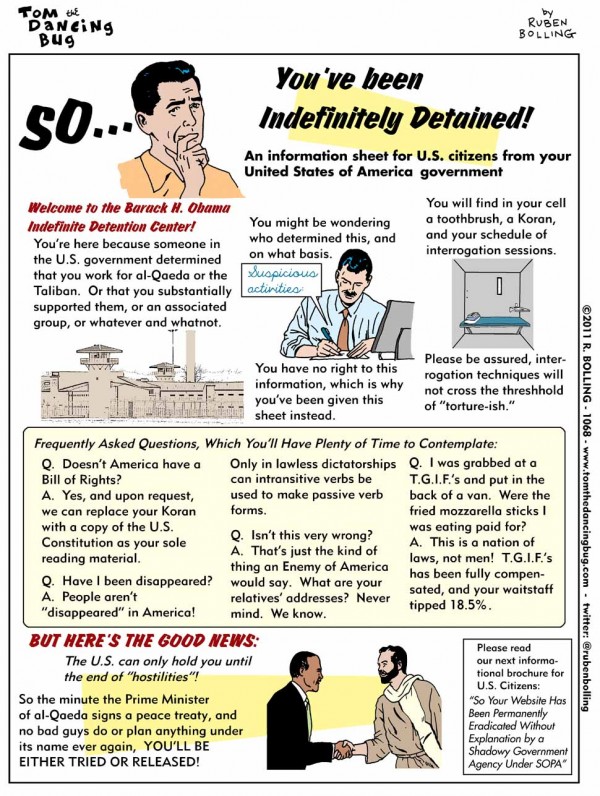
So... you've been indefinitely detained!

It’s for charity - but is it for a good cause?

By Holden

People can get away with some incredible things as soon as they say that what they’re doing is “for charity.” First among these, of course, are the tax advantages that subsidize everything from helping the needy to fighting gun control, convincing people to eat beef, and stockpiling giant piles of cash for eternity. But it isn’t just the IRS that loses all ability to tell right from wrong as soon as the word “charity” comes up. It’s all of us. Except me.

You may not attend a rock concert to benefit beef, but what about cancer research? How about humane societies? Of course, these two causes are in direct conflict over the question of animal testing - many humane societies put significant amounts of their resources directly into trying to illegalize the testing that other “charities” are busy funding.

Charities oppose each other in more subtle ways as well. Going through all these 990s, I’ve really become aware of the huge presence among charities of political advocacy. It’s natural that charities find themselves wanting to address the “root causes” of the problems they address; but as soon as they do this, it’s no longer safe to say that their funds are “going to a good cause” without at least thinking twice. After all, if the legal changes they want to make were completely noncontroversial, you’d think they’d already be made. If you go to a concert to “fight global warming” or “save the environment,” your dollars aren’t going to feed cuddly bunnies; chances are, they’re going to lobbyists, advocates, even demonstrators, with the aim of putting laws in place that might be pro-environment or anti-business, depending on your point of view. And even if you’re on the pro-environment side, it’s worth considering that one of the biggest struggles in politics is not just for position, but for attention and prioritization. When it comes down to it, Greenpeace (saving the environment) and Oxfam (fighting poverty) are largely working against each other - trying to get legislators to pay attention to their issue rather than others.

And at least as big as political advocacy, at least judging by charities’ mission statements, is “raising awareness.” Well, awareness is a zero-sum game too. People only have so much attention span available for things that aren’t sports and diets. You want to raise awareness for Darfur, for global warming, or for Lou Gehrig’s disease? “All of the above” isn’t necessarily an option.

Tooling around through my recent Google alerts (”Charity”), I see a mind-boggling silence on these questions. Indeed, I see Barry Bonds being praised for “giv[ing] some of his own things to charity,” with no mention of what causes he’s supported. I see a whole article on celebrities’ support of charities for Mother’s Day, without the mention of a single charity beyond Eva Longoria’s personal foundation (not a word on that foundation’s priorities). I see plenty of debate on the recent “Idol Gives Back” campaign in terms of whether its “devotion to charity” makes up for its cheesiness … but my question is, what does the ONE campaign (one of its beneficiaries) mean when it talks about “call[ing] for debt cancellation, trade reform and anti–corruption measures”? That sounds like legal change - what does the campaign want and is it a good idea? Nobody else wants to know?

It’s the same old problem: as soon as people hear the word “charity,” their critical faculties turn off. Of course, celebrities and athletes would love it to stay this way - the last thing they need is more questions, just when they’re trying to clean up their image by throwing a few bucks at 501c3’s. But the rest of us would do well to wake up. I’ve said it before and I’ll say it again: if you want to know if someone is doing good things, the best way is to look at what they’re doing.

20111218

Holiday displays dividing Va. town

By Caitlin Gibson

LEESBURG, Va. — Baby Jesus is keeping strange company.

For the better part of 50 years, a creche and a Christmas tree were the only holiday displays on the Loudoun County Courthouse grounds.

Then came the atheists. And the Jedis. And the Church of the Flying Spaghetti Monster -- each with its own decorations. A skeleton Santa Claus was mounted on a cross, intended by its creator to portray society's obsession with consumerism. Nearby, a pine tree stood adorned with atheist testimonials.

Flying Spaghetti Monster devotees are scheduled to put up their contribution this weekend. It's a banner portraying a Nativity-style scene, but Jesus is nowhere to be found. Instead, the Virgin Mary cradles a stalk-eyed noodle-and-meatball creature, its manger surrounded by an army of pirates, a solemn gnome and barnyard animals. The message proclaims: "Touched by an Angelhair."

With the new displays, a new tradition was born: a charged seasonal debate.

This year the dispute struck a particularly raw nerve. Skeleton Santa was ripped down -- twice. Kenneth Reid, Loudoun County supervisor-elect for the Leesburg district, sent a news release opposing "outrageous anti-religious displays."

For Loudoun locals, the heart of the issue isn't about a Santa Claus corpse or a deity made of noodles. And despite a flurry of tongue-in-cheek news reports about the ongoing debate, most people don't find it a laughing matter. Some say the issue is about freedom of speech, or separating church and state; others say it is about the importance of preserving a cherished tradition.

It's also about fast-growing Loudoun County grappling with the inevitability of change.

Stanley Caulkins, who moved to Leesburg in 1937, remembers the first time the Nativity was put up at the corner of the courthouse lawn.

Caulkins, who has owned Caulkins Jewelers in downtown Leesburg for over half a century, sees it as a valued symbol, something that should not be messed with. He went before the county board two years ago to argue that it should stay. Last week, he said that he still does not understand why the issue engenders such controversy.

"The creche is not religious," Caulkins insisted, his voice trembling.

A depiction of the adoration of baby Jesus, attended by the three kings, is not religious?

"It is a belief symbol. You have to believe in something," Caulkins said.

But he expressed little patience for those who believe in flying pasta monsters or the artistic value of a skeleton Santa Claus.

"It is embarrassing to me, and it should be to everyone," Caulkins said of those displays. His perspective, shared by others, shows that the issue cannot be debated entirely on logical grounds; matters of faith -- and even the value of tradition -- are less about facts than feelings.

For decades, the creche took its place without fanfare. Then, in 2009, a courthouse-grounds committee, concerned about a growing number of requests to use the public space, decided that Loudoun should ban all unattended displays on the property.

Public outcry was fierce and emotional. Residents poured into the county boardroom wearing Santa hats and religious pins, pleading with county leaders to respect their freedoms of speech and religion. The board ultimately decided to allow up to 10 holiday displays on a first-come, first-served basis. Applicants got in line.

Baby Jesus has appeared in several displays. But others had far different interpretations of a holiday greeting. One year a mannequin arrangement featured Luke Skywalker of "Star Wars."

Matthew Courtney, a member -- or "Pastafarian" -- of the Church of the Flying Spaghetti Monster, thinks allowing diversity in the decorations is welcoming. "I understand that it's out of the blue for some of these residents -- that there are atheists in the community, or Pastafarians in the community," Courtney said. "A lot of them are uncomfortable with that. At some level I can understand that. But it doesn't bother me. … It does show the diversity of the community, and I think that's a good thing, not a bad thing."

The question remains: Will the "War on Christmas" end this year?

Loudoun County Board of Supervisors Chairman Scott K. York has indicated that the policy probably will be reconsidered when the new, all-Republican board takes office in January. Reid said he believes that the supervisors will be able to find a compromise and salvage the town's tradition.

YouTube Says Universal Had No ‘Right’ to Take Down Megaupload Video

By David Kravets

YouTube said Friday that Universal Music abused the video-sharing site’s piracy filters when it employed them to take down a controversial video of celebrities and pop superstars singing and praising the notorious file-sharing service Megaupload.

YouTube’s copyright filters removed the all-star video, which features Kanye West, Mary J. Blige, will.i.am and others, on Dec. 9. Google reinstated the four-minute spot Wednesday.

“Our partners do not have the right to take down videos from YT unless they own the rights to them or they are live performances controlled through exclusive agreements with their artists, which is why we reinstated it,” Google-owned YouTube said.

Megaupload produced the video for $3 million, and says it has waivers from all the celebrities. The Hong Kong-based service claims in a federal lawsuit filed Monday that the takedown was a “sham” designed to chill free speech. The suit seeks unspecified damages, alleging the label had violated a provision in copyright law that forbids bogus copyright claims.

Megaupload has some 50 million daily users, and the recording industry says it is a haven for music pirates.

YouTube’s statement came a day after Universal Music told a federal judge hearing the case that it had used YouTube’s content filters, known as the Content Management System, to have the video removed shortly after Megaupload had uploaded it. Universal never disclosed to U.S. District Judge Claudia Wilken why it had the video removed.

But Universal told Wilken, an Oakland federal judge, that Megaupload is not entitled to monetary damages, (.pdf) even if Universal Music gamed YouTube’s filters.

Universal said Google’s private system doesn’t count as an official takedown notice under the Digital Millennium Copyright Act, and thus it was immune from legal liability. It’s a position that Ira Rothken, Megaupload’s attorney, said was preposterous.

YouTube has engineered a filtering system enabling rights holders to upload music and videos they own to a “fingerprinting” database. When YouTube users upload videos, the system scans the upload against the copyright database for matches. If a full or partial match is found, the alleged rights holder can have the video automatically removed, or it can place advertising on the video and make money every time somebody clicks on the video.

Under the DMCA, online service providers like YouTube lose legal immunity for their users’ actions if they don’t remove allegedly infringing content if asked to by rights holders. If the content is not removed, internet service providers could be held liable for damages under the Copyright Act, which carries penalties of up to $150,000 per violation.

Megaupload’s lawsuit is pending.